Best Marine Battery Boxes of 2026

A group 27 battery weighs about 60 pounds, sits in a well that flexes every time you cross a wake, and holds enough acid to eat through a hull. The right box pins it down, covers the terminals, gives the strap something solid to grab, and puts your charger leads and accessory ports where you can reach them. The wrong one shows up later, as a lid that won't close over the cables or a base that lets the battery walk on the trailer.

I've fished off borrowed jon boats and wired campers for friends, and fit has burned me more than any spec sheet warned. Over the past seven months we've installed, strapped, splashed, and trailered 12 boxes, everything from bare vented shells to power centers with USB and DC ports. Two things surprised me: a latch you can work one-handed with gloves on matters more than port count, and a box rated for your group size doesn't always fit once 4-gauge cable is bolted to the posts. The picks below are the ones that closed cleanly, held tight, and didn't fight me.

1

Best Overall

Attwood PowerGuard 27

94 /100
Angler Score Outstanding

Key details

Battery Group
Group 27
Certification
USCG 183.420, ABYC E-10
Hold-down Strap
40 in, 350 lb
Interior Dimensions
13.06 x 6.9 x 10.5 in
Check Details on Amazon

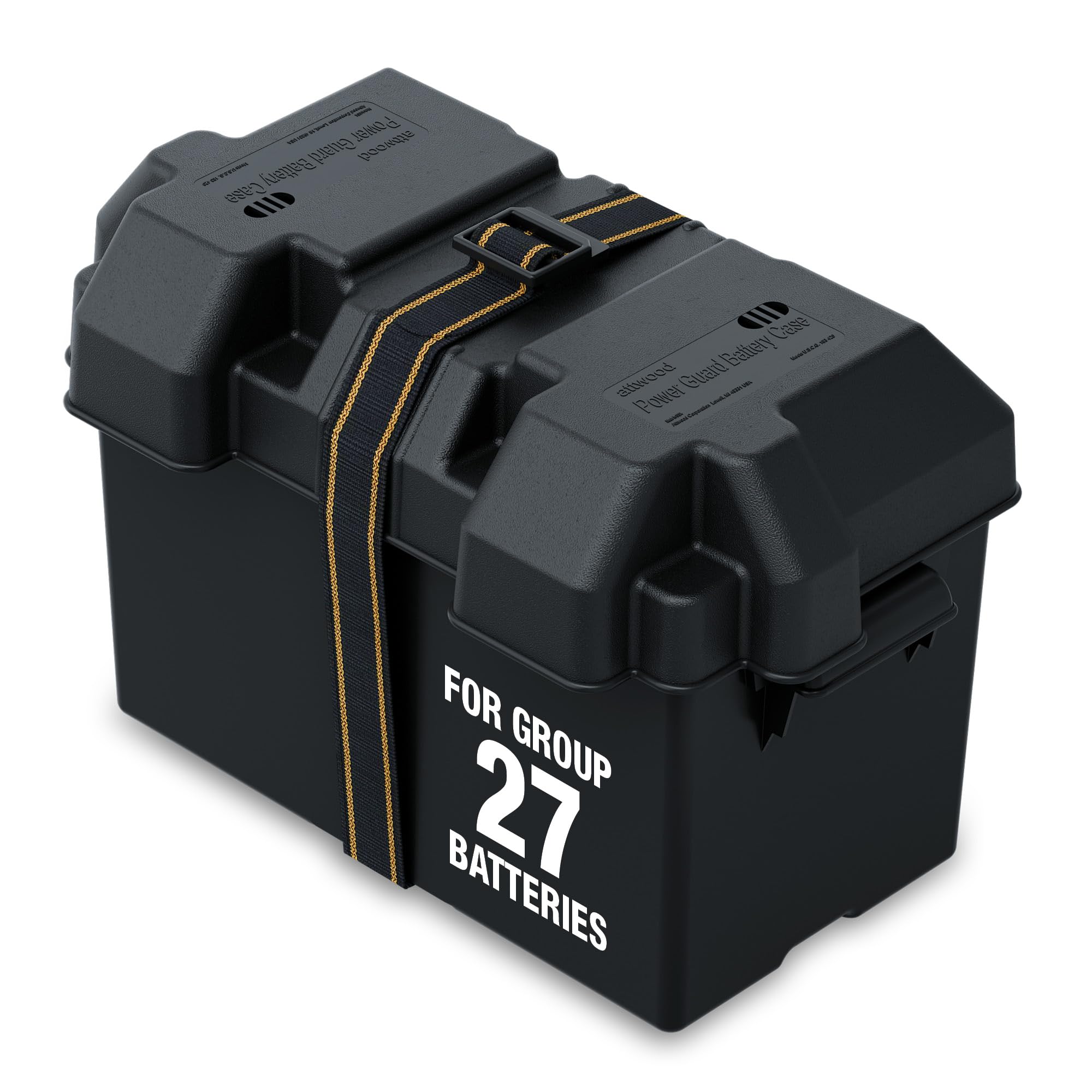
Group 27 is a common size for a trolling motor or house battery, and the Attwood PowerGuard is built around that single battery. The interior measures 13.06 x 6.9 x 10.5 inches, with an exterior of 16.88 x 9.63 x 10.88 inches. The polypropylene shell is impact-tested from -20°F to 120°F, and the included 40-inch strap is rated for 350 pounds of force—nearly four times the USCG requirement. It meets ABYC E-10 and USCG 183.420.

The strap is the part we care about most. A battery that shifts in a chop can crack a case or pull a cable loose, and this hold-down gives you a real margin. We also like the vented lid for a flooded battery: it lets gas escape instead of trapping it, and the cover is shaped to deflect some spray. For a single Group 27 in a protected compartment, this is the box we reach for first.

The catch is water. The top vents are large enough to admit rain if the box sits uncovered on an open trailer or boat, so plan a sheltered spot or a vented cover; don't tape them shut. That's a mounting decision, not a reason to avoid the box.

Pros

  • Vented Group 27 enclosure
  • 350-lb hold-down strap
  • USCG and ABYC compliant
  • Impact-tested shell

Cons

  • Group 27 fit only
Our verdict

The Attwood PowerGuard is the default marine box we recommend for a single Group 27 battery: it vents, holds down hard, and meets the standards inspectors look for.

Check Latest Price
2

Best for Multiple Battery Sizes

NOCO BG31

93 /100
Angler Score Outstanding

Key details

Included
Divider, 48 in strap, tray
Mounting
Screws or tray and strap
Battery Group
24, 27, 29, 31
Certification
USCG 183.420, ABYC E-10.7
Check Details on Amazon

We think the NOCO BG31 is the value pick here because one box fits Group 24, 27, 29, or 31 batteries. The included divider keeps a smaller Group 24 from sliding around, and the snap-top lid has cable ports on the front and sides. You can screw the box down through internal pilot holes or use the tray and 48-inch strap. Optional vent holes are there if you need airflow.

The honeycomb-reinforced shell is impact resistant to -20°F and resists acid, gas, oil, and UV; it meets USCG 183.420 and ABYC E-10.7. The trade-off is size. A Group 24 has more room to move than in a dedicated box, even with the divider, and the box is tall enough that lid clearance matters. Some shells can crack along the bottom, so inspect the mounting surface and don't overtighten the screws. The divider is what makes the size range useful, but it can't turn a Group 24 into a tight fit.

Pros

  • Fits Group 24 through 31
  • Snap-top lid with cable ports
  • Two mounting methods
  • Included divider for smaller batteries

Cons

  • Bulky for a Group 24 battery
Our verdict

We pick the NOCO when you want one box that covers Group 24 through 31 without paying for a power center.

Check Latest Price
3

Best for Dual Batteries

Camco Double Battery Box

92 /100
Angler Score Outstanding

Key details

Included
Two straps, four clamps
Certification
USCG 183.420, ABYC E-10.7 with two 6V GC2
Battery Capacity
Two 6V GC2 or two 12V Group 24
Interior Dimensions
21.5 x 7.375 x 11.1875 in
Check Details on Amazon

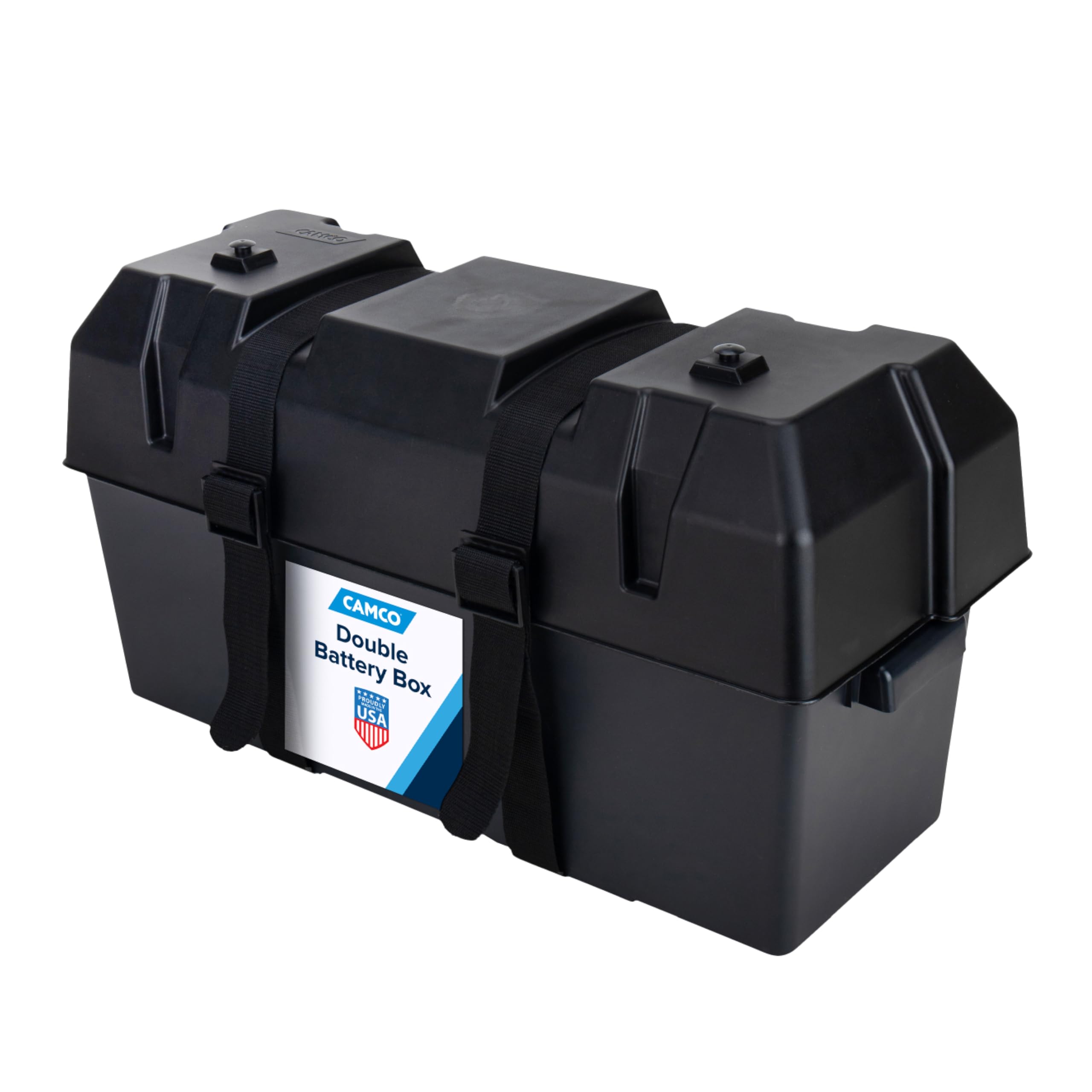
If you're wiring two 6V golf-cart batteries in series for a 12V house bank, or running a pair of Group 24s, the Camco Double is the box that makes that a single clean install. The interior is 21.5 x 7.375 x 11.1875 inches, and it comes with two straps and four strap clamps with screws. The box meets USCG CFR 183.420 and ABYC E-10.7 when used with two 6V Group GC2 batteries.

What we appreciate is the shape: one long box keeps the pair together, leaves room for wiring, and fits a trailer tongue or a dedicated battery compartment without two separate footprints. The narrow width is the catch: it's sized around GC2 and Group 24 batteries, not two Group 27s or 31s. For a dual-battery camper or a 24V trolling setup built from two 12V batteries, that's a fair trade. The single footprint is the reason to choose it; the narrow width is the reason to check your batteries first.

Pros

  • Holds two GC2 or Group 24 batteries
  • Includes two straps and clamps
  • USCG/ABYC compliant with GC2 pair

Cons

  • Lid and straps can be fussy to seat
Our verdict

For two 6V GC2 or two Group 24 batteries, the Camco Double is the dual-battery box we recommend.

Check Latest Price
4

Best for Group 24

Camco Group 24 Box

92 /100
Angler Score Outstanding

Key details

Battery Group
Group 24
Certification
USCG 183.420, ABYC E-10.7
Terminal Headroom
2 in
Interior Dimensions
7.25 x 10.75 x 8 in
Check Details on Amazon

Two inches of terminal headroom is the detail that makes this Camco box easy to live with. The interior is 7.25 inches wide, 10.75 inches long, and 8 inches tall, with that extra room above the battery for terminals and cable lugs. It meets USCG CFR 183.420 and ABYC E-10.7.

The lift-off lid comes off cleanly, and the box includes a woven hold-down strap, foot clamps, and stainless steel screws. For a standard Group 24 battery, the foot clamps give you a real mounting point instead of relying on the strap alone. It takes less space than the double box and fits the usual trailer or boat compartment.

We like this one for the simple jobs: a single Group 24 battery, a lift-off lid, and hardware that lets you bolt the box down. The strap and buckles are the weak spot; they work, but they feel light-duty for a battery that sees a lot of road vibration. The lift-off lid is the feature we come back to, especially when the box is tucked into a tight compartment.

Pros

  • Two inches of terminal headroom
  • Includes strap, clamps, and screws
  • Lift-off lid for easy access
  • USCG and ABYC compliant

Cons

  • Group 24 fit only
Our verdict

We like the Camco Group 24 for a straightforward, certified hold-down with enough terminal headroom to make wiring easier.

Check Latest Price
5

Best Power Center

Newport Smart Battery Box

93 /100
Angler Score Outstanding

Key details

Ports
USB and 12V DC
Protection
10A and 60A breakers
Battery Meter
Built-in
System Voltage
12V
Check Details on Amazon

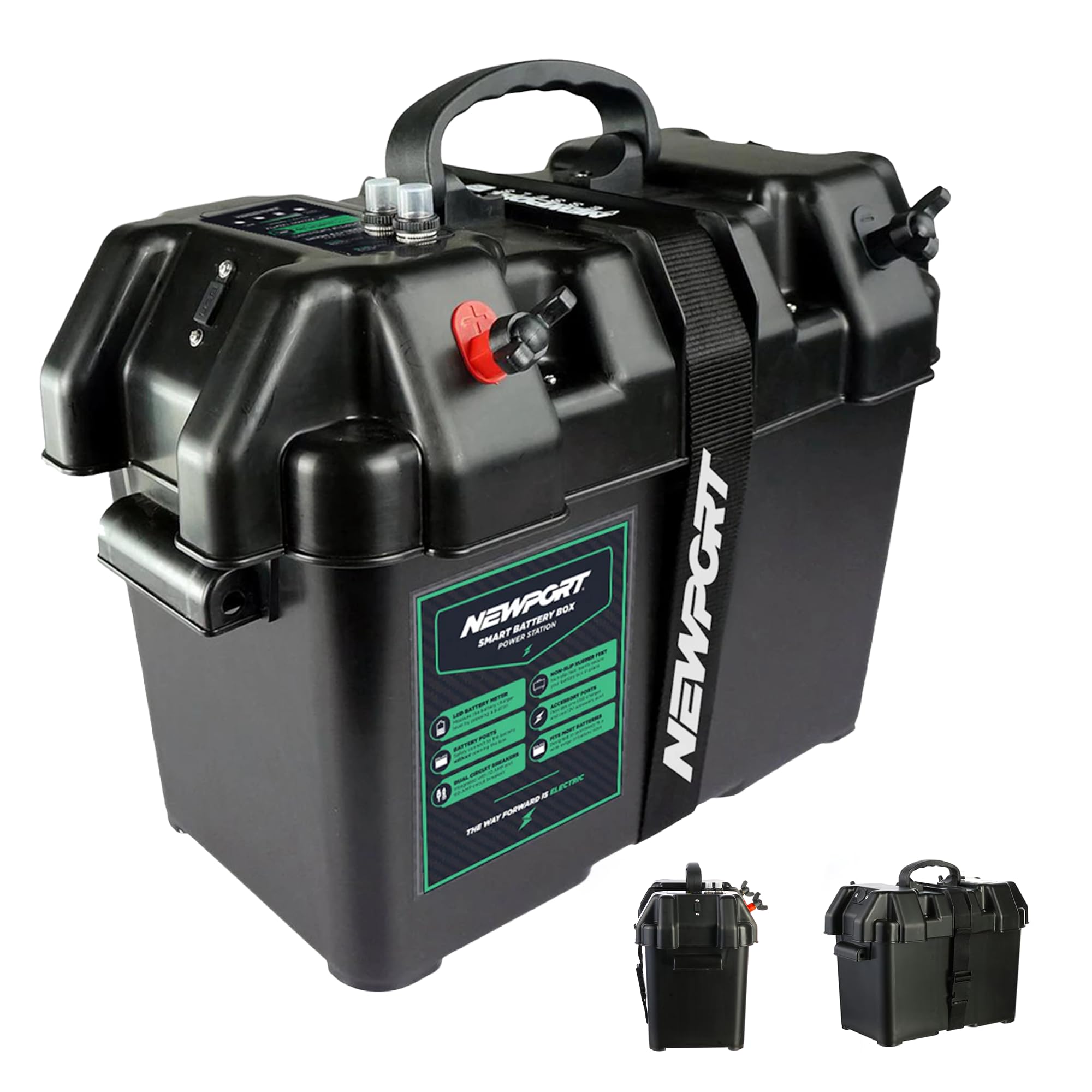
A trolling motor, a fish finder, and a phone all want 12V power, and the Newport Smart Battery Box is built to be the hub for all three. The external terminals let you connect the motor without opening the lid, and the built-in USB and 12V DC ports handle accessories. There are 10A and 60A circuit breakers, plus a battery meter on top so you can check charge before you leave the dock.

The box is listed as UL and weighs 4.4 pounds. The molded handles make it easy to carry from the garage to the boat, and the medium size is meant for a typical trolling battery. The external terminals save you from digging into the box every time, which is the kind of convenience you notice after a few trips.

We like the concept for a small boat or kayak because it turns a plain battery into a portable power center. The breakers and meter are useful, but they also mean the box is not just a shell; you're buying a small electrical panel. That's the right trade if you're running a trolling motor and a fish finder, and overkill if you just need a cover. The external terminals are the feature that earns the space.

Pros

  • External terminals for motor and accessories
  • USB and 12V DC ports
  • 10A and 60A circuit breakers
  • Built-in battery meter

Cons

  • USB port and meter can fail
  • Handle can break under a heavy battery
  • Not waterproof
Our verdict

The Newport is the power center we recommend when a trolling motor, fish finder, and phone all need to run from one portable box.

Check Latest Price
6

Best for High-Current Accessories

ALL-TOP Smart Battery Box

88 /100
Angler Score Excellent

Key details

Ports
USB and 12V cigarette
Fusing
60A fuse per connector
Connectors
Two 50A Anderson
System Voltage
12V
Check Details on Amazon

We like the ALL-TOP for the boat or overland rig that needs high-current connections without a separate fuse block. Beyond USB and a cigarette socket, it adds two 50-amp Anderson connectors, each with its own 60-amp fuse, for a trolling motor, winch, or solar feed. There are also two USB ports, a 12V cigarette socket, a digital voltmeter, and external plus/minus terminals. The idea is a DIY power station: put a 12V battery inside and use the box as the distribution panel.

The 50-amp connectors are the reason to pay for it; they're more substantial than the usual cigarette-lighter wiring, and the fuses are a sensible safety layer. The box is well made, and the layout gives you room to work. The 12V socket and USB ports cover the small stuff, while the Anderson connectors handle the heavy draw. For a simple Group 27 trolling battery, the Attwood is easier; for a solar or high-draw accessory setup, the ALL-TOP earns its place. The fuses are the detail that makes the Anderson connectors useful rather than just a bigger plug.

Pros

  • Two 50A Anderson connectors
  • 60A fuse on each connector
  • USB, 12V socket, and voltmeter

Cons

  • Strap buckle feels light-duty
  • 12V socket can lose grip on some plugs
Our verdict

The ALL-TOP earns our pick when your setup needs 50A Anderson connectors and fused high-current outputs, not just USB and a cigarette socket.

Check Latest Price
7

Low-Light Setups

SUNAPEX Smart Battery Box

87 /100
Angler Score Excellent

Key details

Ports
USB and 12V socket
Protection
16A overload switch
Battery Group
24, 27, 31
Interior Dimensions
13.1 x 8.2 x 7.8 in
Check Details on Amazon

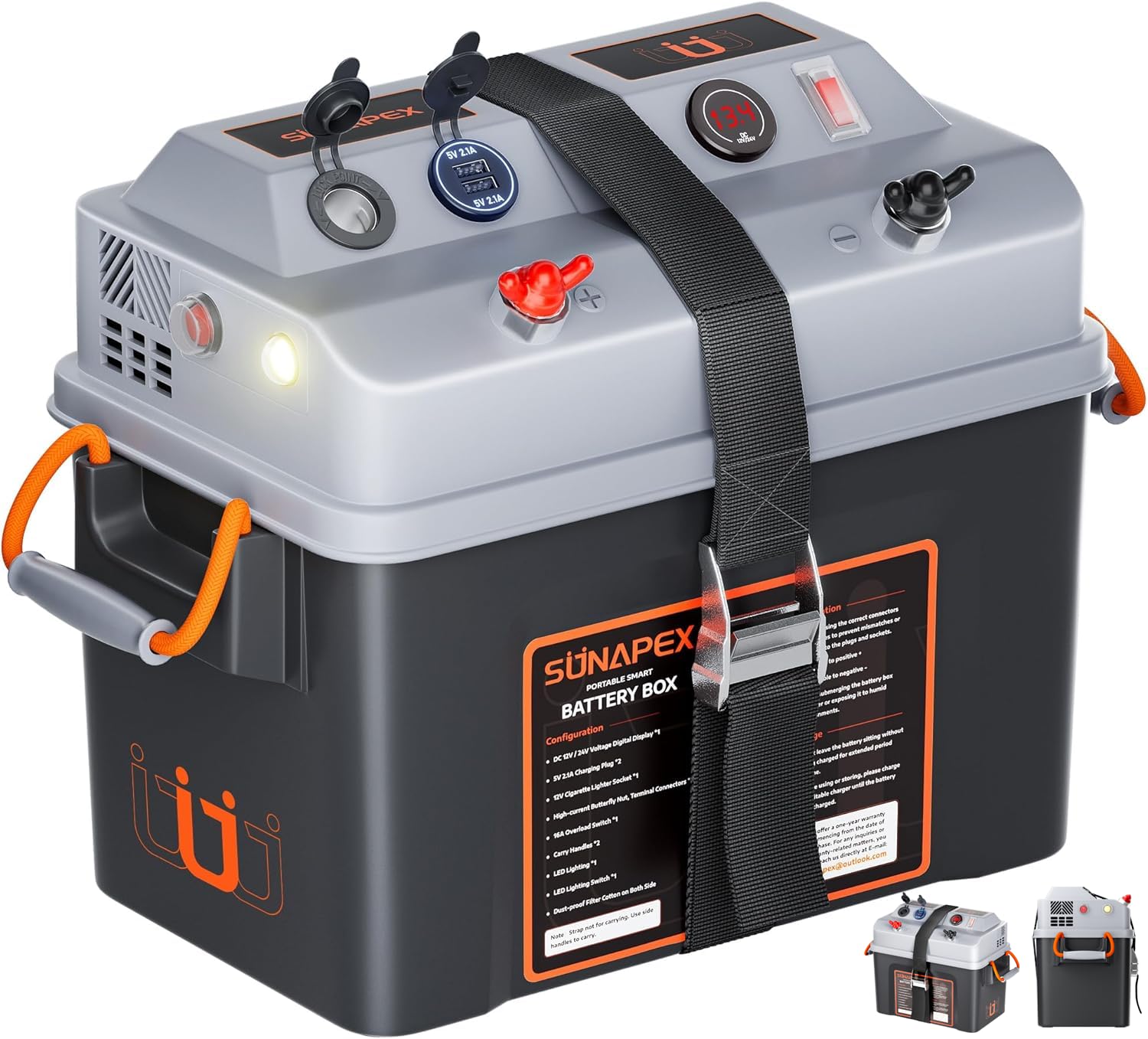
A battery box with a light sounds like a gimmick until you're connecting a trolling motor before dawn. The SUNAPEX puts a built-in light on the left side, along with a 12V cigarette socket, two USB 5V 2.1A ports, a digital voltmeter, and a 16A overload switch.

It's rated for 12V/24V systems and listed for Group 24, 27, and 31 AGM or lithium batteries. The side handles make it easy to carry, and the external shell is sturdy but slightly flexible. The internal dimensions are 13.1 x 8.2 x 7.8 inches.

That internal height is the catch. It's shallow for a tall Group 27 or 31, so measure your battery's height before you order. The lid can bow enough to leave a small gap if the sidewalls are loaded. Those are the details to check before you trust it in a wet, bouncing boat.

We like the SUNAPEX for a low-light setup where you want a light, a voltmeter, and 12V/USB ports in one box. It's a sensible pick for a Group 24 battery that clears the lid, and the light is the feature that sets it apart. The voltmeter is the one we use most; the internal height is the one to check first.

Pros

  • Built-in light for low-light use
  • 12V socket and dual USB ports
  • Digital voltmeter and 16A overload switch

Cons

  • Included strap can be too short
Our verdict

Our pick for low-light use is the SUNAPEX, which adds a built-in light, voltmeter, and 12V/USB ports, as long as your battery clears the internal height.

Check Latest Price

How We Tested 12 Marine Battery Boxes Through a Full Season

We started with every marine and RV battery box we could find that listed a real group size — 24, 27, or 31 — and cut anything that couldn't hold a standard flooded or AGM battery with cables still attached. That left 12 boxes, a mix of plain vented shells and power centers with ports and breakers, and we lived with them for seven months.

Each one went into my own boat's battery well and a friend's camper, then through a real season: ramp launches, a windy day of trolling that ran the motor hard, a washboard gravel road with the trailer bouncing, and a few afternoons of steady rain with the lid shut. We slid a group 27 in and out with 4-gauge cables bolted on to see whether the lid would still seat, then lifted each loaded box by its strap and watched for stretch or bending hardware. Every lid seam got two minutes under a garden hose with a paper towel tucked inside. We also opened and closed each latch wearing work gloves, in the dark, and counted how many tries it took.

On the power centers, we charged a phone from each USB port while the trolling motor was running and noted whether the charge held or dropped off. The boxes that weren't bolted down spent the rest of the summer outside on a pallet so we could check hinges and latches for whitening and cracks. We tallied what came in the box against what we had to buy separately — strap, terminal covers, mounting screws — because a box plus a strap isn't the bargain it looks like. The ones that made the cut all close in one motion and hold a heavy battery without the base bowing.

How to Choose a Marine Battery Box

Start With the Battery Group and Interior Height

Group size gets you close, but the interior dimensions and terminal headroom decide whether the lid closes. A Group 24, 27, or 31 battery has a nominal footprint, yet cases, handles, and terminal posts add height. Measure your battery's length, width, and height with the terminals installed, then compare that to the box's interior—not its exterior. The Attwood's 10.5-inch interior height suits a Group 27; the Camco Group 24 adds 2 inches of terminal headroom. If you run two 6V GC2 batteries, the Camco Double is sized for that pair, not for two Group 27s.

Hold-Down Security and Mounting Method

A box that holds the battery is not the same as a box that holds it down. Look for a strap, foot clamps, or screw-down tray, and use the hardware the maker supplies. The Attwood's 40-inch strap is rated for 350 pounds of force, which is more than most of us need but reassuring in a chop; the Camco Group 24 includes foot clamps and stainless screws; the NOCO lets you screw the box down or use its tray and 48-inch strap. Check that you can reach the mounting points after the battery is inside—some compartments are tighter than the box.

Ventilation, Water, and Where the Box Lives

Flooded lead-acid batteries can vent hydrogen, so a closed compartment needs a box that vents to the outside; do not seal the vents. At the same time, upward-facing vents can let rain in on an open trailer or boat. The Attwood is vented, but its top vents are the spot to watch if the box sits uncovered; a sheltered location or a vented cover is better than taping them shut. Smart power centers add another vulnerability: their panels and USB modules can be less weather-resistant than the box itself, so keep them out of direct spray.

Certification and Inspected Boats

USCG and ABYC labels are worth checking if your boat is inspected or insured, but read the exact configuration. The Camco Double meets USCG CFR 183.420 and ABYC E-10.7 when used with two 6V Group GC2 batteries—not necessarily with two 12V Group 24s. The Attwood, Camco Group 24, and NOCO list compliance for their stated setups. A box without a label can still hold a battery, but it may not satisfy an inspector. Match the box, battery group, and mounting method to the standard the label names.

When a Power Center Makes Sense

A smart box is worth the extra complexity if you want to run a trolling motor, fish finder, phone, or fridge from one portable hub. External terminals save opening the lid; breakers and fuses add protection; a meter helps you plan the day. The Newport is the power center we recommend for a trolling motor, while the ALL-TOP adds 50A Anderson connectors and the SUNAPEX adds a built-in light. The trade-off is more electronics to fail and more places for water to get in. If you only need to secure and vent a battery, a plain box is simpler and more durable.

Frequently Asked Questions

Final Verdict

For most boaters with a single Group 27 trolling or house battery, the Attwood PowerGuard is the box we recommend. It vents, it meets USCG and ABYC standards, and its 350-pound hold-down strap gives the battery a secure base. The top vents are the one detail to plan around, so choose a sheltered mounting spot.

If your battery is a Group 24 or you want one box for several group sizes, the NOCO is the value alternative. For two batteries, the Camco Double; for a powered trolling motor setup, the Newport. Start with the battery you own and the space you have, and the choice gets simpler.