
Best Marine Compasses of 2026

The afternoon I stopped trusting my phone for navigation started with a dead battery and a fog bank rolling in off the point. A compass doesn't need a signal or a charge — it just points north, which is exactly what you want when visibility drops to a hundred yards. The problem is that not every card swings honestly: some wander, some drink a bubble within a season, and some are sized for a boat you don't own.

We've spent seven months living with 12 marine compasses — flush mounts, bracket mounts, and kayak-friendly handhelds — taking bearings in chop, fitting them to consoles and decks, and watching what the fluid did after a few weeks in the sun. A cheap compass with a steady, readable card beats an expensive one you can't see at dusk. One thing first-time buyers learn the hard way: where you mount it matters more than the dial, since anything magnetic within a foot will pull the needle off north. The picks below held their bearing, fit the spot, and were still legible on the ride home.

1

Best Overall

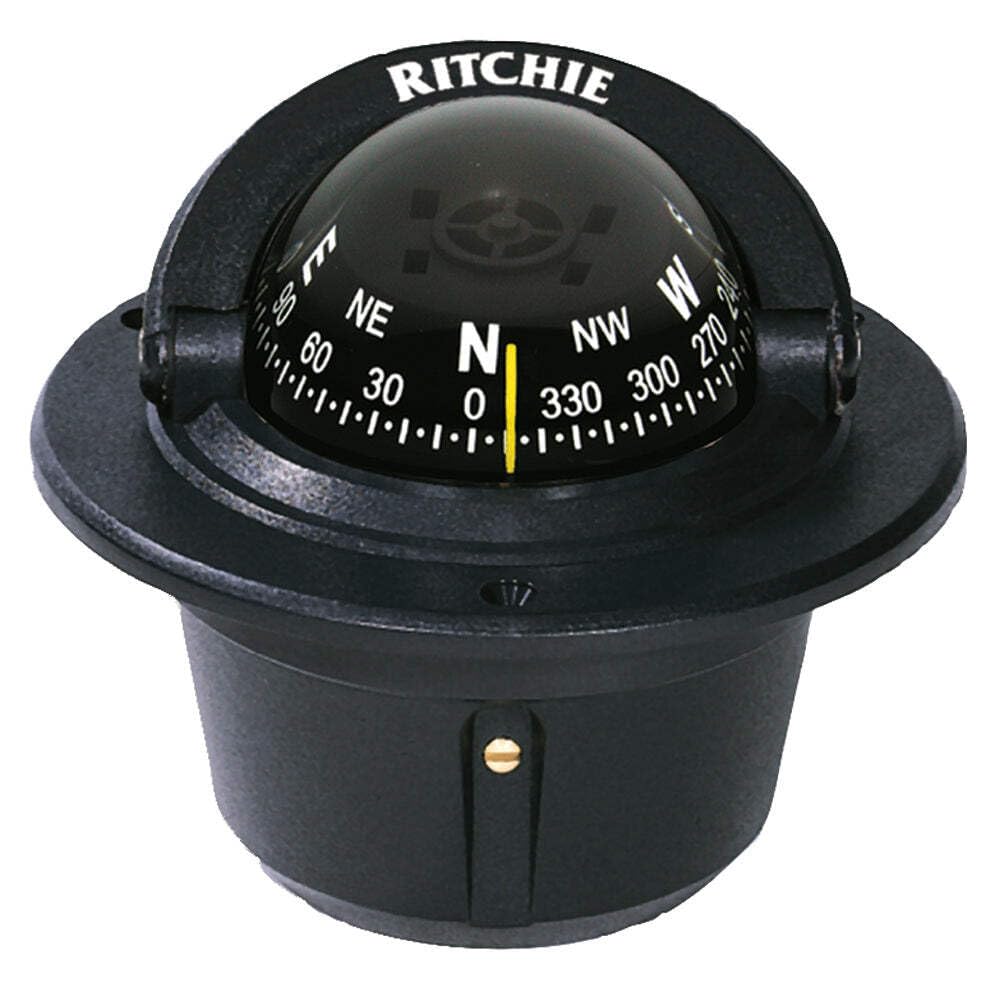
Ritchie F-50 Explorer

90 /100
Angler Score Outstanding

Key details

Dial Size
2-3/4 in
Mount Type
Flush mount
Compensators
Built-in
Night Lighting
Green NiteVu
Check Details on Amazon

The green glow is what sold us. Ritchie's NiteVu lighting is built into the dial, so once the sun drops the card comes up lit instead of disappearing into a dark bezel — that is the difference between a compass you can steer by on a late run home and one that just sits there. The card itself is a 2-3/4-inch direct-read dial, the size we like on a small to midsize helm: big enough to read from a seated position, compact enough to live in a crowded dash.

It ranks first here because the engineering that matters is actually present. A sapphire jewel bearing against a hardened steel pivot is what stops the card spinning through a full arc every time the boat rolls, and the built-in compensators give you adjusting screws to cancel out the magnetism of everything else bolted near the helm. Reads steadily, reads true once installed properly — that combination is why this is the one we name first for a dash cutout.

If there is already a compass in your dash, this is the class of unit that goes back in the same place, and it is the swap we reach for. Measure the existing hole and the depth behind the dash before ordering, because a flush compass needs room for its body as well as its bezel — the dial size tells you nothing about what sits behind it.

Five years of warranty is the longest cover in this group, and for an instrument that lives in sun, salt, and spray that is worth more than the number suggests. What you trade for all of it is flexibility: a flush mount lives at one helm for good.

Pros

  • Direct-read 2-3/4-inch card is easy to follow
  • Green NiteVu lighting keeps it readable after dark
  • Built-in compensators adjust for on-board deviation
  • Five-year warranty is the longest in this group

Cons

  • Fixed flush mount serves one helm only
Our verdict

For a helm with a dash cutout, this is the compass we recommend: a readable 2-3/4-inch card, green night lighting, and built-in compensators, backed by a five-year warranty.

Check Latest Price
2

Best Bracket Mount

Ritchie RA-91 Angler

89 /100
Angler Score Excellent

Key details

Weight
1 lb
Dial Size
2-3/4 in
Dial Color
Blue
Mount Type
Bracket mount
Check Details on Amazon

The Angler is the answer for the console you cannot bring yourself to cut. It sits in a bracket that screws to a flat surface and holds the compass above it, so the card ends up on top of the console, on a bulkhead, or on a seat box — wherever the helmsman actually looks — instead of wherever the factory happened to drill. On a molded dash or a teak panel, that makes it the better answer, and it is why we keep it in the bracket-mount slot rather than treating it as a cheaper Explorer.

We think the 2-3/4-inch blue card on the gray case is the sharpest-looking combination in this group, and it reads from a few feet away as well as it looks. There is green night lighting behind it for after dark.

About a pound, and no hole to fill, means it unscrews and moves to a second boat in less time than it takes to find the right screwdriver. That is more useful than it sounds when you keep a tender and a cruiser off the same mooring. Mount it where the bracket base sits flat and where the compass is not an arm's length from a speaker, and the whole job takes minutes.

The trade-off is exposure. A bracket mount stands above the dash where a jib sheet, a cooler lid, or a knee can find it, and it takes the sun full on rather than sitting behind a bezel. Plenty of skippers take that deal to keep the console whole.

Pros

  • Bracket mounts without cutting the dash
  • Blue 2-3/4-inch dial reads well and looks sharp
  • Light enough to unscrew and move between boats

Cons

  • Sits proud of the dash, exposed to sun and knocks
Our verdict

When there is no hole in the console, the Angler screws down on a bracket and puts a 2-3/4-inch blue card where the helmsman can actually see it.

Check Latest Price
3

Best for Kayaks and Paddleboards

Sun Company SeaTurtl

85 /100
Angler Score Excellent

Key details

Hood
Adjustable
Weight
8.8 oz
Mount Type
Four elastic cords
Case Dimensions
4.09 x 2.91 in
Check Details on Amazon

Elastic cords instead of screws is the detail that earns the SeaTurtl its place. Four adjustable cords with hooks stretch over a kayak's deck lines or a paddleboard's bungees and hold the compass snug, so you get a full-size marine card on a deck you never have to drill. Pull it off for the drive home and there is nothing left behind.

The adjustable hood is the part we underrated at first. Flipped up it shades the card from the low sun that turns a wet deck into a mirror; flipped down it covers the face when the boat is riding on the roof rack. Combined with a liquid-filled, full-size card, it makes for a compass you can read from the cockpit without taking a hand off the paddle.

It is also the least expensive of the mounted options here, and paddlers are not giving up the essential job to get there. The card holds steady in chop, the case is light enough to forget about at 8.8 ounces, and the whole thing goes back in a hatch bag when the day is done — part of why it is the one we hand to paddlers.

Two things to know before you commit. There is no illumination, so a dusk or night paddle means a headlamp on the card. And the plastic hooks take some fiddling to seat and to peel off, especially with cold hands. Neither bothers a day paddler; both matter if you launch before dawn in November.

Pros

  • Elastic cords mount to deck lines without drilling
  • Adjustable hood cuts glare and protects the face
  • Full-size liquid-filled card reads from the cockpit

Cons

  • Not illuminated for dusk or night paddling
  • Plastic hooks are fiddly to place and remove
Our verdict

For kayaks and paddleboards, four elastic cords and a glare hood deliver a readable full-size card without drilling a single hole in the deck.

Check Latest Price
4

Simple Open Boats

Odowalker LED Marine Compass

84 /100
Angler Score Excellent

Key details

Weight
9.35 oz
Case Size
5.51 x 4.33 in
Mount Type
Screw-down dash
Night Lighting
Incandescent bulb
Check Details on Amazon

At 5.51 inches across, this is the largest case in the group — noticeably wider than the 2-3/4-inch flush dials — and the footprint is the first thing we check on a small console, because it takes real estate you may not have. On a wide, empty dash it works in your favor: the card is easy to read from a distance and you do not have to lean in to catch the number.

What you get is a screw-down ABS case, an adjustable declination piece for setting it up, an incandescent bulb behind the face, and two power cords in the box. For a jon boat, a skiff, or a truck dash where a flush-mount Ritchie is overkill, we think that is a sensible trade. It costs a fraction of the mounted picks in this group and it does the basic job of telling you which way the bow is pointed.

The catch is magnetic interference. A dashboard crowded with speakers, a radio, and a steel steering column pulls a card off heading, and a truck dash is exactly where a cheap compass tends to get fitted. Give it a clean spot — away from the stereo, away from the wiring loom, away from steel — and it settles down. Test the bulb before you screw the base down, too; it is a bulb rather than an LED, and a dead one out of the box is a nuisance you can catch early.

Pros

  • Large 5.51-inch case reads from a distance
  • Screws down with the mounting hardware included
  • Adjustable declination piece for setup

Cons

  • Incandescent bulb rather than LED
  • Reads poorly near speakers or steel
Our verdict

A budget dash compass with the largest face here, best on an open boat or a truck dash where nothing magnetic lives within a few feet.

Check Latest Price

How We Tested a Dozen Marine Compasses on the Water

We started with a shortlist of about 40 compasses sold for small boats, kayaks, and skiffs, then cut anything with vague mounting hardware, a dial too small to read at arm's length, or a base that wouldn't fit a standard dash cutout. That left 12, which we bought at retail so no brand could send us a hand-tuned unit.

Each one went onto a real boat — a center console, a tiller skiff, and two kayak decks — and we timed the install alone, noting whether the bracket lined up with existing holes, whether the screws needed a backing plate, and how much clear dash or deck space the base ate up. Then we took bearings on the same three fixed landmarks from the same spot, once on calm water and again in a two-foot chop, comparing what the card said to a handheld GPS bearing.

We heeled the boat deliberately, too, watching whether the card settled in a second or swung for five, and checked the dial at dusk and again after dark to see how the markings read in low light. The kayak-sized ones got carried in a dry bag, strapped down, splashed, and weighed after packing — portability matters when your compass lives in a hatch. Every few weeks we pulled each one to look for bubbles or cloudy fluid and to see whether the sun had faded the dial.

Fit and finish got scored as well: whether the housing felt solid or hollow, whether the dome scratched, whether the bezel turned without slop. We kept a running note on price against what each one actually did, because an inexpensive bracket compass that holds north is a better buy than a costly one with a bubble in it. These stay mounted on our boats, and we'll update as the seasons pass.

How to Choose a Marine Compass

Pick the mount before the model

Flush, surface, bracket, or strap: four ways to get a compass onto a boat, and the choice is decided by your console rather than your budget. A flush mount needs a hole and clear space behind the dash, so measure both before ordering. If you are replacing a cracked original, match the dial size and the cutout instead of assuming a 2-3/4-inch dial means a universal fit.

Surface and bracket mounts screw to a flat top and leave the dash intact, and a bracket also lets you place the card where the helmsman actually looks. Strap mounts exist for paddlecraft, where drilling a composite deck is the last thing you want to do.

Location beats specification

A well-made compass in a bad spot reads worse than a cheap one in a good spot. Deviation — the error caused by nearby magnetism — comes from speakers, radios, electric motors, wiring bundles, and any steel in the structure. On a fiberglass console you usually have room to shift the compass a few inches away from the worst offenders, and that is time better spent than comparing dial diameters.

The good mounted units here carry built-in compensators: small adjusting screws that cancel the remaining error on board. Mount it, compensate it, then check the heading against a known bearing on a clear run.

Steadiness in a chop is what you pay for

A dial that swings a full turn every time the boat rolls tells you nothing. What prevents that is the pivot under the card — Ritchie fits the Explorer with a sapphire jewel bearing against a hardened steel point — plus a properly filled, sealed case that damps the movement without sticking. On a kayak or a paddleboard, where the whole boat moves with every stroke, a liquid-filled full-size card is what keeps the number legible.

A hood or a deep bezel helps as well, because glare off wet gelcoat hides more headings than darkness does.

Decide about lighting before you cut

Night lighting is the feature people forget until the first late run home. There are three answers in this group: built-in green lighting on the Explorer, a small bulb behind the face on the Odowalker, and nothing at all on the SeaTurtl. A lit compass needs a feed run to the mounting location, which is far easier to plan before the hole is cut than after it.

If you day-sail and carry a handheld light, an unlit dial is fine. If you are regularly out after sunset, wire it.

Frequently Asked Questions

Final Verdict

If your dash already has a cutout, buy the Ritchie Explorer and be done: a card you can read at night, compensators to clean up the install, and five years of cover behind it.

No hole and no appetite for cutting one? The Angler's bracket does the same job from the top of the console. Paddlers should go straight to the SeaTurtl, where the cords and the hood are worth more on a kayak deck than a cutout ever would be.