Best Planer Boards for Trolling of 2026

A planer board does one job: it grabs your line and hauls it out sideways, away from the boat, so your baits fish water the hull would otherwise spook. Get it right and a two-rod spread becomes six; get it wrong and you spend the morning chasing a board that flipped, slipped, or sulked straight behind the transom. What separates the good ones is the clip, the shape, and how honestly the instructions explain both.

I've fished in-line boards for years, mostly on windy days when fish sit tight to structure, and my team and I just spent six months running 15 different boards from the first open water of spring through fall turnover. The thing nobody tells a first-timer is that the clip matters as much as the board itself — braid slips out of a stiff pad, mono creeps out of a soft one, and a board that won't track wide is just a very expensive bobber. What follows are the ones we'd put back on the line.

1

Best Overall

Off Shore Planer Combo Kit

88 /100
Angler Score Excellent

Key details

Releases
Two OR-19 heavy-tension
Snap Weights
Two OR-16 Pro clips
Strike Flags
Tattle flag kit per board
Boards Included
Left and right OR-12 pair
Check Details on Amazon

The Off Shore combo is the closest thing here to a turnkey trolling setup: two side planers, one left and one right, plus two heavy-tension releases, two snap-weight clips, and a tattle-flag kit for each board. That completeness is why it's our top pick. You can rig a two-sided spread without hunting down separate releases or flags, and the left/right pair means you're not improvising a port-side board from a starboard one.

We like the OR-19 releases for heavier pulling presentations, and the OR-16 clips give you a place to add snap weights when fish are deeper. The tattle flags are the detail we appreciate most: a small fish or a fouled bait shows at the board instead of waiting for a rod tip to load. For walleye, salmon, or mixed-bag trolling, that feedback is worth the extra hardware. The boards themselves are simple side planers, which is fine; the value is in the complete rig.

The releases need setting, as any board's do: run them too tight and small fish won't trip them; too loose and waves will. That's a dock-side adjustment, not a reason to avoid the kit. The kit also saves you from buying three or four small parts separately, which is where a budget board can stop being a bargain. If you want one box that covers a full spread, this is the one we reach for first.

Pros

  • Complete left-and-right board kit
  • Releases and snap-weight clips included
  • Tattle flags signal small fish
  • One box covers a two-sided spread

Cons

  • Premium price for casual anglers
Our verdict

We recommend the Off Shore combo as the default because it puts both boards and the key hardware in one box, so you can build a two-sided spread without a parts list.

Check Latest Price
2

Best Budget Pair

Krazywolf Planer Board Pair

83 /100
Angler Score Excellent

Key details

Board Pair
Left and right
Line Clips
Pressure-lock snaps
Strike Flags
Spring-loaded
Board Dimensions
8"L x 3"W x 6"H
Check Details on Amazon

Two boards, one left and one right, are the reason the Krazywolf pair earns a budget spot. The boards are 8 by 3 inches in this variant, bright yellow, with spring-loaded flags and pressure-lock snaps. If you want to try inline boards without committing to a premium kit, this is the lowest-cost way here to put a pair in the water.

We think the value is real, but the clip is where you'll spend your tuning time. The pressure-lock snaps hold mono well enough, yet braid can slip unless you get the tension just right. The spring flags are a useful strike indicator, and the bright yellow is easy to spot in low light. The boards themselves are simple, and the pair is ready to rig once you have a system.

For a first set of boards or a spare pair for guests, that trade-off is easy to accept. If you run braid exclusively or want a kit that's ready to fish out of the box, the Off Shore combo is the easier call. The Krazywolf boards are not the most refined here, but they get lines spread out and they tell you when something is happening. They're also small enough to store in a tackle box between trips.

Pros

  • Pair includes left and right boards
  • Spring-loaded flags signal strikes
  • Bright yellow is easy to spot
  • Adjustable spring tension for bait size

Cons

  • Assembly guidance is minimal
Our verdict

We think this pair is the smart budget start for someone who wants two boards in the water and doesn't mind tuning the clips.

Check Latest Price
3

Best for Heavy Baits

Edge 2 Planer Boards

77 /100
Angler Score Very Good

Key details

Mounting
Reversible left or right
Board Length
10 inches
Board Material
Powder-coated aluminum
Trolling Speed
Up to 2.0 mph
Check Details on Amazon

The Edge 2 is the board we like for a narrow, demanding job: dragging heavy cut bait or live bait at slow speeds, up to 2.0 mph. The 10-inch powder-coated aluminum body and curved front are built to keep that pull stable without plowing. The 10-inch body is large enough to carry a big bait but not so large that it feels clumsy in a small boat. If your trolling is mostly catfish or striper at walking pace, that brief makes more sense than a general-purpose walleye board.

The reversible arm is a practical touch—one board can run port or starboard, so a two-pack covers both sides without buying dedicated left and right models. We also appreciate the stainless bolts and nylon lock nuts; those are the parts that loosen first on a board that lives in a wet boat. The adjustable clip tension lets you dial the release for heavier baits, though it takes some trial and error.

The 2.0 mph ceiling is the real boundary: this is not a board for fast summer salmon programs or long leads at speed. For slow, heavy presentations it is a smart budget pick; if your trolling regularly runs faster, the Off Shore kit is more versatile. The Edge 2 does one job well, and it doesn't pretend to be a generalist.

Pros

  • Stable at slow heavy-bait speeds
  • Reversible for port or starboard
  • Stainless bolts and lock nuts
  • Powder-coated aluminum board body

Cons

  • Clips can slip on braided line
Our verdict

Choose the Edge 2 if your trolling is slow and heavy; the aluminum body and reversible arm make it a focused tool for big baits.

Check Latest Price
4

Best for Night Trolling

Gator Board Planer Board

87 /100
Angler Score Excellent

Key details

Line Clips
Two Gator Grip clips
Strike Signal
Strike flag kit
Board Material
Plastic
Included Light
LED light
Check Details on Amazon

The Gator Board's LED light is the first thing that separates it from the singles here. Night trolling is hard enough without guessing where your outside board is, and a built-in light gives you a visual reference that reflective tape can't match. That matters when you're setting lines before dawn or running the last pass after sunset. The board also comes with a strike flag kit, two Gator Grip clips, a wrench, and instructions.

The orange plastic body is simple rather than fancy, and that's fine for a board that takes abuse. We like that the hardware is included and that the clips are the upgraded Gator Grip design; those small extras add up. The flag kit is a genuine strike indicator, not a cosmetic extra. The orange color also helps in daylight, though the light is the real night-time feature.

We think it's the best single here for low-light trolling because the light and flag do real work, and the included clips mean you can fish it without a parts run. The board is simple, but that simplicity is why it stores easily and why there's less to fail. If you fish after dark and want one board that's ready to go, this is the one.

Pros

  • Built-in LED for night trolling
  • Strike flag kit included
  • Two Gator Grip clips
  • Bright orange board is easy to see

Cons

  • Sold as a single board
Our verdict

For night trolling, we like the Gator's built-in LED and included flag kit; it makes the board easy to track after dark.

Check Latest Price
5

Best for Walleye

Church Tackle Walleye Board

87 /100
Angler Score Excellent

Key details

Origin
Made in USA
Board Side
Starboard
Board Shape
Catamaran
Keel Weight
Adjustable
Check Details on Amazon

The Church Walleye Board's catamaran shape is the reason to look at it. Two hulls give it a different ride than a flat plastic board, and the adjustable keel weight lets you tune how it tracks. The orange plastic body is simple, but the shape is the feature: the twin hulls are designed to keep the board riding consistently instead of wandering. The spring-loaded retaining pin is a nice detail for quick changes, and it's made in the USA.

We like it for walleye trolling because the shape and keel weight are aimed at steady tracking rather than maximum buoyancy. The board is light—8.16 ounces—so it won't overload a light rod, and the adjustable weight gives you something to work with when the water is choppy. In a spread, that steadiness is what lets you read the board's attitude and trust it to stay out to the side. The spring pin is the kind of detail you notice when you're changing settings with cold hands; it's quicker than fiddling with a screw. It rewards an angler who already has a hardware system and wants a precise board for walleye trolling.

Pros

  • Catamaran shape tracks steadily
  • Adjustable keel weight for tuning
  • Spring-loaded retaining pin for changes
  • Light 8.16-ounce board body

Cons

  • Sold as one starboard board
Our verdict

We like the Church Walleye Board for walleye trolling because the catamaran shape and adjustable keel track steadily in chop.

Check Latest Price
6

Best for High-Speed Trolling

Church Tackle TX-44 Super

85 /100
Angler Score Excellent

Key details

Board Weight
12 oz
Trolling Use
Drop weights and hard-pulling lures
Retaining Pin
Spring-loaded
Board Dimensions
10 x 3.5 x 1 inches
Check Details on Amazon

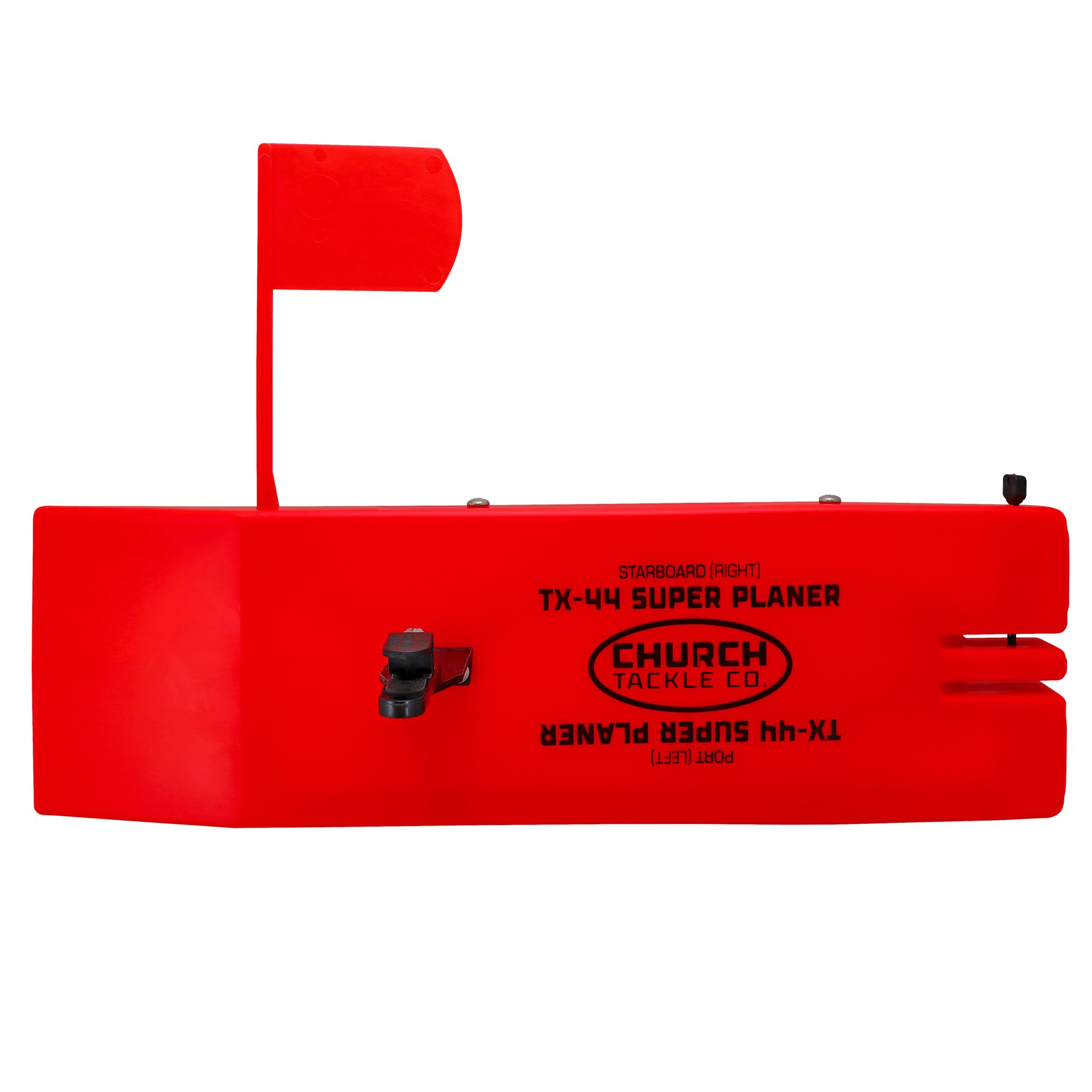
The TX-44 is the board for the job the lighter picks avoid: pulling drop weights and hard-pulling lures at higher trolling speeds. The 10-by-3.5-inch body weighs 12 ounces, and the spring-loaded retaining pin is built for quick, secure changes. If your spread includes big divers or heavy hardware, this is the one that won't feel overmatched.

We like the heft for rough water and fast presentations. A heavier board tracks with less skittishness, and the TX-44's size gives it something to push against when a lure is loading the line. It is more board to handle than a small walleye board, but that is the point.

The trade-off is versatility. The same size that makes it steady at speed makes it less fun for light baits and short leads; it's not the board we reach for when the fish want a small presentation. The spring pin is easy to work with cold hands, though the board's bulk is noticeable when you're storing a full set.

For salmon, big walleye, or any trolling program built around heavy pull and speed, the TX-44 earns its place. If you mostly fish slow and light, the Edge 2 or the Off Shore kit is a better match. This is a specialist, and it's a good one.

Pros

  • Stable at high trolling speeds
  • Handles drop weights and big lures
  • Spring-loaded retaining pin for changes
  • 12-ounce body tracks well

Cons

  • Sold as a single board
Our verdict

The TX-44 is our pick for high-speed trolling with drop weights and hard-pulling lures; its extra heft keeps it tracking when lighter boards struggle.

Check Latest Price
7

Offshore Trolling

AFW Fishing Planer Board

87 /100
Angler Score Excellent

Key details

Board Size
Size #6
Trolling Use
Controlled depth
Blade Material
Stainless steel
Check Details on Amazon

The AFW board is the offshore specialist in this group: a size #6 board with a stainless steel blade, aimed at controlled-depth trolling. The stainless is the detail that matters for saltwater and long days on the water, where corrosion is the enemy of anything that stays wet.

We like the simple, corrosion-resistant build for offshore work, and the package is easy to stow. The size #6 designation puts it in the offshore class rather than the small-walleye class, so match it to the water you fish. The board is the focus here, so check what's in the box before you order and plan your releases and flags around it. The board also carries a lead and nickel exposure warning, so wash your hands after rigging and keep it out of reach of children.

There's less here to judge than with the complete kits, and the board's performance in a spread depends on the hardware you pair it with. For an offshore angler who already has a rigging system and wants a stainless board, the AFW is a sensible choice. For a first setup, the Off Shore combo is the easier call because it removes the guesswork.

Pros

  • Stainless steel blade resists corrosion
  • Built for controlled-depth trolling
  • Simple offshore-ready build

Cons

  • Big-water size limits small-lake use
Our verdict

The AFW is a sensible offshore board for an angler who already has a rigging system and wants stainless hardware for controlled-depth trolling.

Check Latest Price

How We Tested Planer Boards Through a Full Open-Water Season

We started by pulling together every board we could find with real specs published — board length and displacement, left-and-right pairs versus singles, tow-line hardware, and whether replacement clips were even available. Anything that only came in one side or had no parts support got cut. That left 15 boards, which we ran over six months, from first open water in spring through fall turnover, trolling inland lakes and a couple of windswept reservoirs for walleye, striper, and catfish at 1.5 to 3 mph.

Each board got the same treatment. We clipped it to 10-pound mono, 30-pound braid, and lead core in turn, ran it out to 50, 100, and 150 feet, and watched whether it planed wide of the boat or dragged in the prop wash. We noted where the line sat in the clip, whether the pad scuffed or flattened the line on release, and how much thumb pressure it took to open a clip with cold, wet hands. Boards that wandered got a second and third run before we wrote them off.

We also read the instructions cold, before touching the hardware, then had a second person set up each board from the paperwork alone — that told us more about ease of use than any spec sheet did. Build quality got checked the hard way, with boards bouncing off gunwales, dunked at the launch, and left baking in the sun, and we kept a running log of strikes per rod-hour so catching performance wasn't just a feeling. Value came down to one question: did it survive the season without needing new clips?

How to Choose Planer Boards for Trolling

Match the board to your speed and baits

A board that runs well at 1.5 mph may skate or dive at 3 mph, and a board built for big divers can feel like overkill when you're pulling small crankbaits. Start with the presentations you use most: slow live-bait trolling for catfish and striper calls for a stable, heavy-bait board like the Edge 2, while drop weights and hard-pulling lures at higher speeds point to the TX-44. If your trolling is mixed, choose a general-purpose kit and learn its limits rather than buying three specialists.

Check clip grip against your line

The release clip is the part that decides whether a board works with your setup. Mono has enough stretch and texture for most pressure-lock clips; braid is slicker and can slide through a clip that hasn't been tensioned for it. Before you buy, decide whether you'll run braid, and plan to test the release in shallow water. If a board slides down the line, tighten the rear clip or add a line stop. A clip that trips too easily in waves is just as bad, so set tension for the water you fish.

Decide between a pair, a kit, and a single

A complete kit is the least fussy way to start: the Off Shore combo includes left and right boards, releases, snap-weight clips, and tattle flags, so you're not matching parts. A single board makes sense when you already have hardware or want a dedicated night board, as with the Gator. Just remember that one board covers one side of the boat. If you want a symmetrical spread, price two singles before assuming a pair is more expensive.

Look for visibility and strike indication

Planer boards run away from the boat, so you need to see them before you can read them. Bright colors help in daylight, but a flag or light is what tells you a small fish or fouled bait has changed the board's attitude. Tattle flags are especially useful for walleye, where the strike may not pull a rod tip hard. A built-in LED is worth having if you troll after dark, since reflective tape only works when a light hits it.

Budget for the hardware, not just the board

The board is only part of the cost. Releases, snap-weight clips, flags, and line stops add up, and cheap clips are often the first thing to need attention. A kit that includes the right hardware can be better value than a lower-priced board you have to rig from scratch. Check what comes in the box, especially on single boards, and factor in a spare release or clip before your first trip.

Frequently Asked Questions

Final Verdict

The Off Shore Planer Combo Kit is the best default for most trolling anglers because it arrives with the two boards, releases, snap-weight clips, and tattle flags that make a spread work. If you pull heavy baits slowly, choose the Edge 2; for high-speed, hard-pulling presentations, the TX-44 is the specialist. Budget-minded anglers can start with the Krazywolf pair, then upgrade the clips if braid gives them trouble.