
Best Stinger Hooks of 2026

A stinger hook is cheap insurance: a short-shank hook trailing off the back of a jig or soft plastic to catch the fish that grabs the tail and lets go. It's the difference between getting short-struck all afternoon and putting fish in the boat. What separates a good one from a bad one isn't obvious on the card, though. A stinger has to be sharp enough to stick in a jaw it barely touches, stiff enough not to bend open, and light enough that it doesn't kill the action of the bait it's riding on.

The learning curve is mostly about size. A stinger that's too long swings around the leader and fouls on the cast; one that's too short never reaches the fish that nipped the tail. We spent four months fishing 16 different stinger hook styles — trailer hooks, jigging assists, and full kits — and the ones that earned a spot in my box kept their point and stayed where I put them.

1

Best Overall

Gamakatsu B10S Stinger

91 /100
Angler Score Outstanding

Key details

Finish
NS Black
Hook Size
6
Point Style
Needle point
Pack Quantity
25
Check Details on Amazon

Twenty-five hooks to a pack is the first thing that makes this one a keeper, and the point is the second. The B10S is a fly hook at heart — it's what goes on the tail of an articulated streamer — but the wide gap and straight eye make it just as useful behind a finesse bait or a small paddletail. Straight out of the wrapper the point is needle-fine, and a session bouncing over rock doesn't turn it into a glide.

What we noticed over a season is how little the hook changes. The temper is stiff enough that the gap doesn't roll open, and the NS Black finish has come through a wet box without the rust bloom that turns a bargain hook into a one-trip item. That's the argument for paying per hook here rather than grabbing the cheapest card on the rack: you're not sorting through a pack looking for the four that were finished properly.

Size 6 is what ships, and it's the honest limit. It's right for streamers in the two-to-four-inch range, neko-rigged stickbaits, and small soft-plastic trailers, and it's too small for a big paddletail or a heavy saltwater jig. Buy the same hook in the size that matches your bait, or move to a jigging assist hook for deep water — the rest of this list covers that end.

Pros

  • Needle point stays sharp through a session
  • 25 per pack, the best per-hook value here
  • Stiff temper resists the gap opening
  • Works for streamers, neko rigs, and trailers

Cons

  • Bare hooks; no cord or rings included
Our verdict

Our default stinger: the sharpest, most consistent hook here, and the 25-pack makes it the cheapest way to keep trailing points rigged, as long as size 6 suits your baits.

Check Latest Price
2

Best for Saltwater Jigging

Capt Jay Assist Hook

90 /100
Angler Score Outstanding

Key details

Color
Glow green
Material
Carbon steel
Hook Size
4/0
Point Style
Spear point
Check Details on Amazon

Sizing is the part that catches people out. These don't follow the numbers on a standard hook card — the 4/0 reads larger in the hand than the number suggests, and the glow-green dressing adds bulk of its own. Hold it against the jig you plan to hang it from before you commit, because a hook that crowds the tail of a jig will stall the fall you bought the jig for.

What you get is a finished hook: flat-forged carbon steel on a whipped Kevlar cord, looped and ready to hang off the front eye the moment the pack opens. We appreciated that on a moving deck, since building an assist from a bare hook, a split ring, and a length of cord is the job that eats a drift. The flat forging keeps the shank slim, so a hook with real bite to it doesn't drag the nose of the jig down.

The wire is where these hold their own. Drag power is listed at 100 to 300 pounds, which is the hook's ceiling rather than a promise about your leader; think of it as one less thing to worry about when the drag is locked down. The spear point is genuinely sticky, and the finish has come back from repeated saltwater trips black rather than spotted. The glow skirt is a detail we ended up valuing more than we expected — a bit of flash at the business end and something to track when the jig is falling in low light.

Pros

  • Pre-tied Kevlar cord, ready to hang
  • Flat-forged wire keeps the jig falling clean
  • Sticky spear point that survives saltwater

Cons

  • Priciest per hook in this group
Our verdict

A finished saltwater assist hook we trust on jigs from slow-pitch to speed — just size it against the jig, not against the last hook card you bought.

Check Latest Price
3

Best Kit

AGOOL Jigging Assist Kit

87 /100
Angler Score Excellent

Key details

Hook Sizes
2/0, 4/0, 6/0, 8/0, 10/0
Split Rings
25
Total Pieces
53
Hook Material
420 stainless steel
Check Details on Amazon

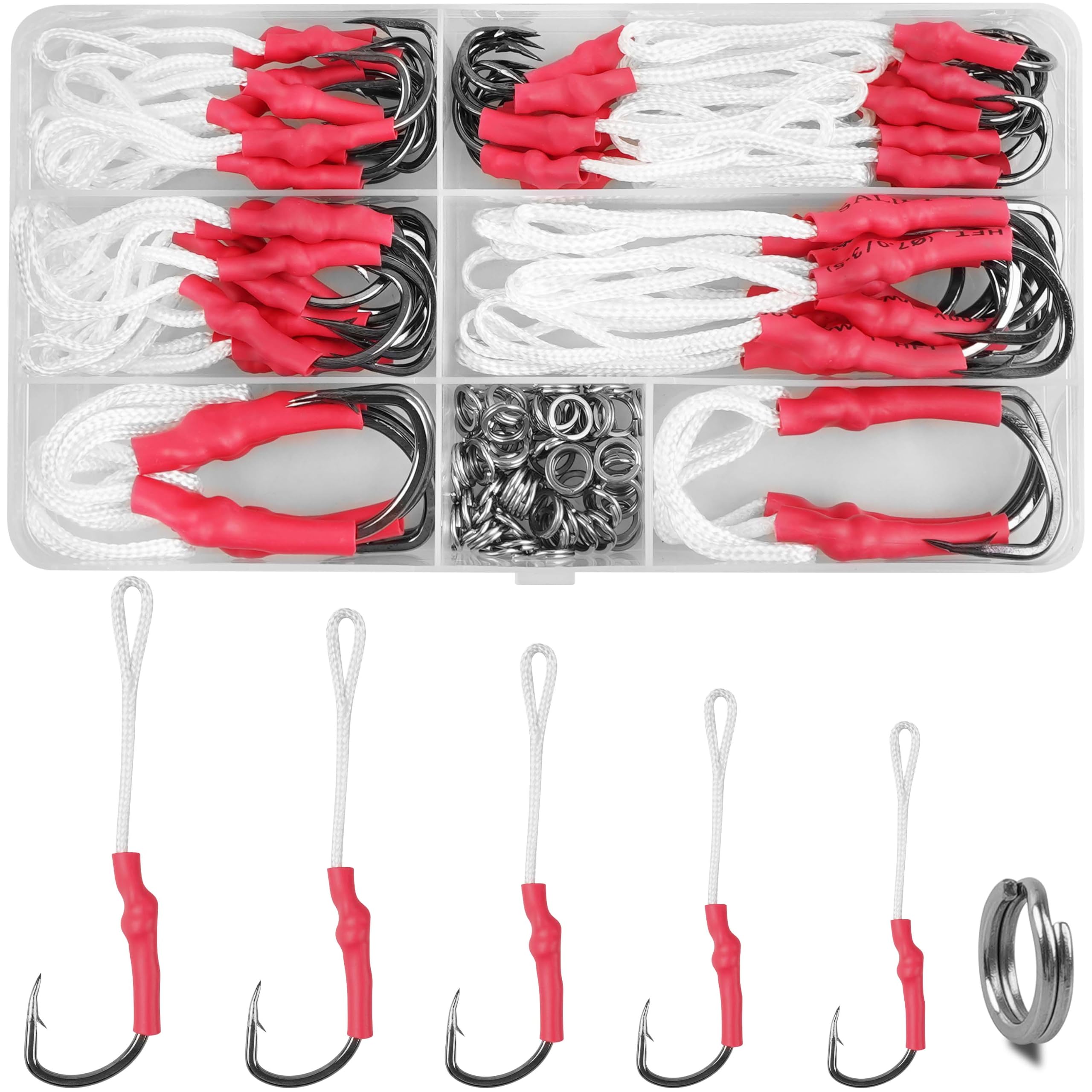
Kits usually mean a drawer full of sizes nobody ties on. This one earns its shelf space: 2/0 through 10/0 in a single box, 28 hooks and 25 split rings, enough to keep a jig bag running through a season of slow-pitch and speed jigging without buying five separate cards. The red heat-shrink collar over the PE cord is a small thing that matters, because it stops the loop fraying where it rubs the jig eye.

The hooks are 420 stainless with a conical point. That's a corrosion-first choice rather than a hardness-first one, and it's the right call for something that will live in a wet boat locker: they shrug off salt air, and in exchange they don't hold a fine point as long as a carbon hook that gets rinsed and dried after every trip. We treat a kit like this as a consumable and swap hooks out rather than babying them.

As a starter box, we think it's the right buy. The size spread matches a mixed jig collection, having the rings in the same pack means you can rig everything the day it arrives, and the price lands in the middle of this group for a lot more hooks than the premium picks give you. It's a starting point rather than a finishing kit, and the two things we change first are listed at the end of this card.

Pros

  • Five sizes plus split rings in one box
  • 420 stainless shrugs off salt and damp storage
  • Heat-shrink collar protects the cord loop
  • Midrange money for a whole season of hooks

Cons

  • Split rings lighter than the hooks they hold
  • Sizes run small for their numbers
Our verdict

The kit to buy before a trip you can't restock for: a usable spread of assist hooks and rings in one box, with hardware you'll want to upgrade.

Check Latest Price
4

Best for Spinnerbaits and Buzzbaits

Gamakatsu Spinnerbait Trailer

89 /100
Angler Score Excellent

Key details

Material
High carbon steel
Hook Size
1/0
Point Style
Spear point
Pack Quantity
5
Check Details on Amazon

A spinnerbait or buzzbait worked through cover collects short strikes: the fish boils behind the skirt, misses the main hook, and is gone. Hanging a second hook off the back is the oldest fix in bass fishing, and this is the trailer we keep in the boat — stiff high-carbon wire, a spear point, and an eye large enough to swing free on a split ring instead of binding against the main hook. It's a small, unglamorous thing that turns follows into fish in the livewell.

The pack includes a short piece of PVC tubing, and that tube is where most of the confusion lives. It isn't a cap for the eye. Cut it into short sections, slide one over the shank of the spinnerbait's main hook, and the trailer rides upright behind the skirt instead of folding back over it. Skipped, the hook comes back to you folded or not at all; done right, it stays put through a retrieve.

Five to a pack, which is the number that matters, because trailer hooks are the item you lose to a snag on a cast you thought was clear. We've re-tied mid-morning more than once with these, and spares in the box beat a run back to the ramp.

Pros

  • Stiff high-carbon wire holds its shape
  • Large eye swings free on a split ring
  • Turns short strikes into hookups
  • Five per pack covers snag losses

Cons

  • One size only, 1/0
Our verdict

Our pick for spinnerbaits and buzzbaits: a stiff, sharp trailer hook that turns short strikes into hooked fish, in a pack that keeps you fishing after a snag.

Check Latest Price
5

Walleye Stinger Rigs

Northland Sting'R Hook

89 /100
Angler Score Excellent

Key details

Color
Red
Leader
12 lb monofilament
Hook Type
Treble
Pack Quantity
3
Check Details on Amazon

A walleye that nips the tail of a jig and lets go is the fish this rig exists for. The Sting'R is stinger fishing made snap-on simple: a treble on a short length of 12-pound monofilament, a fast-snap on the other end, no tying, no split rings, no cord to whip. Clip it on, drop the jig, and the fish that grabs the back of the bait finds a point waiting for it.

We keep one on when the bite turns soft and short, and take it off when we're working rock or timber — that's the honest trade with a treble on a leash. Open water and clean bottom, it's a fish-catching piece of kit. In cover, it's three points looking for a snag, and you'll spend more time retying than fishing.

It reads as an old-fashioned product, and that's part of the appeal: nothing to assemble, nothing to adjust, nothing to lose except the rig itself. Three to a pack matches how it gets used — clip it on, fish it, cut it off, grab another. For a walleye box it's the lowest-fuss way to add a stinger hook to a jig.

Pros

  • Snap-on rigging, no tying on the water
  • Built for light-biting walleye
  • Ready to fish straight out of the pack

Cons

  • Leader length and treble size are fixed
Our verdict

The snap-on answer for short-striking walleye: no tying, no split rings, and it works, as long as the water is open enough for a treble.

Check Latest Price

How We Tested Stinger Hooks on the Water

Every hook in the running came out of the same research pass: we worked through trailer hooks, jigging assists, and prepacked kits, compared wire gauge, hook gap, whether a split ring and braid cord came included, and how many sizes in a pack were actually usable. From that pile we bought 16 styles and fished them for four months, from the late-spring shad run into early fall.

Most of that time was spent on the water the way these hooks really get used: vertical jigging over rock piles, slow-pitch jigs drifted through bait schools, spinnerbaits cast along weedlines, and live bait soaking off a dock. Each hook was matched to a bait it was built for, then bumped a size up and a size down to see what a heavier or lighter trailer did to the bait's action.

We checked sharpness by dragging the point across a thumbnail before the first cast, then again after a dozen fish, and we counted how many fish that grabbed the tail still ended up hooked in the back of the jaw. Stability got watched on every cast — whether the stinger trailed straight behind the bait or helicoptered and wrapped the leader. After each saltwater trip the hooks were left unrinsed overnight so we could see which ones pitted and which split rings rusted, and we counted usable hooks per pack rather than trusting the number on the label. The small stuff counted too: whether the eye closed cleanly and the point sat centered on the shank.

How to Choose Stinger Hooks

Match the gap to the bait, not the number

Stinger hook numbering is not standard across brands, and a 4/0 from one maker can sit closer to a 6/0 from another. What actually decides the fit is the gap: the hook has to clear the body of the bait or the tail of the jig without crowding it, so a fish that eats the back half finds steel instead of plastic. Hold the hook against the lure before you tie it on.

When you're between sizes, go smaller. An oversized stinger kills the action of a light bait, and a stinger's job is to trail the lure, not steer it. A size 6 fly-style hook is the right call for a four-inch streamer and the wrong one for a one-ounce jig, and no number on the card tells you that as quickly as the gap does.

Decide how much rigging you want to do

Stinger hooks come three ways: a bare hook you attach with a split ring or a length of cord, a hook already whipped to a Kevlar assist cord, and a snap-on rig with the leader and treble tied for you. Each one trades time for control.

A pre-tied assist goes from pack to jig in seconds, which is what you want when the drift is short and the fish are up high. A bare hook lets you choose the cord length and the hook size, which matters if you're fussy about how the hook hangs. A snap-on rig surrenders both choices and buys you the fastest re-rig of the three.

Single hook or treble

Single hooks snag less, come out of a fish faster, and are easier on anything you plan to release. Trebles hook more of the fish that swipe at the tail. That's the trade in one line, and it should drive your choice more than brand does.

Weed edges, brush, and catch-and-release water argue for a single. Open water and light-biting walleye argue for a treble. Plenty of anglers carry both and switch at the first short strike, which is why a snapping rig and a loose hook in the same box isn't redundancy.

Fresh water, salt water, and the wire

Carbon steel takes and holds a finer point than stainless, which is why the sharpest hooks here are carbon. Stainless resists corrosion, which is why a kit built for saltwater uses it. Neither is better in the abstract — one is sharper, the other is lazier to own.

If your hooks live in a saltwater boat, choose corrosion resistance and accept that points need replacing sooner. Freshwater anglers can take the sharper wire. Either way, rinse in fresh water and let the hooks dry before the box closes; a hook stored wet is a hook you throw away.

Buy enough to lose a few

Stinger hooks are consumables. They snag, they get cut off, and they leave with fish. The per-hook math almost always favors the bigger pack, and a 25-pack of the size you actually use beats three packs of sizes you don't.

Look at what comes in the box, too. Split rings and sleeves bundled with a kit are usually the lightest hardware in it, and swapping them for your own is cheap insurance before you hook something with shoulders.

Frequently Asked Questions

Final Verdict

Buy the Gamakatsu B10S if you want one box of hooks covering streamers, finesse trailers, and neko rigs, and if size 6 matches the baits you actually throw. It's the sharpest, most consistent hook in this group and the cheapest per hook by a wide margin.

If you're jigging saltwater, the Capt Jay assist hooks are the better tool — pre-tied, flat-forged, and built for a locked-down drag. And if the problem you're solving is short strikes on a spinnerbait, skip both and put a trailer hook on the skirt.