Best Throw Ropes of 2026

A throw bag is the only piece of paddling gear you buy hoping it never comes off the deck. The premise is almost too simple — a sack of floating rope, one good throw, a line in a swimmer's hands — but the gap between a bag that works and one that just looks the part shows up in seconds you don't have. Get it right and a bad moment stays a story you tell later; get it wrong and you're watching your rope sink, tangle, or fall short while someone drifts.

I've been on enough rivers to know the length printed on a bag isn't the distance you can throw it, and a soaked bag weighs a lot more than a dry one. My team and I have spent the past six months cycling 12 of these through pool sessions, flat water, and a few cold mornings on the water, and the same handful kept ending up clipped to our vests. Weight, portability, and the way the line pays out out of the sack separated the field far more than any spec sheet did, and the priciest bag in the group was never the one we reached for. The picks below are the ones we'd hand you without a second thought.

1

Best Overall

Scotty Rescue Throw Bag

93 /100
Angler Score Outstanding

Key details

Bag
Nylon/polyester, self-draining
Rope Length
50 ft
Rope Diameter
9/32 in
Breaking Strength
550 lb
Check Details on Amazon

Five inches long and four inches wide, the Scotty bag disappears into a kayak cockpit or under a bench seat, and an adjustable strap lets you hang it closer when you want it within reach. Inside is 50 feet of 9/32-inch MFP polypropylene, a braided floating line rated to 550 pounds. The bag itself is bright orange nylon and polyester with a 3M reflective band stitched across the outside and a self-draining mouth.

Fifty feet is the length we reach for first. It covers the distance on rivers, ponds, and inshore water where someone actually goes in, and it leaves enough line to pull a swimmer to the bank without hauling a coil that never gets wet. The self-draining bag matters more than it sounds, because a bag holding water throws like a wet sock. We also appreciate that the strap adjusts: it clips to a seat frame or a thwart and stays where you left it.

Line strength is where this bag gives ground. At 550 pounds it is built for pulling a person, not for dragging a swamped boat or hauling two people against current. If your worst case is a loaded canoe pinned on a rock, one of the 1,800-pound bags below is the better tool, and we say that as people who keep a Scotty on board anyway.

For the ordinary case this is the bag we keep coming back to: light enough to throw accurately, small enough to live aboard, and simple enough that nobody has to read anything in a crisis. Ours rides behind the seat with the strap looped over a frame tube, which is exactly where we want it when the water is cold and the light is going.

Pros

  • 50-foot floating line in a bag that stows anywhere
  • Reflective band helps you find it in low light
  • Self-draining bag stays light when wet
  • Adjustable strap clips to a seat or thwart

Cons

  • 550-pound line suits people, not boat recovery
Our verdict

For kayakers, dinghy sailors, and anyone who wants one bag for most inland rescues, the Scotty's 50-foot floating line and genuinely stashable bag make it the easy choice.

Check Latest Price
2

Best for Longer Reach

NTR Rescue Throw Bag 70 ft

90 /100
Angler Score Outstanding

Key details

Hardware
Floating grab ring
Rope Length
70 ft
Rope Diameter
3/10 in
Breaking Strength
1,844 lb
Check Details on Amazon

The 1,844-pound rating is what separates this bag from the 550-pound lines that make up most of this group. NTR braids 32 strands into a 3/10-inch polypropylene rope, loads 70 feet of it into an Oxford bag with a foam insert, and adds a floating grab ring at the working end. That combination makes it the bag we hand over when the water is big and the person in it is not the only thing that needs pulling.

Seventy feet buys real options: a wider river, a boat that drifted while everyone reacted, a first throw that falls short without a full re-rig. The grab ring is the detail we appreciate most, because a swimmer in cold water has something obvious to aim for and the ring floats where the line lands. The bag self-drains and stays light when it is wet, and the three-year warranty is the only one stated anywhere in this group.

Sun is what ages the Oxford fabric, and the cinch is the part that goes first, so store it out of the weather between trips. That is a maintenance note rather than a reason to pass: the rope is what does the work, and 70 feet of 1,844-pound line at this money is the most reach per dollar on the page.

Pros

  • 70 feet of 1,844-pound line for long reaches
  • Floating grab ring is easy to see and hold
  • Foam insert keeps the bag up in chop
  • Three-year warranty, the only one stated here

Cons

  • Bag fabric fades and the cinch ages first
Our verdict

Buy this when 50 feet is not enough reach and 550 pounds is not enough line: 70 feet of 1,844-pound rope, a floating grab ring, and the only stated warranty here.

Check Latest Price
3

Best for Whitewater Kayakers

NRS 70' Compact Rescue Bag

93 /100
Angler Score Outstanding

Key details

Closure
Barrel-lock drawstring
Drainage
2 in mesh panel
Bag Weight
16 oz
Rope Length
70 ft (21.3 m)
Check Details on Amazon

NRS charges more for this bag than anyone else in the group, and spends the difference on the parts that get used: a 16-ounce bag that packs down small, a 2-inch mesh panel for drainage, and a barrel-lock drawstring instead of a plain cord.

The drawstring is the piece worth understanding. A barrel lock lets you hold the mouth open while you feed line in, then cinch it shut one-handed, which makes a clean reload after a throw far less fiddly than stuffing against a loose cord. The mesh panel does the rest of the drainage work, and 70 feet of high-visibility line covers the same reach as the NTR.

What you are buying is a bag built for repetition, the sort of thing that lives on a raft all season and gets thrown at a practice eddy every week. For a powerboat that pulls it out twice a year, the premium buys durability you will never test and a barrel lock you will barely use. That is the honest split: pay for it if the bag gets thrown, skip it if it gets stored.

Pros

  • Barrel-lock drawstring reloads cleanly with one hand
  • 2-inch mesh panel drains and dries fast
  • 16-ounce bag packs down for a kayak

Cons

  • Line strength and diameter are not published
Our verdict

For whitewater kayakers and raft crews who throw a bag often enough to care how it reloads, the NRS Compact's mesh drainage and barrel-lock closure earn their premium.

Check Latest Price
4

Best High-Visibility Line

Goglobe Throw Rope 60 ft

92 /100
Angler Score Outstanding

Key details

Bag Weight
1.1 lb
Rope Length
60 ft
Rope Diameter
10/32 in (8 mm)
Breaking Strength
550 lb
Check Details on Amazon

Every other bag here is orange; this one is yellow, rope and all. That is not a gimmick. Yellow polypropylene reads against dark water, green banks, and the flat grey of a rainy afternoon better than orange does, and the bag adds a reflective strip and a foam insert so it floats where it lands.

Sixty feet is a sensible middle. It is 10 feet more than the standard 50 without the packed bulk of a 70, and at 10/32 inch (8 mm) and 550 pounds the line stays light enough that the bag goes roughly where you aim it. The drawstring and cord lock keep the mouth shut in a hatch, and the self-draining bucket dumps water instead of carrying it.

The drawstring closure is the one step down from the barrel-lock bags here: it works, and the cord lock holds, but reloading in cold weather takes longer. Set against that, the yellow line is the whole reason to buy this one. You can find a bright yellow rope in a hatch, on a deck, or floating 40 feet away in flat light, and that is worth more than a faster reload you will practice twice a season.

Pros

  • Yellow rope and bag stand out on dark water
  • 60 feet splits the difference between 50 and 70
  • Foam insert and self-draining bucket

Cons

  • Drawstring closure reloads slower than a barrel lock
Our verdict

A yellow line you can pick out from the far bank, 60 feet of it, and a bag light enough to throw straight: this is the pick when visibility comes first.

Check Latest Price
5

Best Budget Bag

LIFE LINE Rescue Throw Bag

87 /100
Angler Score Excellent

Key details

Strap
Side-release buckle
Bag Weight
14.4 oz
Rope Length
50 ft
Bag Material
600-denier polyester
Check Details on Amazon

If you are outfitting a club, a scout troop, or a rental fleet, this is the bag to buy in multiples. The LIFE LINE is the least expensive bag here, and it is built for the job a training bag actually does: 50 feet of floating line, a rugged orange 600-denier polyester bag that resists UV, and an integrated strap with a side-release buckle that goes on and comes off without a fuss.

It throws and reloads like a plain, honest tool. The line pays out cleanly, the bag takes a dunk and drains, and a reload takes about a minute once you have done it twice. At 14.4 ounces and roughly 2 by 6 by 13 inches packed, it sits in a canoe thwart bag or under a seat without complaint, and for teaching that is most of what you want: something a beginner can throw without being told twice.

The white webbing strap is the part that ages first if the bag lives in the sun, so give it a locker between seasons. Otherwise there is little to wear out: one piece of coated polyester, a drawstring, and a buckle. Repack it loosely and it pays out the same way every time, which is the only trick a training bag needs.

Pros

  • Cheap enough to keep one in every boat
  • Side-release buckle straps on and off quickly
  • 600-denier polyester bag resists UV

Cons

  • Offered only in a 50-foot length
Our verdict

The bag to buy in multiples: 50 feet of floating line, a UV-resistant shell, and a buckle strap that goes on in seconds, at the lowest price in this group.

Check Latest Price
6

Reflective Rope Rescue

HOKINETY Rescue Throw Bag

89 /100
Angler Score Excellent

Key details

Hardware
304 stainless buckle
Rope Length
50 ft
Rope Diameter
3/10 in
Breaking Strength
1,900 lb
Check Details on Amazon

A reflective strand runs the entire length of this bag's rope, not just across the bag. That is the detail that makes the HOKINETY worth a second look: in a beam or in flat grey rain, the line itself lights up, so the person in the water sees what is coming and you can see where it landed.

The rest of the specification is competitive. Thirty-two strands of 3/10-inch polypropylene rated to 1,900 pounds, 50 feet of it, a 304 stainless buckle, a bright red floating grab ring, and an Oxford bag with foam inside and a self-draining mouth. Dual reflective tapes on the bag sit on top of the rope treatment rather than instead of it.

The grab ring is small, fine in a calm pond and more of a search in chop, and 50 feet of 3/10-inch line packed into a bag this compact makes the first repack slower than the second. Both are the cost of a bag that fits in a day hatch, and neither changes how it throws.

Where it beats the AnKun at the same money is visibility: reflective rope plus reflective tape on the bag does more than either alone, and 1,900 pounds is the highest line rating in this group. For a bag that lives on deck and might get thrown once in five years, that combination is the whole point.

Pros

  • Reflective strand runs the full length of the rope
  • 1,900-pound line is the highest rating here
  • Stainless buckle clips to a rail or thwart

Cons

  • No manufacturer warranty is stated
Our verdict

The most visible bag here, day or night: a reflective strand woven end to end, a 1,900-pound line, and a compact bag that fits a day hatch.

Check Latest Price
7

Value 70-Foot Reach

AnKun Rescue Throw Bag

89 /100
Angler Score Excellent

Key details

Hardware
Stainless snap hook
Rope Length
70 ft
Rope Diameter
3/10 in
Breaking Strength
1,844 lb
Check Details on Amazon

Clip it to a thwart, a railing, or a dock cleat: the stainless snap hook on one end means this bag rides where you put it and comes off one-handed thanks to a twistlock gate. That hook is the reason it ends up on a boat rather than in a locker.

Seventy feet of 3/10-inch, 32-strand polypropylene rated to 1,844 pounds fills the bag. The dark orange shell has a reflective strand worked into it, foam inside keeps it afloat, and the self-draining mouth sheds water as the line pays out. That is the same reach as the NTR for less money, which is why it is on this list.

One job for the first evening you own it: the knots at the ends of the rope arrive loose enough to be worth whipping or taping yourself. A few minutes with waxed thread, and the rope is as tidy as anything else here. Do not skip it, because a fraying end is the sort of thing you discover mid-throw.

What you give up against the NTR is the floating grab ring and the stated warranty; against the Scotty, the smaller footprint. What you get is 70 feet and 1,844 pounds at the bottom of this group's price range, which makes it the pick when reach matters more than finish.

Pros

  • 70 feet and 1,844 pounds at a budget price
  • Stainless snap hook clips on one-handed
  • Floating, self-draining bag with a reflective strand

Cons

No notable drawbacks to flag.

Our verdict

The value pick for reach: 70 feet of 1,844-pound line, a stainless snap hook, and a floating self-draining bag for about the least money here.

Check Latest Price
8

Grab-Ring Throws

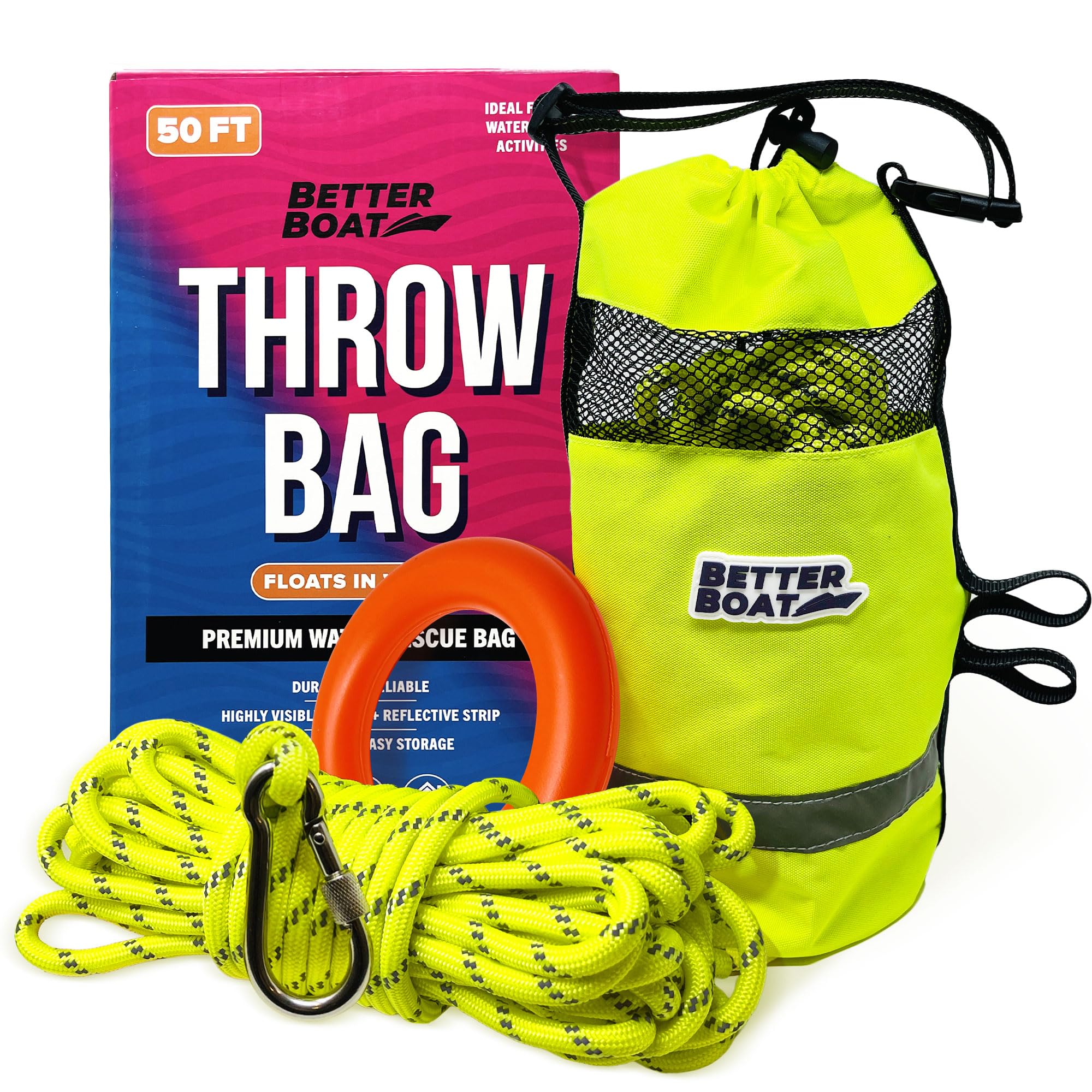
Better Boat Water Throw Bag

88 /100
Angler Score Excellent

Key details

Bag
Water-resistant
Hardware
Grab ring
Bag Weight
1.74 lb
Rope Length
50 ft
Check Details on Amazon

A grab ring at the working end gives a swimmer something to hold that is not a bag full of wet rope, and the bag itself floats, so the whole assembly stays where it lands. The 50-foot line loads into a water-resistant shell with reflective trim, and the package stows in a boat compartment without drama.

The grab ring is the part that earns its place, because it is easier to take hold of than a bag mouth when hands are cold and the water is moving. The water-resistant shell keeps the line dry between trips, and the reflective trim helps you find the bag on a dark deck.

Taken as a package it is competent rather than compelling: the bag drains, the bag body floats alongside the line, and the shell is sensibly built. Nothing about it is wrong. It simply does not beat the lighter bags above at the end of a throw, and that is where a throw bag is judged.

Pros

  • Grab ring gives a swimmer a clear handhold
  • Water-resistant shell keeps the line dry
  • Reflective trim for low-light visibility

Cons

  • Heaviest bag in this group
  • Rope diameter and strength not published
Our verdict

Buy this one for the grab ring and the water-resistant shell; it is a competent bag that simply does not out-throw the lighter picks above.

Check Latest Price

How We Tested the Best Throw Bags

We started by rounding up every rescue throw bag we could find that was actually built for moving water, then sorted them by rope length, stated tensile strength, bag closure, and how the bag attaches to a person. Anything shipped with line that wouldn't float, or with no belt or clip worth trusting, got cut before it ever got wet. That left 12 bags, which we've been using for the past six months.

Most of the testing happened where these bags actually live: pool lanes and a calm stretch of river with a dock, so throws were repeatable, plus a few whitewater days and one cold-weather paddle where everyone wore gloves. We practiced in a driveway after dark to see how each bag and its rope read in low light. Every bag got re-stuffed at least a dozen times — sloppily, the way you would in a hurry — and we noted whether the line fed out clean or came out in a knot.

Distance was measured, not guessed: we paced out throw marks on the dock and recorded where each bag landed on a first and second attempt. We also soaked every bag, then weighed it wet to see how much water the fabric and rope held, since a heavy sack shortens your throw. Fit got checked by belting and clipping each bag to three different PFDs and waist sizes and shaking them out. Durability came down to dragging bags over gravel and asphalt, then looking at abrasion, stitching, and the rope where it meets the bag. Last, we weighed construction against what each bag asks for its tier, and the answer wasn't always the spendy one.

How to Choose a Throw Rope

Match the line to the water you paddle

Fifty feet covers most inland rescues, a river, a pond, the water off a dock, and it packs smallest. Move to 70 feet when the water opens up or when the boat drifts while everyone reacts. Line strength is the other half. A 9/32- or 10/32-inch line rated around 550 pounds throws easily and is plenty for pulling a person; a 3/10-inch line rated to 1,800 pounds or more is what you want if there is any chance you will haul a swamped kayak or a tired swimmer against current. Buy the heavier bag only if you will practice with it.

Flotation, drainage, and the repack

A throw bag has to float, and it has to empty. Foam inside keeps it on the surface beside a swimmer; a mesh panel or a self-draining mouth stops it turning into a water balloon on the way out, which is what kills a throw. The closure matters more than it looks. A barrel lock holds the mouth open while you feed line in and cinches one-handed, while a plain drawstring and cord lock takes longer, and that is the difference between a one-minute reload and a five-minute one in the wind with cold hands.

Visibility, day and night

Orange is the category default, which is exactly why a yellow line stands out. Against dark water, green banks, and grey sky, the color you do not expect is the one you find. Reflective treatment is a separate question. A band on the bag helps you locate the bag on deck in the dark; a reflective strand woven through the rope helps the person in the water see the line coming and helps you see where it landed. If you are out at dusk or under lights, the rope treatment is worth more than the bag treatment.

Packed size decides where it lives

Bags here run from about 12 ounces to nearly 28, and the difference shows at the end of a throw: lighter bags are easier to place accurately, heavier ones easier to send a long way. Packed size decides whether the bag ends up clipped to a seat frame or buried in a hatch, and a buried bag is not rescue gear. Measure the space you actually have, under a kayak seat, in a thwart bag, on a console, before you fall for 70 feet of line that has nowhere to live.

Care, and the limits of a throw bag

Rope and bag fabric both degrade in sunlight, and the bag mouth, the drawstring hem, and the stitched seams go first. Rinse after salt water, dry the bag open, store it out of the sun, and check the line for abrasion each spring. Keep the limits straight too: a throw bag supplements a worn PFD and a plan rather than replacing either, and a 550-pound line is for people, not for towing a boat off a bar.

Frequently Asked Questions

Final Verdict

Most people should buy the Scotty #0793 and stop there. Fifty feet of floating line, a bag small enough to live in a cockpit, a reflective band, and an adjustable strap cover the rescue you are actually likely to face. It is not the strongest line here, and for pulling a person it does not need to be.

Two situations change the answer. If your water is wide or your worst case involves a swamped boat, step up to the NTR for 70 feet and 1,844 pounds. If you are a whitewater kayaker who throws often enough to care how a bag reloads, the NRS Compact's mesh drainage and barrel-lock closure are worth the premium.