Best Transducer Mounting Arms of 2026

The worst sound in kayak fishing isn’t a missed hookset—it’s the clack of a transducer arm folding under a wake. A good mounting arm fixes that by locking the transducer at the angle you set, letting you stow it fast, and fitting the track or rail you already have without a garage full of tools. I’ve watched too many clever-looking arms wobble at the first choppy crossing, so I care less about sleek design and more about whether the thing holds steady when the boat isn’t behaving. The right arm disappears into the background; the wrong one turns every paddle stroke into a small negotiation.

We tested 12 transducer mounting arms over seven months, installing each on kayak tracks and rails and living with them through lake launches, weed beds, and the inevitable dock bump. Some were a breeze to fit and some fought every inch of rail; a few felt rock-solid until I tried to adjust them with cold hands. The ones that earned a spot below got the basics right—sturdy hardware, clear instructions, and an arm that stays where you put it—without asking you to overpay for the privilege.

1

Best Overall

Scotty 0141 Transducer Arm

92 /100
Angler Score Outstanding

Key details

Swivel
360 degrees
Material
High-strength composite
Mount Type
Gear-head track adapter
Arm Extension
11.5 to 18 inches
Check Details on Amazon

Swinging it up over a shoal and dropping it back down is a one-hand job, and after a few trips we stopped thinking about the transducer at all, which is the best thing a mount can do for you. The gear-head adapter drops into a Scotty slide track, the arm swivels a full 360 degrees, and it telescopes from 11.5 inches compact to 18 fully extended, enough to clear the hull on most sit-on-top kayaks.

The composite arm has deliberate give in it, and we count that as a feature: bump a stump and the arm absorbs the hit instead of passing the shock into your track bolts. That same give is why we lift the arm clear of the water before running anywhere rocky. It is the part that flexes, so it is also the part that eventually fails if you leave it down and hit something square.

The last thing to settle is your transducer, not the arm. The mounting hole suits a small bracket, and a wider one needs reaming out, which is five minutes with a drill and a miserable job with a knife. Hold your bracket against the arm before the season starts and you will spend the summer fishing instead of drilling.

Pros

  • Telescopes 11.5 to 18 inches
  • Full 360-degree swivel
  • Lifts off the track in one motion
  • Flexible composite absorbs bumps

Cons

  • Gear-head can need shimming on other tracks
  • Slide track and sounder mount sold separately
Our verdict

Our default for kayak and SUP anglers: it swivels a full 360 degrees, telescopes to 18 inches, and lifts off the track in one motion, with a transducer hole worth checking first.

Check Latest Price
2

Best Display-And-Transducer Combo

WINDFRD 2-in-1 Track Mount

84 /100
Angler Score Excellent

Key details

Warranty
3 years
Mount Type
1.5-inch ball on T-bolt track
Maximum Load
10 lb
Arm Extension
11.42 to 17.91 inches
Check Details on Amazon

One base, two jobs: this is the only mount here that carries the finder screen and the transducer arm on the same track plate, and on a kayak with a short stretch of rail that is the difference between a workable cockpit and a cluttered one. A 1.5-inch double-socket ball holds the display, the arm runs from 11.42 to 17.91 inches, and the assembly is rated for 10 pounds of electronics.

The ball joint is the part we care most about. It tightens anywhere in its arc, so tilt and swing are one adjustment instead of two clamps, and the arm slides through its collar to put the transducer deeper without leaning out of the seat. The other side of that freedom is creep: a ball holding a heavy unit can work loose, and checking the tension at the launch takes the problem off the table.

Fit deserves five minutes before you order. The plate is predrilled for Garmin, Lowrance, and Humminbird units, but predrilled is not the same as universal, and a deep display base can need longer fasteners than the box supplies. Set your finder bracket on the plate, line the holes up, then decide what you need from the hardware bin.

Pros

  • Holds display and transducer on one base
  • Ball joint tightens at any angle
  • Extends to 17.91 inches
  • Three-year warranty

Cons

  • Ball joint can creep under a heavy display
  • Plate may need longer fasteners for deep bases
Our verdict

The one to buy if you want your finder screen and transducer on a single base, as long as you hold your display bracket against the plate before you mount anything.

Check Latest Price
3

Best Long Reach

Brocraft Transducer Arm

85 /100
Angler Score Excellent

Key details

Swivel
360 degrees
Material
Marine-grade aluminum, nylon
Mount Type
Deck mount
Arm Extension
17 to 25 inches
Check Details on Amazon

Twenty-five inches is a lot of arm, and it is the reason to look at this one. Where the Scotty and the WINDFRD top out around 18, the Brocraft telescopes from 17 inches to 25, enough to hang a transducer out past the gunwale of a canoe, pontoon, or inflatable without leaning over the side to do it.

The base is a deck mount rather than a track mount, screwed or bolted straight down, which is right for a boat and a real commitment on a kayak you would rather not drill. Once it is down, the arm swivels a full 360 degrees and a slip disc gives micro adjustments instead of a choice between notches, so you can aim the cone at a drop-off rather than at the next detent.

Our read is that this is the boat arm, not the kayak arm. On a kayak you are carrying reach you will run short and angled anyway, plus a deck mount on a hull you may not want to touch. On a 14- to 16-foot aluminum boat or a pontoon, 25 inches of marine-grade aluminum that comes off in seconds for trailering is exactly the right tool. Measure from your mounting spot, around the hull, and down to the waterline before you assume it reaches, because freeboard eats length quickly.

Pros

  • Reaches 25 inches fully extended
  • Marine-grade aluminum arm
  • 360-degree swivel with slip-disc trim

Cons

  • Screws down, so drilling is required
  • Long arm is more than a kayak needs
Our verdict

The long-reach choice for boats and canoes: 25 inches of aluminum arm with a 360-degree swivel, provided you are mounting to a deck you are willing to drill.

Check Latest Price
4

Best Modular Track Arm

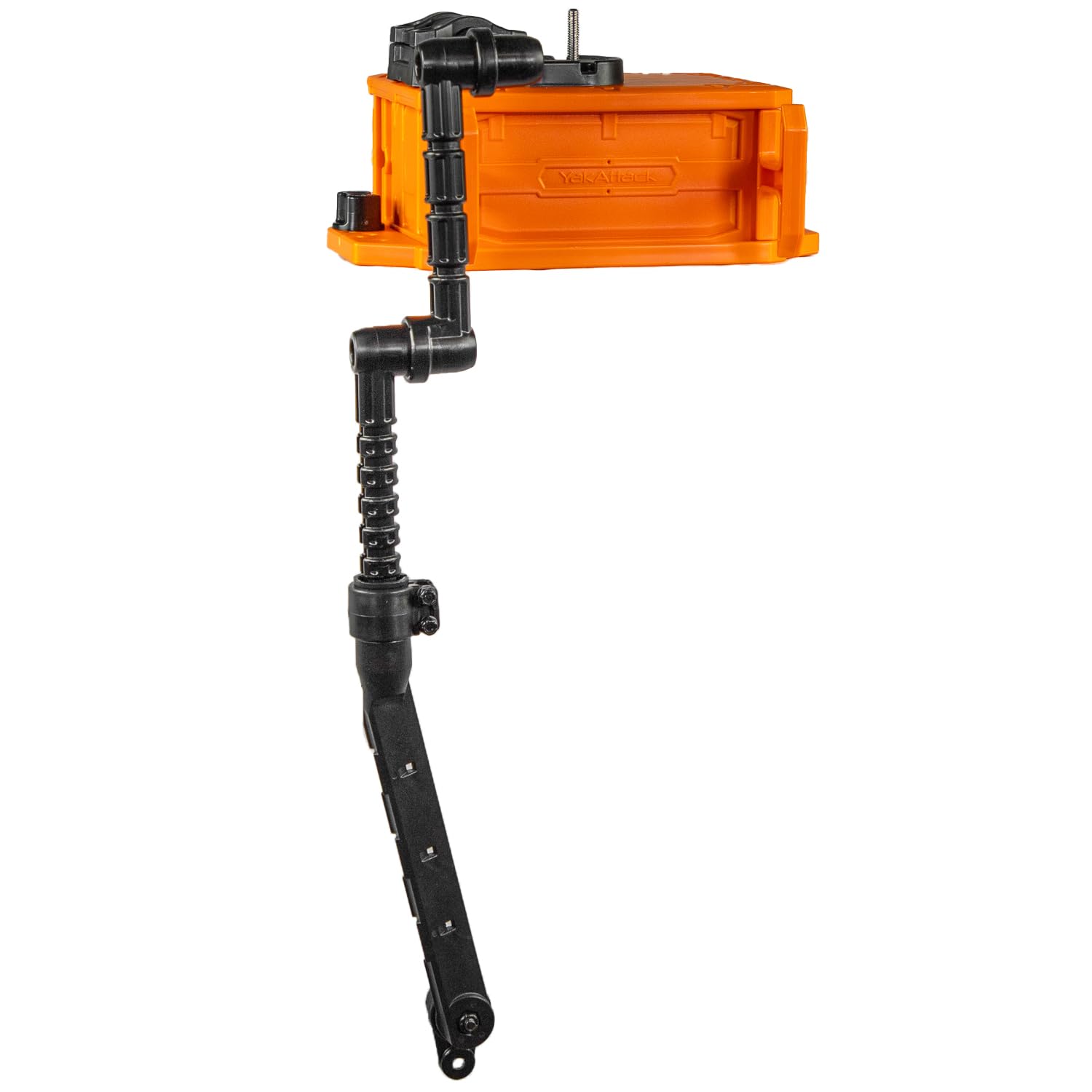
YakAttack Switchblade

89 /100
Angler Score Excellent

Key details

Material
UV-resistant polymer, stainless
Mount Type
Track or deck mount
Arm Sections
Removable for custom length
Total Arm Length
25.75 inches
Check Details on Amazon

It folds, and none of the telescoping arms here do. The Switchblade's blade swings up and lies flat in one motion, so a sandbar, a shallow launch, or a forgotten stump costs you a second instead of a transducer. Anyone who has dragged an arm through the shallows knows which design they want next.

Reach is the other half of the design. The arm measures 25.75 inches in total, but it is modular, so you pull a section out and it matches a short kayak instead of towering over it. That is a better answer than a fixed tube for fitting one arm to different hulls, and it is why we rate it the most adaptable mount here for a track-equipped kayak. Compatibility is broad as well: GearTrac and MightyMount, plus most RAM, Scotty, and YakGear rails.

Adaptable is not the same as fuss-free. Plan on building it from the hardware bag rather than from the instructions, which are thin enough that laying the parts out on a table beats reading them. And check the joint before each trip: the blade holds position at trolling speed, but a loose collar lets the transducer wander, and your depth reading wanders with it.

Pros

  • Folding blade stows in one motion
  • Removable sections set custom length
  • Fits most kayak track systems
  • Lifetime guarantee, made in USA

Cons

  • Assembly instructions are thin
  • Joint needs checking and re-tightening
Our verdict

Our pick for track-equipped kayaks: a folding blade that clears the shallows instantly and a modular arm that fits your hull, with a joint worth checking each trip.

Check Latest Price
5

Budget Track Mounting

EDSRDPLT Universal Mount

76 /100
Angler Score Very Good

Key details

Material
Stainless steel and composite
Mount Type
Tool-free gear track
Arm Extension
9 to 14 inches
Check Details on Amazon

No tools, no drilling, no bracket to bolt down: the clamp opens, drops over your gear track, and closes. On a kayak that lives on a roof rack that matters, because the whole mount comes off in about the time it takes to unclip a paddle, and the arm telescopes between 9 and 14 inches once it is on.

Positioning comes from a stainless-and-composite arm with enough pivots to drop the transducer below the hull and tilt the face level again. The 14-inch maximum is the shortest here by a margin, against 18 on the Scotty and 25 on the Brocraft and the Switchblade, and that specification decides the purchase for you. On a sit-on-top with low freeboard it reaches clean water easily; on a deep hull where the puck has to clear the chine, it will not.

What we liked most is how little there is to think about. Nothing to maintain, nothing to wire, and a track clamp that works the same way the pricier mounts here do. That makes it a sensible first arm, or a second one for a paddleboard, provided you go in knowing the reach is the trade.

Pros

  • Tool-free track installation
  • 9- to 14-inch adjustable arm
  • Stainless and composite build

Cons

  • Shortest reach here at 14 inches
Our verdict

The tool-free budget pick: clamps onto a gear track in seconds and adjusts three ways, with a 14-inch reach that suits low-freeboard kayaks and SUPs.

Check Latest Price
6

Complete Battery Rig

YakAttack CellBlok Combo

84 /100
Angler Score Excellent

Key details

Box Weight
1.4 lb
Mount Type
Track mount
Battery Capacity
10Ah batteries such as Nocqua or Dakota Lithium
Included Components
CellBlok battery box, Switchblade arm
Check Details on Amazon

Two products arrive in one box, the CellBlok battery box and the Switchblade arm, and together they turn a bare kayak into a fish-finder boat without a battery sliding around the cockpit. If wiring and transducer deployment are the two things that have kept you from fitting a finder, this handles both in one purchase.

The pairing is genuinely well thought out. The box is injection-molded, weighs 1.4 pounds empty, and holds a 10Ah battery such as a Nocqua or Dakota Lithium, with cable wraps that keep the leads from becoming a nest under your seat. The arm is the same folding blade as the standalone version, so it articulates up and out of the water in one motion and adjusts for side-imaging transducers. Track mounting means no drilling, and the whole rig moves to a second kayak in seconds.

The catch is the putting together. The instructions are the weakest part of the package, sparse and with diagrams that do not match the hardware bag, and the assembly is fiddly enough that it belongs on a bench at home rather than in a parking lot at the ramp. Set aside an evening, lay everything out, and what you end up with is the neatest rig in this group.

Pros

  • Battery box and arm in one unit
  • Holds 10Ah Nocqua or Dakota batteries
  • Cable wraps keep wiring tidy
  • Tool-free track mounting

Cons

  • Assembly is fiddly and poorly documented
  • Battery sold separately
Our verdict

The all-in-one answer for kayak electronics: battery box, tidy cable routing, and a folding transducer arm on one track mount, as long as you are patient with assembly.

Check Latest Price

How We Tested Transducer Mounting Arms

We started by pulling together every transducer arm we could find that was designed for kayak tracks, rail systems, or both, then narrowed the shortlist by build material, mounting hardware, folded length, stated compatibility, and price. That left 12 arms, which we tested over seven months on kayaks and paddleboards in freshwater lakes and tidal creeks. Each one was installed from scratch, timed solo with the clock running, and checked against the instructions—whether the kit needed extra bolts, whether the track plate fit without slop, and whether I could make the adjustment one-handed while the boat drifted.

We switched arms between boats with different tracks and rails to see what actually fit versus what needed shimming or a different base. On the water, we trolled at 2 to 4 mph, paddled through weed edges, folded and redeployed the arm at every stop, and deliberately bumped the shaft against dock posts and paddle blades. I noted whether the arm crept out of angle, whether the transducer kicked up or twisted, and whether the joint developed play after a few weeks. Back at the truck, we checked how much water and grit collected in the hardware, how easy it was to remove for travel, and whether the folded arm cleared rod holders and hatch lids.

We also paid attention to the unglamorous stuff: how clearly the instructions explained track fit, whether the included tools were enough, and whether the price matched the hardware. Arms that needed constant retightening, or that only worked with one style of base, lost points. The 12 units were scored on sturdiness, ease of installation, adjustability, compatibility, stability underway, and value—not on how flashy they looked on the deck. We’ll keep using them through another season and update if anything loosens, cracks, or surprises us.

How to Choose a Transducer Mounting Arm

Start With How You Will Attach It

Track mounts assume a rail is already bolted to your boat. The Scotty gear-head, the YakAttack blade, and the EDSRDPLT clamp all need one, and the trap is buying a no-drill arm for a hull that has no track on it. You end up drilling to install the track instead, which is the bigger hole in the more awkward place.

Deck mounts, like the Brocraft, screw straight down and suit boats where a rail would be underfoot. If your kayak came with a short GearTrac or MightyMount, measure it before assuming: an arm base plus a display base can eat most of a 6-inch section.

How Much Reach You Actually Need

The transducer has to sit in clean, bubble-free water below the hull, which is why arm length so often settles the purchase. In this group the spans run from 9 to 14 inches on the EDSRDPLT up to 17 to 25 on the Brocraft, with the Scotty and the WINDFRD in the middle at roughly 11 to 18.

Longer is not automatically better. Every extra inch is a longer lever, and a thin arm at 20 inches will wag more at trolling speed than a stiff one at 15. Measure from your mounting point, out and around the hull, and down to the waterline, then add a few inches for the transducer bracket.

Joints, Clamps, and Holding Position

Two joint styles dominate: a gear head or toothed clamp that locks in steps, and a ball socket that tightens anywhere in its arc. Balls adjust more freely and can creep under a heavy display; gear heads stay put but offer fewer angles. Neither is better in the abstract, they just fail differently.

Whichever you choose, plan to check tension. An arm that swings freely in the driveway can sag once a transducer is hanging off the end of it at speed, and a folding blade such as the YakAttack's adds a fast stow that a plain telescoping tube cannot match.

Will Your Transducer Bolt On?

Every arm here assumes a bracket bolts to it, and the hole patterns are not identical. The Scotty's mounting hole suits a small bracket and may need reaming for a wider one; the WINDFRD's plate is predrilled for the major brands without being universal.

Take your transducer bracket off the boat and hold it against the arm. Check the bolt spacing, and check whether the arm's hole is wide enough to pass the fastener. A plate or adapter solves most mismatches, and it is cheaper to buy one on purpose than to improvise at the ramp.

Storage, Transport, and the Hit You Will Eventually Take

Arms live at the edge of the boat, which is exactly where stumps, rocks, and trailer straps find them. Models that fold, swivel, or lift off the track, like the Scotty popping out of its gear head or the Switchblade folding flat, spare the joint on the way in to shore.

Take the arm off for the road; a transducer hanging off the stern at highway speed is how these break. Keep material in mind too. Composite gives on impact, which is what you want, but it also means the arm is the part that fails.

Frequently Asked Questions

Final Verdict

Buy the Scotty 0141 and you are done deciding. It swivels a full 360 degrees, telescopes to 18 inches, and lifts off the track in one motion, and the fittings on it are the ones most kayaks are already prepared for. The shim it may want on an off-brand rail and the transducer hole you may need to open up are small jobs done once.

Two requirements change that answer. If the finder screen has to ride on the same base, the WINDFRD carries both. If you are mounting to a drilled deck instead of a rail and need the transducer out past a gunwale, the Brocraft's 25 inches is what the job takes.