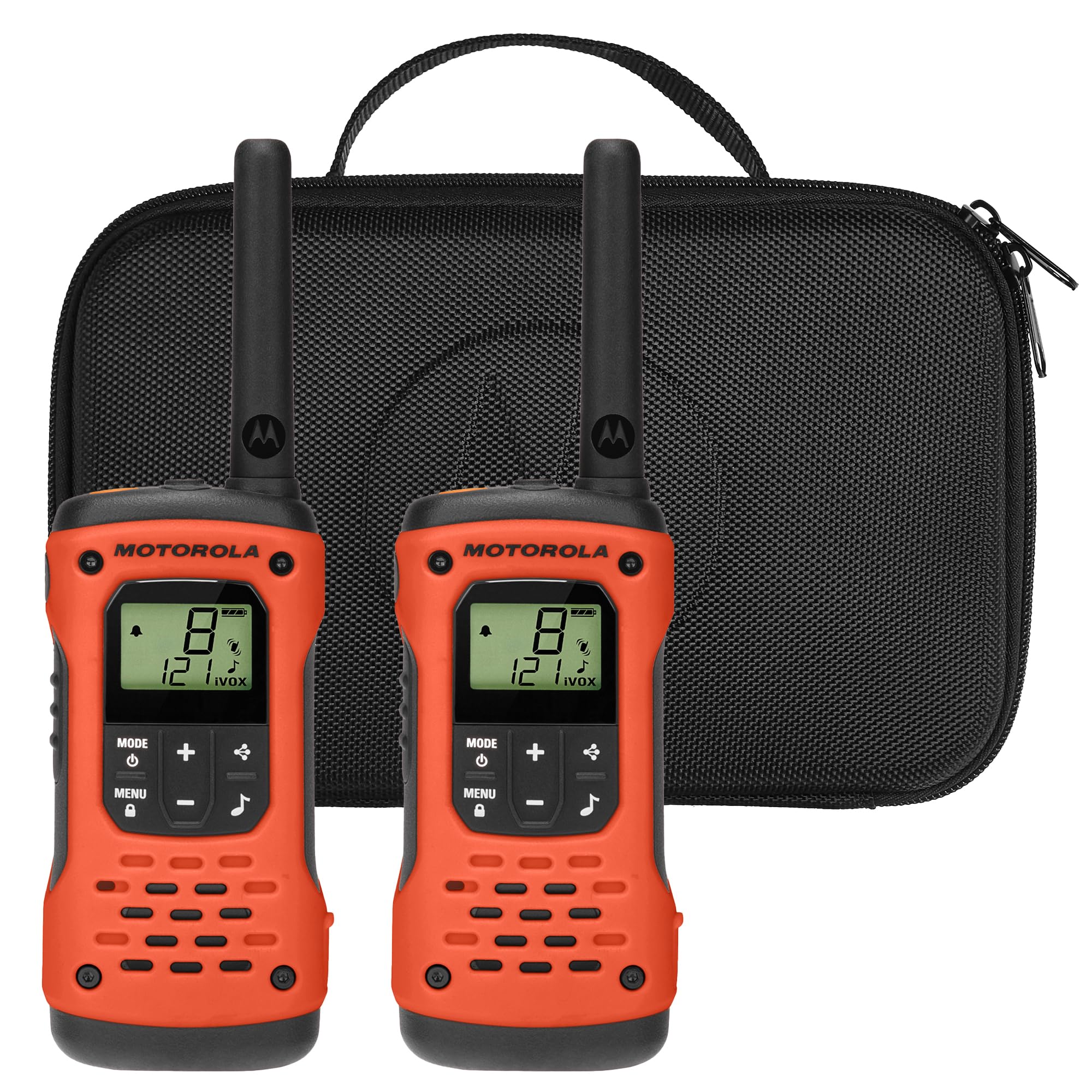
Best Two-Way Radios of 2026

Every two-way radio box has a number on it — 35 miles, 20, sometimes 50 — and none of them survive a real forest. Through trees or a concrete parking garage you get less than a mile; over open water, maybe a few. What a good set actually fixes is simpler than the box promises: it keeps your group talking when the bars disappear. My team spent seven months with 12 handhelds in campsites, on ski slopes, in warehouse aisles, and on two-car road trips, and the gap between the good ones and the rest shows up fast.

Ignore the mile count and check how you'll charge instead — a radio that dies at hour six is worse than one with half the range. Channel count is mostly marketing; what matters is whether the buttons make sense with gloves on. I handed these to kids, grandparents, and a friend who won't read manuals, and the ones that stuck were the ones nobody had to think about. The picks below are sorted by where they earn their keep.

1

Best Overall

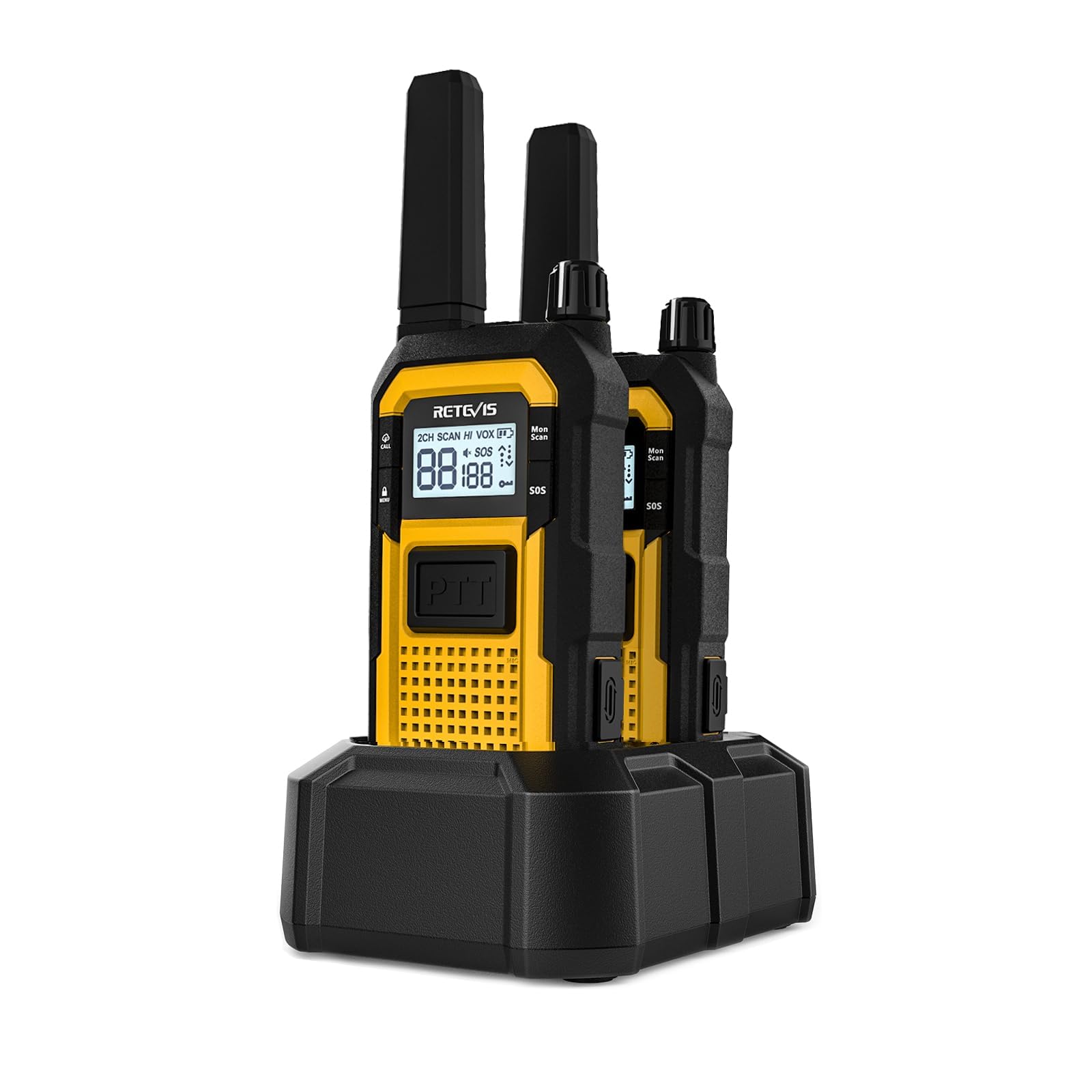
Retevis RB48

89 /100
Angler Score Excellent

Key details

Battery
2,000 mAh, up to 18 hrs
Channels
22 (FRS, license-free)
Charging
2-in-1 dock and USB-C
Water Rating
IP67, floats
Check Details on Amazon

A radio that survives a wet afternoon matters more on the water than one with an extra channel, and the RB48 is built around that idea. Retevis rates the shell IP67 against dust and immersion, tests the body to MIL-STD-810H, and lists it as floating, which together mean a knock into the bottom of a kayak or a wave over the gunwale is an inconvenience rather than the end of the trip. The high-visibility yellow is less a style choice than a findability feature.

The charging kit is what we appreciated most. A two-in-one dock takes both radios at once, and each body also carries USB-C, so the cradle lives on the counter and a power bank covers the truck. The 2,000 mAh battery is rated for up to 18 hours, which is a full fishing day plus the drive home. Push-to-talk buttons are silicone-covered and sized for a gloved thumb, with a second one on the opposite side, and a built-in weather alert hands you NOAA storm warnings without a second device in the bag.

The trade-offs are about scale. It is FRS only, so there is no GMRS channel count or extra power to grow into, and you get two radios for money that buys four elsewhere. If your group is a family of four on a pontoon, the RT22 below covers that for less; if you are the one who ends up in the water, this is the pair.

The five-year warranty on the radio body is the longest coverage in this guide, and it is why we are comfortable calling this the default rather than the splurge. You are paying more per radio and getting the backing to match, which is not something we can say about everything here.

Pros

  • IP67 rated and floats if it goes overboard
  • Up to 18 hours from a 2,000 mAh pack
  • Dock and on-body USB-C charging both included
  • Five-year warranty on the radio body

Cons

  • Volume knob spins down in a pocket
Our verdict

Our pick for anyone who fishes, hunts, or works outside: license-free, waterproof enough to dunk, and rated for a long day, so you charge it at night and forget it.

Check Latest Price
2

Best for Range and Weather Alerts

Midland GXT1000VP4

89 /100
Angler Score Excellent

Key details

Power
Rechargeable pack or AA cells
Weather
NOAA scan and alert
Channels
50 GMRS, 142 privacy codes
Water Rating
JIS4
Check Details on Amazon

The GXT1000VP4 is the most feature-loaded handheld in this guide: 50 channels and 142 privacy codes, a weather radio built into the body, and a dual-power design that takes AA cells when the rechargeable pack goes flat. It is also a full-size radio at 7.9 inches tall, so it rides on a belt clip rather than in a shirt pocket, which is the right trade for something that stays switched on all day.

Two features earn it a place. The NOAA weather scan locks onto the strongest of the ten weather channels and sounds an alert when something severe is coming, which is worth more on a ridge or a lake than any of the ten call tones. And the dual-power design is genuine insurance: when the pack dies at dusk, a set of AA cells keeps the conversation going. Two headsets, a desktop charger, and AC and DC adapters come in the box, backed by three years of parts and labor.

Range is where the marketing outruns the radio. Thirty-six miles is an open-sky figure; in our use it holds over water and open ground, and hills, trees, and a couple of buildings cut it hard. JIS4 means splashes are fine and a dunking is not, so this is a boat bag radio rather than a pocket one. For a group spread across a field or a lake in good weather, it has the reach; for a creek full of alders, plan on shorter hops.

Pros

  • 50 channels and 142 privacy codes
  • NOAA weather scan with severe-weather alert
  • AA cells keep it running when the pack dies

Cons

  • GMRS channels require an FCC license in the U.S.
Our verdict

We recommend it to groups who will register for GMRS: the most channels here, storm alerts, and AA backup when the rechargeable pack gives out.

Check Latest Price
3

Best Budget Multi-Pack

Retevis RT22 (4-Pack)

91 /100
Angler Score Outstanding

Key details

Pack
4 radios, 2 dual-port chargers
Battery
Up to 12 hrs, USB-C
Channels
16 (FRS, license-free)
Water Rating
IP65
Check Details on Amazon

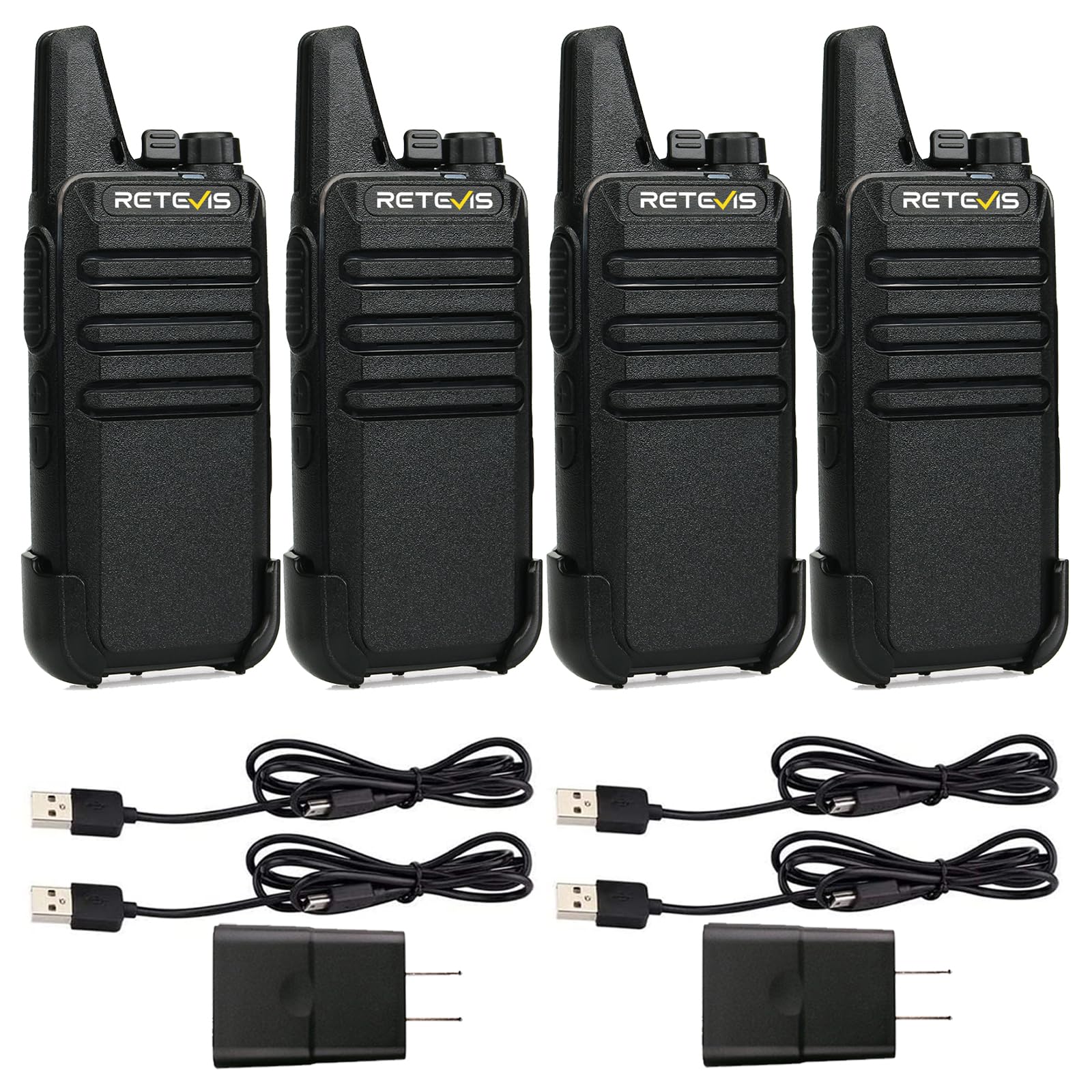
Four radios, four USB-C cables, and two dual-port chargers make the RT22 the value play in this guide. What you get for it is a deliberately plain FRS handheld: a channel knob, a volume wheel, a push-to-talk button, and nothing else on the face to press by accident. That is not a stripped-down compromise so much as a decision about who is holding it, whether that is a kid, a server, or a volunteer who needs to talk rather than to program.

IP65 and a rated 12 hours of runtime cover a hiking day or a restaurant shift, and the USB-C port on each body means one charger in the car handles the whole set. We are fonder of the blunt, stubby antenna than we expected: it does not snag on a life jacket or poke a child in the face, and it is a big part of why this is the set we hand to families. The separate belt clip comes off without undoing the whole rig, and the 300 mW speaker is clear at conversational distance.

Reach is the compromise. Across open water it does roughly what the listing says; put trees, walls, or a couple of floors in the way and you are working in hundreds of yards rather than miles. For a campground, a marina, or a shop floor, that is the right amount of radio. For staying in touch across a big lake, it is not, and the RB48 or the Midland is the honest answer.

Pros

  • Four radios plus two dual-port USB-C chargers
  • Channel and volume only, so nothing gets misprogrammed
  • IP65 shell and up to 12 hours per charge

Cons

  • May not hear other brands until privacy codes match
Our verdict

The set we hand out when four people need to stay in touch cheaply: simple enough for kids, tough enough for a kitchen, charged by the same cable as your phone.

Check Latest Price
4

Best for Work Crews

SAMCOM FPCN30A (6-Pack)

88 /100
Angler Score Excellent

Key details

Channels
20 (UHF)
Group Call
One-key broadcast to all
Range Claim
3-5 miles open ground
Transmit Power
5 W
Check Details on Amazon

One key on the FPCN30A broadcasts to every radio in the crew, whether or not each one is sitting on the same channel. That sounds like a small thing until you are rounding up a landscaping crew, a warehouse shift, or a volunteer team across a campus, and then it is the feature that decides the purchase. Twenty channels are plenty once one button reaches all of them.

The rest is built for the same buyer: five watts of UHF power, two oversized push-to-talk buttons you can find with a glove on, VOX, and a hard shell rated for drops, dust, and rain. We were struck by how even this set is, sitting near the top of this group on range, battery, sound, and durability at once, where most radios here are strong on two of those and shaky on the third. The 1,500 mAh pack charges in a base and is rated to cover a full shift.

It is a specialist, though. The shell resists weather but will not survive a dunking, you will want to confirm the frequency licensing for your site before deploying six of them, and this is the biggest single outlay in the guide. What you are buying is all-call, a six-pack, and a radio that keeps working after a season of job-site handling.

Pros

  • One-key group call reaches every radio on site
  • Two oversized PTT buttons work with gloves
  • Even strength on range, battery, sound, and durability

Cons

  • Talks only to other SAMCOM FPCN30A radios
Our verdict

For a crew that keeps splitting up, this is the six-pack we point to: one button reaches every radio, and the shell survives daily drops.

Check Latest Price
5

Boat and Kayak

Motorola T605 H2O

80 /100
Angler Score Excellent

Key details

Extras
Water-activated flashlight
Battery
9 hrs, USB-C
Channels
22 (FRS, license-free)
Water Rating
IP67, floats face up
Check Details on Amazon

Every waterproof radio claims to survive a dunk; the T605 H2O is designed around the part where you have to find it again. It floats face up, so it stays visible on the surface instead of vanishing, and the flashlight switches itself on when the radio hits the water. For kayak fishing, a canoe, or a small boat in chop, that pairing is worth more than another channel.

The rest is a competent license-free FRS pair: 22 channels, IP67, USB-C charging on each radio rather than a proprietary cradle, a two-year warranty, and audio that comes through clearly. Sound is the strongest part of this set's showing. The controls are simple enough to work one-handed with cold hands, and there is no menu to get lost in while you are bailing.

Runtime is the tax. Motorola rates the pack at nine hours, and a long day on the water tends to run past that, so the honest way to own this pair is a power bank in the dry bag and a top-up at lunch. What you are paying for is the flotation and the water-activated light, and those earn their keep the first time a radio goes over the side.

Pros

  • Floats face up with a water-activated flashlight
  • IP67 and license-free FRS on 22 channels
  • USB-C charging on each radio body

Cons

  • Line-of-sight range, well short of the 35-mile claim
  • Premium price for a two-radio set
Our verdict

This is the pair we hand over when a radio might go in the water: it floats face up and lights up, and we accept a shorter day per charge for that.

Check Latest Price
6

Kids and Campsites

MOICO T5

88 /100
Angler Score Excellent

Key details

Extras
Backlit LCD, LED flashlight
Battery
4 AAA (not included)
Channels
22 FRS, 99 privacy codes
Water Rating
IP65
Check Details on Amazon

The T5 is the radio that ends up in a kid's hand, and it is designed for that: a backlit LCD that is readable in a tent, a flashlight on the bottom, 22 FRS channels with 99 privacy codes, and controls simple enough that the manual mostly stays in the box. It is also the only set here with a screen, which matters more than you might think when you are squinting at a channel number in the dark.

For short-range work it does what a first radio needs to do. It is light enough to clip to a belt loop, loud enough to hear across a campsite, and clear at conversational distance. We found the VOX setting genuinely useful with its three sensitivity levels, since it goes hands-free while you are holding a rod or a paddle, and the keypad lock stops a pocket from changing channels on you. IP65 covers a splash and a dusty tailgate.

Reach is the trade-off, and the listing is honest about it: roughly half a mile to a mile once buildings are in the way, which is a backyard and campground figure rather than a lake-crossing one. For a kid working the dock and the tent, that is plenty, and the pair costs less than any other set here. For anything that has to work at distance, spend more and buy the RB48.

Pros

  • Controls simple enough for children to use
  • Backlit LCD and a built-in LED flashlight
  • Lowest-cost pair in this guide

Cons

  • AAA cells drain quickly with regular use
Our verdict

Cheap, clear at short range, and simple enough for a child to run, this is the pair we buy for a dock, a campsite, or a first radio.

Check Latest Price

How We Tested the Best Two-Way Radios

We started with spec sheets for roughly 30 models, then cut anything that couldn't be charged from a car or a power bank and any bundle where the price per radio only made sense if you needed six of them. That left 12 radios, which we ran for seven months.

Range testing happened in three places: a line of sight across a lake, a wooded ridge trail, and a three-story concrete parking garage. We walked apart until the audio broke up and counted how many times we had to say 'say again' to hold a conversation. Battery life we tracked the way people actually use radios — a Saturday at a job site, a four-day camping trip — logging talk time before the low-battery chirp and whether we could top up from a car or had to hunt for an outlet.

Durability took the worst of it: we dropped each radio onto pavement from waist height, left them out in the rain, and threw them in a backpack with car keys. Sound we judged on recorded clips at six inches and at arm's length, listening for hiss and whether voices stayed clear in wind. Ease of use meant handing two radios to a 9-year-old and to a friend who'd never used one and timing how long they took to find the same channel; we also pressed every button one-handed in winter gloves.

Portability came down to whether the belt clip held while running, and value we calculated per radio once headsets, docks, and replaceable batteries were accounted for — a cheap set with a soldered-in battery isn't a bargain. Everything still works, and we'll keep using them.

How to Choose a Two-Way Radio for the Outdoors

Check the license before the channel count

FRS radios are license-free and ready out of the box, which covers the Retevis RT22 and RB48, the Motorola T605, and the MOICO T5. GMRS, the band the Midland GXT1000VP4 uses, shares the same 462-467 MHz neighborhood but needs an FCC license before you transmit. Business-band UHF sets like the SAMCOM sit on different frequencies again, with their own licensing to confirm. If paperwork is the thing that would keep a radio in a drawer, buy FRS and be done with it.

Read every range figure as line of sight

The 36-mile and 35-mile claims on the Midland and Motorola boxes assume two people on open ground with nothing between them. Water and open fields come close to that; woods, hills, and a couple of buildings cut it to a fraction. Plan a group's spacing around a working mile or two, and treat the printed number as a best case rather than a promise. If you need to stay in touch across a lake, buy for water resistance and battery, not for the distance on the packaging.

Water ratings are not interchangeable

IP67 means dust-tight and able to survive a dunking; IP65 means jets of water but not immersion; JIS4 is splash resistance at best. Flotation is a separate feature again, and only the Retevis RB48 and the Motorola T605 claim it. For fishing from a boat or a kayak, put IP67 and flotation ahead of channel count, and clip the radio where you can reach it without standing up. For a set that lives in a jacket pocket on hikes, IP65 is plenty.

Battery: runtime, spare cells, and how you charge

Sealed packs are convenient right up until they are empty. The RB48 is rated for up to 18 hours and charges by dock or USB-C; the GXT1000VP4 is rated at 10 and can fall back to AA cells; the T605 is rated at 9, so a power bank belongs in the dry bag. AAA radios like the MOICO are the other path: cheap to feed, hungry. An on-body USB-C port is the single most useful charging feature, because one cable in the truck then covers every radio in the group.

Pack size, gloves, and who has to use it

Buy the number of radios your group actually is, then look at the controls. One-key all-call on the SAMCOM is worth real money to a crew that keeps splitting across channels; a channel knob and a volume wheel on the RT22 are worth more to a family with kids in the mix. If the radios come out in cold or wet weather, size the push-to-talk for a gloved thumb. And if your group mixes brands, expect to match privacy codes before everyone can hear everyone.

Frequently Asked Questions

Final Verdict

After a season of handing these around, the Retevis RB48 is the pair we recommend without a caveat: license-free, IP67, floating, rated for up to 18 hours, and covered for five years. It costs more than the four-packs, and it is the one we reach for when the weather turns.

If four people need radios and the budget is tight, the RT22 does the same job with less reach. For a crew that keeps splitting up, the SAMCOM six-pack's all-call button earns its price. Buy the Midland only if you will register for GMRS and want the channel count that comes with it.