Best Overall

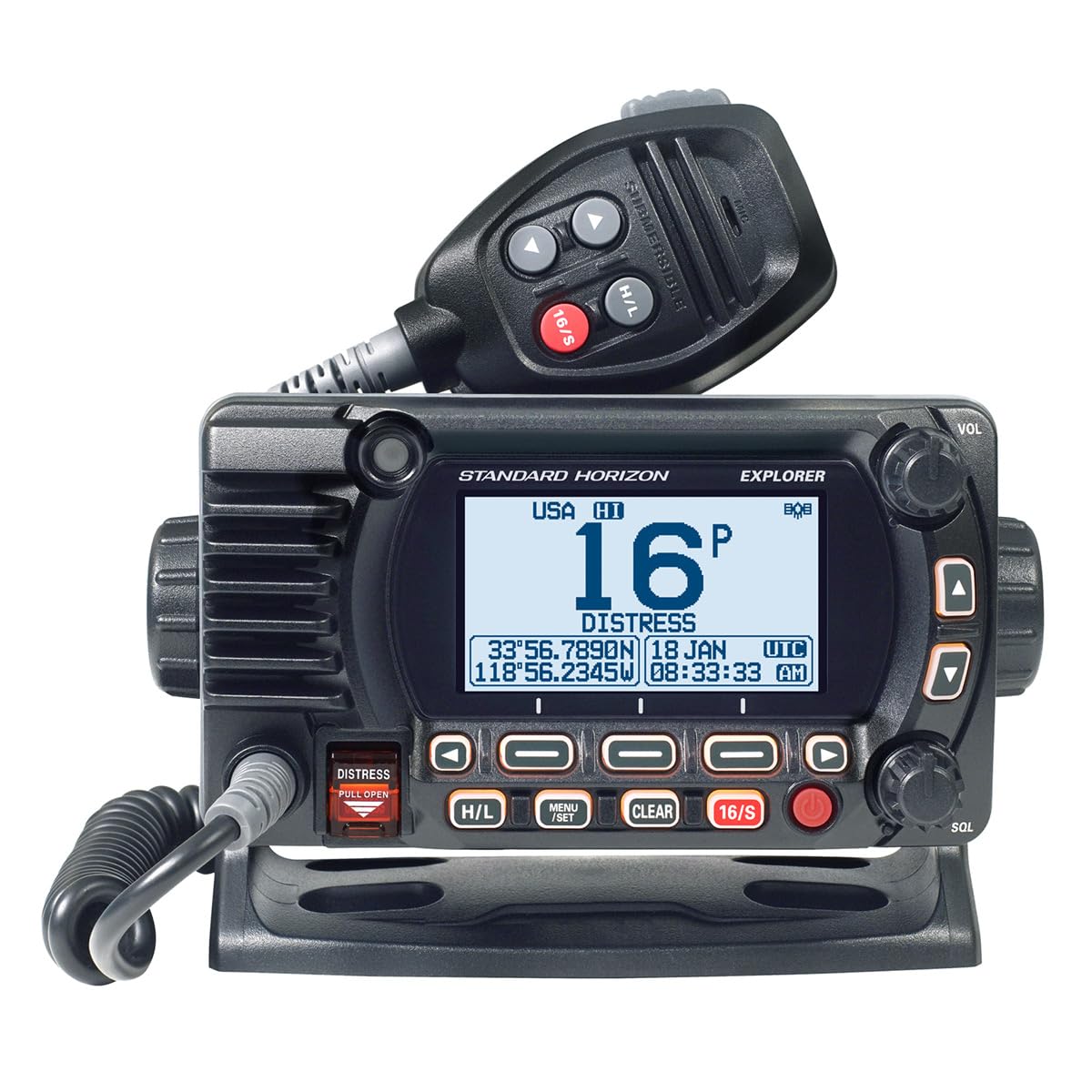
Standard Horizon GX1400
Key details
- Display
- 31 x 55 mm dot matrix
- Controls
- All on the microphone
- Position Input
- NMEA in and out
- Waterproof Rating
- IPX8
Standard Horizon put the whole radio on the microphone. Channel changes, volume, the 16/9 key and the soft keys you program for yourself all sit in your hand, so you can run the set without turning away from the water or reaching under the dash.
That's a large part of why we make it the default pick here. The rest is the specification doing exactly what a helm radio should: IPX8 submersible to 1.5 meters for 30 minutes, Class D DSC with its own Channel 70 receiver so a distress call still gets through while you're talking on 16, and an oversized 31 by 55 mm dot-matrix display that holds up in daylight.
Position is the one thing it doesn't bring with it. There's no GPS inside, so run the NMEA connections to your chartplotter and the distress button transmits coordinates; leave that wiring out and the alert still goes, just without telling anyone where you are. The preset key recalls ten channels, and NOAA weather alert covers the afternoons that turn sour.
The box arrives complete — bracket, knobs, microphone hanger, mounting hardware and power cord — which sounds like a small thing until you're mid-install on a Saturday missing the right bracket. The menu is deeper than daily use requires, but almost nothing you touch at the helm lives there anyway.
Pros
- Every control you use at the helm sits on the mic
- IPX8 rated to 1.5 m for 30 minutes
- Class D DSC with a dedicated Channel 70 receiver
- Oversized 31 x 55 mm dot-matrix display
Cons
- No built-in GPS; DSC position needs a plotter feed
We tell most boat owners to start here: a submersible, mic-controlled 25-watt radio that does DSC properly once you run two wires from your plotter.