
Best Walleye Jigs of 2026

A walleye jig has to do two jobs that fight each other: stay in contact with the bottom in wind and current, and stay light enough that you can feel a soft pickup before the fish drops it. Go heavier and you get bottom feel but a bait that plows; go lighter and you're guessing. A good jig fixes that guessing — weight, hook, and collar working together so the only thing left to think about is the bite.

I've fished jigs that looked great in the package and went blunt after a dozen snags, and bucktail jigs that shed hair by the second trip. Over the past five months, my team and I have fished 16 jig styles — bucktails, swimbait heads, jigging baits, floating heads — on rivers and reservoirs, and the gaps in sharpness, sturdiness, and value showed up fast. One thing new buyers rarely hear: hook gap matters as much as the point, because a wide gap behind a bulky plastic is what actually drives that point home. Below are the ones we kept tying back on.

1

Best Overall

Dr.Fish Bucktail Jig (3-Pack)

91 /100
Angler Score Outstanding

Key details

Hook
High-carbon steel J hook
Colors
White, chartreuse, red and white
Weight
1/2 oz
Pack Size
3 jigs
Check Details on Amazon

Cold water is where a hair jig earns its keep. The bucktail on this Dr.Fish head breathes and pulses on the drop, so a walleye that won't chase a hard bait still gets a look at something with life in it, and you can slow the presentation to a crawl without the jig going flat. At 1/2 oz it's also heavy enough to stay in touch with the bottom in a moderate river push, which is where a lot of walleye fishing actually happens.

That combination is why the three-pack is our top pick. White, chartreuse, and red-and-white cover stained water, clear water, and low light between them, each head comes tied with a scaled body and 3D eyes, and the hook is sharp enough to fish straight out of the bag. We fished it vertically and on a slow cast-and-drag, and it did what a hair jig should — fell slowly, stayed visible, and kept us in contact with the bottom.

The hook is high-carbon steel with a spear point, and it held up to repeated hooksets. What it doesn't like is being put away wet. The heads rust if they sit damp in a box, so wipe them down and let them air dry before the lid goes back on. A minute of housekeeping is the difference between one season and several.

Two things to know before ordering. This pack is 1/2 oz only, so shallow, calm water calls for a lighter head from elsewhere on this list. And the hair runs sparse on some heads — comb it straight and it still fishes, but don't expect a fat, dense tie. Neither changes the call: three sharp, walleye-ready jigs you can fish three different ways is exactly what a default should be.

Pros

  • Hair slows the fall in cold water
  • Three colors cover most walleye water
  • Hook is sharp out of the package
  • 1/2 oz holds bottom in river current

Cons

  • Only three jigs per pack, one weight
  • Hair runs sparse on some heads
Our verdict

Our top pick for walleye: a 1/2 oz hair jig with a sharp hook and three colors that cover stained water, clear water, and low light.
Check Latest Price
2

Best Vertical Jigging Lure

Rapala Jigging Rap 09

91 /100
Angler Score Outstanding

Key details

Hook
Single reversed hooks
Color
Perch
Weighting
Balanced zinc
Body Length
3-1/2 in
Check Details on Amazon

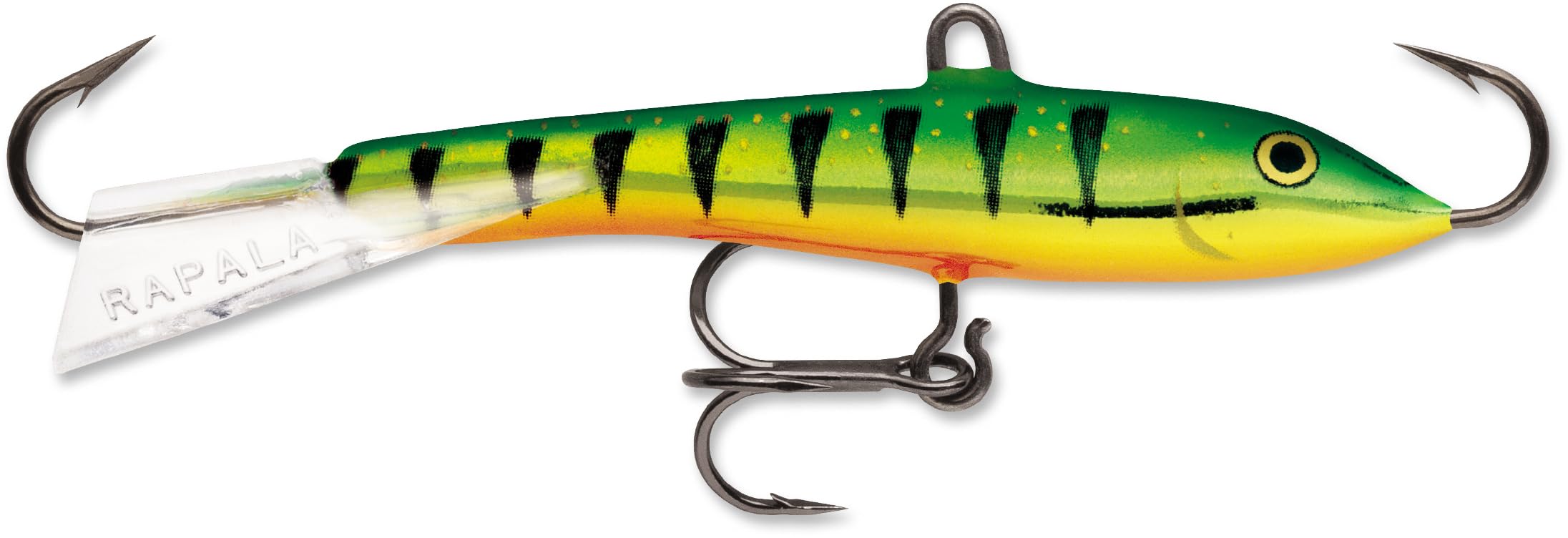
Every other pick on this list is a head and a hook that you dress yourself. The Jigging Rap is the finished article: a 3-1/2-inch minnow profile with a balanced, zinc-weighted body and a single reversed hook hanging off the tail.

The balance is the whole point. The lure is built to fall and swing on a slack line instead of dropping straight down, so a lift-and-drop cadence over a deep flat covers water a plain jig head can't work as efficiently. The single hook suits walleye too — it comes out of a mouth quickly and snags far less in rock than a treble.

Perch is the color to start with, a natural forage match that still shows up in stained water, and the glow finishes are worth carrying for low light and through the ice. At 3-1/2 inches it's a big enough mouthful for a walleye and still small enough that perch and jumbo crappie will take it, which is a nice bonus on a slow day.

If your walleye fishing is vertical — through the ice, off the edge of a hump, straight down over a school — this is the lure we tie on first, and it's the one pick here that needs no plastic, no trailer, and no thought. Treat it as a specific tool rather than a box filler and it earns its space.

Pros

  • Balanced body glides on the drop
  • Single reversed hooks release fish cleanly
  • No trailer or rigging needed

Cons

  • One lure per pack, no spare
Our verdict

Buy this one if your walleye fishing is straight down — through the ice or over deep structure — where a balanced, single-hook lure beats any jig head.

Check Latest Price
3

Best Swimbait Jig Heads

OJYDOIIIY Swimbait Jig Heads (15-Pack)

89 /100
Angler Score Excellent

Key details

Hooks
3/0 and 4/0
Extras
Belly ring for stinger hook
Weights
3/16, 1/4, 3/8, 1/2 oz
Pack Size
15 heads
Check Details on Amazon

Look under the chin of these heads and you'll find the detail that put them on this list: a small belly ring for a stinger hook. Walleye are notorious for nipping the tail of a swimbait without touching the hook, and a short treble clipped to that ring turns those taps into fish in the net.

The rest of the package is built for rigging. A stacked cone keeper runs down the shank and holds a paddle tail where you put it, the minnow-shaped head and 3D eyes give the bait a nose, and the weights run 3/16, 1/4, 3/8, and 1/2 oz on 3/0 and 4/0 hooks — enough range to fish a shallow flat in the morning and a deep ledge after lunch.

This is the pack we reach for when we're rigging 3.5- to 4-inch swimbaits and want them to track straight. The keeper does the work, so you aren't sliding plastics back up the shank after every cast, and the eyelets come clean with a burr-free finish out of the box. Fifteen heads across four weights is a sensible way to buy jig heads, and nothing about the pack feels like a compromise.

Pros

  • Belly ring takes a stinger hook
  • Stacked cone keeper holds plastics
  • Four walleye weights in one pack

Cons

No notable drawbacks to flag.

Our verdict

Our go-to swimbait pack for walleye, because the belly ring lets you hang a stinger hook for fish that nip the tail and never touch the point.

Check Latest Price
4

Best Hook Quality

Berkley Fusion19 Swimbait Jighead

91 /100
Angler Score Outstanding

Key details

Hook
Forged, 40-degree bend
Size
3/4 oz, 5/0 hook
Color
Chartreuse
Pack Size
3 heads
Check Details on Amazon

The hook is what you're paying for. Berkley forges these Fusion19 heads with a needle point and a 40-degree bend that puts the pull point where it belongs, and the wire is heavy enough that a good walleye doesn't straighten it on the set.

On big water with big baits, this is the head we hand someone. The current variant is 3/4 oz on a 5/0 hook — a deep-river, heavy-current, five-inch-paddletail combination, and not the head for a calm eight-foot flat. The conical keeper and its wire locks hold a plastic seated through repeated casts, which is the part that decides whether you're fishing or re-rigging.

Three per pack means you're buying a specialist, not filling a box. Pair it with a lighter head for the shallow half of the day and keep these for the deep structure where you need the bait down and in contact. That's a narrow job, and it does the narrow job well.

Pros

  • Forged hook holds under load
  • Wire-lock keeper holds plastics
  • 3/4 oz reaches deep current

Cons

  • One weight and hook size only
  • Three heads per pack
Our verdict

A specialist head for big baits in deep current — the forged hook is the strongest here, and 3/4 oz is more weight than most walleye water needs.

Check Latest Price
5

Best for Finesse Swimbaits

LUCKYFISHING Swimbait Jig Head (15-Pack)

88 /100
Angler Score Excellent

Key details

Hook
3X high-carbon steel
Size
1/8 oz, 1/0 hook
Pack Size
15 heads
Bait Keeper
Double collar
Check Details on Amazon

Clear water and pressured fish are where this head makes sense. At 1/8 oz on a 1/0 hook it's the lightest jig here, and that's the point — a small swimbait on a light head sinks slowly and swims with a wobble instead of dragging along the bottom.

The hook is 3X high-carbon steel with an unusual bend, and it's the stoutest light-wire hook in this group; it holds its shape on a good fish. A double collar sits behind the head and grips a 2.8- to 3.5-inch swimbait, and the 3D eyes and sculpted gills give the bait a face. Fifteen heads to a pack means losing a couple to snags doesn't end the trip.

The catch is that the listing sells one weight and one color at a time — here, the natural 1/8 oz pack — so it's a finesse tool rather than a one-box answer. Fish it on light line over shallow rock and weed edges, and switch to something heavier when the wind comes up.

Pros

  • Light 1/8 oz falls slowly
  • Stout 3X hook resists bending
  • Double collar grips small swimbaits

Cons

  • One weight and color per pack
Our verdict

The finesse answer for clear, pressured water: a 1/8 oz head with a stout hook that lets a small swimbait swim instead of drag.

Check Latest Price
6

Best Floating Jig for Live Bait

Northland High Ball Floater (12-Pack)

89 /100
Angler Score Excellent

Key details

Head
Floating
Size
#1 hook
Colors
Assorted neon
Pack Size
12 heads
Check Details on Amazon

A floating jig head is a different idea, and one a lot of walleye anglers never try. The head is buoyant enough to lift a minnow, a crawler, or a leech off the bottom, so the bait rides just above moss and weed instead of burying in it.

It fishes on a slip rig: a sinker above a leader, the floater on the end, the head doing the floating while the weight keeps you in contact. Go heavier on the weight in deep water or a crosswind — the head isn't holding depth, it's holding the bait up. The #1 hook suits a 3- to 4-inch minnow, and the assorted neon colors are easy to find in a crowded box.

Where the bottom is soft and weedy, this keeps a bait in the strike zone when a jig head would be buried and invisible. It's a technique pick rather than a first-choice jig, but a dozen floaters in the box opens up water the rest of this list can't fish.

Pros

  • Keeps bait above moss and weed
  • Twelve heads with neon colors
  • Works with live bait or plastics

Cons

  • Needs a separate slip weight for depth
Our verdict

The pick for weedy, mossy bottom: a floating head that keeps a minnow or crawler up where walleye can see it, fished on a slip rig.

Check Latest Price
7

Finesse in Cover

Fish Eye Swimbait Jig Heads (12-Pack)

87 /100
Angler Score Excellent

Key details

Hook
High-carbon steel
Design
Separated weight and hook
Weights
1/8, 3/16, 1/4, 3/8 oz
Pack Size
12 heads
Check Details on Amazon

Snaggy cover is where this head earns its place. The weight sits on the belly with the hook riding free behind it, so a plastic works with more freedom than it does on a fixed jig head and the point stays tucked away from wood and weed.

The assortment covers a useful range — 1/8, 3/16, 1/4, and 3/8 oz, three of each in the pack — and the heads rig a Texas-style or Ned-style plastic without extra hardware. Hooks are sharp out of the pack, and the small sizes are genuinely small, so buy these for 3- to 4-inch baits rather than big paddletails.

Durability is the part to watch. Hooks can break off at the head under a hard load, and the stick-on eyes can peel after a few trips. Check the hook after every fish and retire any head that's been bent, and a pack of twelve is still a reasonable way to fish cover you'd otherwise avoid.

Pros

  • Separated weight frees the plastic
  • Covers 1/8 to 3/8 oz
  • Rigs Texas or Ned style

Cons

  • Hooks can break off at the head
Our verdict

A snag-resistant finesse head for weedy walleye cover, as long as you check the hook after every fish and accept the eyes may peel.

Check Latest Price

How We Tested Walleye Jigs

We started with a long list of jigs walleye anglers actually talk about, pulled the listed weights, hook sizes, and pack counts, and cut anything that came in only one size or cost more per jig than we'd be willing to snap off on a snag. That left 16 styles, from bare bucktails to swimbait heads to vertical jigging baits, in weights from 1/8 to 1/2 ounce.

Testing ran five months, almost all of it on the water. We vertical jigged in 20 to 35 feet on calm mornings, drifted wind-blown shoreline breaks where holding bottom is the whole game, and cast bucktails into current below a dam. Each jig got fished until we lost it or had a reason to retire it.

Sharpness got checked the low-tech way: dragged across a thumbnail, then stuck into cork before and after a day of bouncing off rock and wood. We counted trips until paint chipped, bucktail hair pulled loose of the collar, and soft-plastic keepers tore. Every jig went on a kitchen scale to see how close the labeled weight ran, since a quarter-ounce that fishes heavy behaves differently in current. We also fished the same weights shallow and deep to learn which ones held bottom without killing the feel of a light bite. The jigs that came through all of that with a still-sharp point and their hair intact are the ones below.

How to Choose Walleye Jigs

Weight Comes Before Color

A jig only works if you can feel what it's doing down there. A 1/8 to 3/16 oz head suits shallow flats, calm days, and clear water; 1/4 to 3/8 oz is the everyday range on most lakes and moderate rivers; 1/2 oz and up is for deep structure, heavy current, and wind.

The trap is buying heavy because it casts easier. An overweight head drops like a stone, drags on the retrieve, and takes away the slow fall walleye respond to. The smallest ball heads on the shelf are panfish sizes, so walleye work starts around 1/8 oz and builds from there.

Hooks and Bait Keepers

A jig is a hook delivery system, so the wire matters more than the paint. Forged hooks hold their shape under load; thin wire straightens on a good fish or on a snag you're trying to free. Run the point across a thumbnail — if it slides instead of catching, touch it up before you fish.

Then look at how the head holds a plastic. A stacked cone keeper or a wire-lock collar keeps a swimbait seated through repeated casts, while a plain barbed shank has you sliding the bait back up after every strike. If you fish plastics often, the keeper is worth paying for.

Match the Head to the Presentation

Head shape decides how a jig falls and how it travels through cover. A round ball head is the all-purpose choice for live bait and grubs, a minnow-shaped swimbait head tracks straighter on a steady retrieve, a hair jig slows the fall and adds pulse in cold water, and a weighted swimbait hook slips through weeds with the point tucked away.

Vertical jigging lures are their own category — balanced, hook-hung, and fished on the drop. Most walleye anglers end up carrying two or three of these, because the water changes the answer. One style forced to do everything is the most common mistake we see.

Stinger Hooks and Jig Care

Short strikes are a walleye specialty, and a head with a belly ring lets you hang a stinger treble behind the bait to convert the fish that nip the tail. With no ring, a stinger can go on the hook shank, but the ring is cleaner and faster to change.

Care matters as much as rigging. Wipe jigs dry before they go back in the box, since wet storage is what rusts hooks and lifts paint, and retire any hook that's been bent straight — it will bend again.

Frequently Asked Questions

Final Verdict

The Dr.Fish bucktail is the jig we tie on first: three colors covering stained, clear, and low light, a hook that's sharp out of the bag, and a 1/2 oz head that fishes vertically or on the cast. Wipe it dry before it goes back in the box and it lasts.

Fish straight down through the ice and the Rapala Jigging Rap is the better tool. Rigging swimbaits over a river ledge, the fifteen-head OJYDOIIIY pack with the belly ring is the one to grab.