Best Waterproof First Aid Kits of 2026

A waterproof first aid kit that keeps water out usually keeps you out, too. I've crouched on a wet dock working a stubborn zipper with numb fingers while a fishing hook stayed exactly where it shouldn't, and I've opened a supposedly sealed kit after a season in a boat hatch to find the gauze pads soft and the tape gone brown. The right kit fixes both halves of that problem: it holds the water off and still opens in one motion when your hands are wet and someone's bleeding.

Over the past six months my team and I have put 14 kits through car trunks, kayak hatches, tackle boxes, and one memorably rainy camping weekend. What separated them had less to do with piece counts than with whether the closure actually sealed, whether the contents were still usable after all that sealing, whether the case fit a glovebox or a pack lid, and whether the price bought supplies we'd genuinely reach for instead of a pile of bandages in sizes nobody uses. The ones still riding in my car and my dry bag are the ones worth your money, and a couple of them cost less than lunch for two.

1

Best Overall

Surviveware Waterproof First Aid Kit

94 /100
Angler Score Outstanding

Key details

Weight
2.25 lb
Mounting
MOLLE-compatible straps
Dimensions
7.5 x 5.5 x 3.5 in
Water Resistance
IPX7 rated
Check Details on Amazon

Only one kit in this group backs the word waterproof with a rating, and that's why it leads. Surviveware builds the case to an IPX7 standard and closes it with a watertight zip, which is the detail we check first: a shell can shrug off rain and still funnel water in along the closure. If your kit rides in a boat locker, a kayak hatch, or the wet bottom of a pack, the gap between a rated seal and a marketing adjective is the whole purchase.

Inside, the compartments are labeled, so a hand goes to the gauze without tipping the contents onto a wet deck. We came to value that more than a bigger piece count. The case measures 7.5 by 5.5 by 3.5 inches, carries MOLLE-compatible straps for lashing it to a pack or a rail, and has a small inner pouch for personal additions such as your own antihistamines.

A real seal costs something. The zip takes a firm, two-handed pull and will never open as fast as a nylon pouch, and at 2.25 pounds this is the heaviest kit we're recommending. Neither is a defect so much as the price of the rating, and both are why it lives in a boat bag or a truck box rather than a life vest.

The part we keep coming back to is restocking. The sleeves are sized to be refilled rather than replaced, so when the bandages run out you top up a compartment instead of buying another kit. Add a tourniquet and your own medications, and the case is the part you keep.

Pros

  • IPX7-rated case with a watertight zip
  • Labeled compartments speed up a search
  • MOLLE straps lash it to a pack or rail

Cons

  • Heaviest kit here at 2.25 pounds
Our verdict

The only kit here with a rated watertight seal, and the one we recommend for boats, kayaks, and packs that get soaked — if you can live with the weight.

Check Latest Price
2

Best Small Kit

Vriexsd Mini First Aid Kit 150

96 /100
Angler Score Outstanding

Key details

Case
Waterproof EVA hard shell
Pieces
150
Weight
10.9 oz
Dimensions
6.49 x 4.92 x 2.76 in
Check Details on Amazon

Under three inches deep and 10.86 ounces, this is the kit that vanishes into a center console, a wader pocket, or the side pocket of a fishing pack and stays there until something goes wrong. We keep one in the truck and one in the boat bag, and we've stopped noticing either of them.

What earns it the space is how much fits inside that footprint: 150 pieces, split into labeled sleeves so the antiseptic pads aren't buried under a wad of bandages. Gloves and povidone-iodine prep pads are in there too, which we didn't expect in a case this small. As a first kit — one for the glovebox, one for the tackle box — this is the one we point people toward.

The carabiners turned out to be the detail that earned their keep. Clip the case to the outside of a pack and it stays reachable instead of migrating to the bottom of the bag, and the hard EVA shell doesn't collapse when a cooler lands on it.

Pros

  • 150 pieces in a palm-sized hard case
  • Labeled sleeves keep small items findable
  • Carabiners clip it to a pack or belt

Cons

  • Zip closure means splash protection, not submersion
Our verdict

We recommend this to anyone who wants a small, inexpensive kit that lives in a vehicle or a pack — just don't expect it to survive a dunking.

Check Latest Price
3

Best for the Car

Protect Life Travel First Aid Kit

95 /100
Angler Score Outstanding

Key details

Case
Waterproof hard case
Pieces
100
Weight
9.88 oz
Dimensions
7.5 x 5.2 x 1.5 in
Check Details on Amazon

A thermal emergency blanket is the item small kits tend to leave out, and it's the one you want when a turned ankle makes a short walk back into an hour in the cold. Protect Life puts one in the case, along with a doctor-designed first aid guide, and still keeps the whole thing an inch and a half thick.

At 7.5 by 5.2 by 1.5 inches and 9.88 ounces it slides under a seat or into a glovebox without a fight, and the case is a waterproof hard shell rather than fabric. The contents cover the ordinary stuff — bandages, gauze, antiseptic wipes, gloves, scissors — which is most of what a roadside injury actually needs.

As a car kit, this is our pick. The flat profile means it can live where you'll actually reach it, the blanket buys time in bad weather, and the guide is genuinely useful in a household where nobody has done first aid since a driving test.

Worth knowing before you buy: the guide walks you through common injuries rather than listing supplies, so it rewards a read before the emergency instead of during one. And the blanket is single-use, so check it's still folded in the case when you restock.

Pros

  • Includes a thermal emergency blanket
  • Doctor-designed first aid guide included
  • Flat 1.5-inch case slides under a seat

Cons

  • Packed tight, so the layout takes a minute to learn
Our verdict

The car kit we recommend: a flat, waterproof case with an emergency blanket and a doctor-designed guide, for people who want to be ready without thinking about it.

Check Latest Price
4

Best for Boats and Kayaks

WELL-STRONG Roll Top First Aid Kit

92 /100
Angler Score Outstanding

Key details

Weight
12 oz
Closure
Roll-top dry bag
Dimensions
2.36 x 3.74 x 10.24 in
Construction
Hot-pressed closures
Check Details on Amazon

A roll-top beats a zip in one specific way, and it's the way that matters on a boat: you fold the top over, clip it down, and there are no teeth for water to track along. That closure is why this is our pick for kayaks, skiffs, and jet skis. The bag uses hot-pressed closures rather than a zipper, so the whole thing behaves like a dry bag with a first aid kit inside.

It measures 2.36 by 3.74 by 10.24 inches and weighs 12 ounces — tall and narrow, which means it stands in a rod holder or slots beside a seat instead of wallowing at the bottom of a hatch. The supplies inside are the standard run of bandages, wipes, and tape, with enough slack in the bag to add a few things of your own.

The bag only earns its place where a kit genuinely gets wet; on a dry shelf you're paying for a seal you'll never test. On a boat, it's the difference between a kit you trust and one you open nervously after a wave comes over the bow.

Pros

  • Roll-top seal with no zipper teeth to leak
  • Tall, narrow shape fits a rod holder
  • Room to add a few of your own supplies

Cons

  • Soft bag, so no crush protection
Our verdict

Our boat and kayak pick — a roll-top that seals like a dry bag, for anyone whose kit gets splashed rather than stored in a dry locker.

Check Latest Price
5

Best for Backpacking

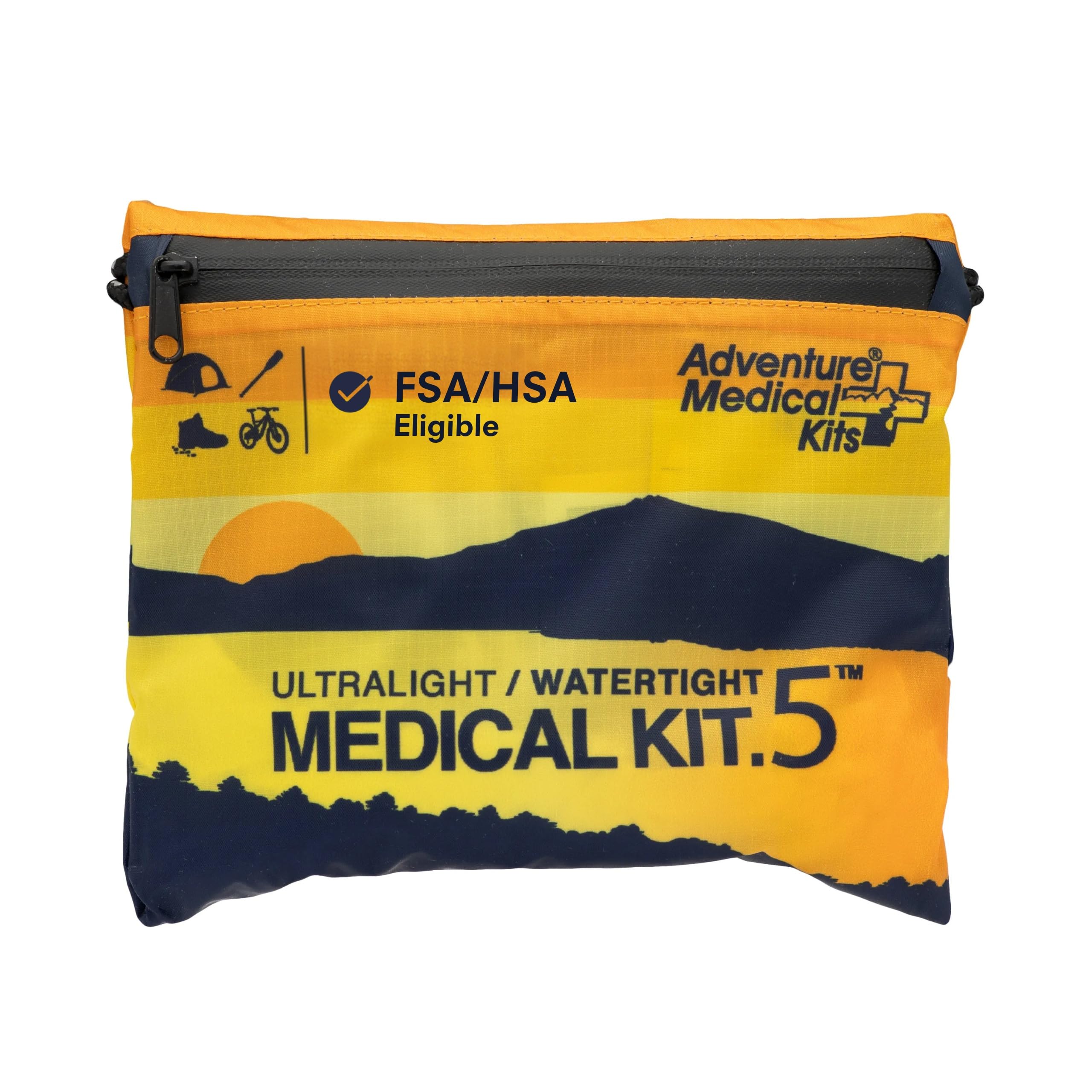
Adventure Medical Kits Ultralight/Watertight .5

93 /100
Angler Score Outstanding

Key details

Weight
3.52 oz
Capacity
2 person
Dimensions
7 x 1 x 5 in
Water Resistance
Waterproof DryFlex inner bag
Check Details on Amazon

Three and a half ounces is the number that decides this one. Adventure Medical Kits builds the .5 for people counting grams, and at 3.52 ounces and an inch thick it disappears into a pack's side pocket or a hydration sleeve.

The water protection is a two-layer arrangement: a waterproof DryFlex inner bag holds the supplies and a water-resistant outer bag protects the inner one. That's a different approach from a hard case, and a better one for a pack, because the whole thing squashes flat when you're carrying less.

For a day hike, or a multi-day trip where the kit has to justify every ounce, this is what we carry. The contents are chosen for what actually happens on a trail — bandages and gauze, antiseptic wipes, antibiotic ointment, sting relief, and die-cut moleskin for blisters — rather than for a big piece count.

You pay a premium here for the sealing and the weight, not for volume. It's also a two-person kit in name only once gear gets split between packs: if two of you are carrying, buy two, because a kit in someone else's bag isn't a kit.

Pros

  • 3.52 ounces, flat enough for a pack pocket
  • Waterproof DryFlex inner bag
  • Moleskin and sting relief for trail problems

Cons

  • Outer bag is water-resistant only; the inner bag does the sealing
Our verdict

We recommend it for backpacking and hiking, where 3.52 ounces and a sealed inner bag matter more than having forty extra bandages.

Check Latest Price
6

Best Large Kit

VRIEXSD Premium 320-Piece First Aid Kit

93 /100
Angler Score Outstanding

Key details

Case
Waterproof EVA hard shell
Pieces
320
Weight
1.26 lb
Dimensions
8.65 x 5.88 x 3.54 in
Check Details on Amazon

This is our small-kit pick with the lid taken off: the same EVA shell, the same labeled sleeves, the same carabiners, scaled up to 8.65 by 5.88 by 3.54 inches and 320 pieces. If the 150-piece version felt like a starter kit, this is the one that stops feeling like one.

We reach for it when the kit has to cover more than one person or more than one day — a boat with a crew, a basecamp, a truck hauling everyone else's gear. At 1.26 pounds it's still light enough to carry in a tote, and the compartments keep the same labeled layout, so finding something doesn't turn into a search.

The water protection is the EVA shell and a water-resistant zip, which handles spray and rain but isn't a submerged seal; for a dunking, our top pick is the case to buy. That's the honest limit of this one — it's a big, well-organized kit for a locker or a shelf, not a waterproof vault.

Pros

  • 320 pieces with the same labeled layout
  • Double zippers and carabiners
  • Light enough to tote at 1.26 pounds

Cons

  • At 8.65 inches, it won't fit a pocket or a small pack
Our verdict

For a family, a boat, or a truck that carries everyone's gear, this is the size we recommend — 320 pieces in a case that stays organized.

Check Latest Price
7

Bike and Car

THRIAID Mini First Aid Kit 100

96 /100
Angler Score Outstanding

Key details

Case
Water-resistant EVA hard shell
Pieces
100
Weight
0.53 lb
Check Details on Amazon

The title calls it water-resistant and the bullet points call it waterproof, which is the kind of muddle worth sorting out before you buy. Read it the cautious way: a hard EVA shell that keeps splashes and rain off the contents, not a sealed case you can drop in the bottom of a boat.

At 0.53 pounds it's the lightest hard case in this group — light enough to hang off a bike frame or a belt without noticing — and the 100 pieces inside include iodine pads and burn gel alongside the bandages. The supplies are described as hospital grade, with international certifications behind them.

The interior is divided into partitions, so the iodine pads stay away from the bandages and you can take in most of the kit at a glance. That's a small thing until you're hunting for a wipe one-handed in the rain.

As a second kit — one for the bike bag, one for the car, one for a day hike — it earns its place, and it weighs less than our small-kit pick while costing about the same. For a boat that gets genuinely wet, put the money into a sealed case instead.

Pros

  • Lightest hard case here at 0.53 pounds
  • Iodine pads and burn gel included
  • Partitions keep contents sorted

Cons

No notable drawbacks to flag.

Our verdict

A light, tidy second kit we're glad to keep in a bike bag or a car — as long as you're not asking it to survive a soaking.

Check Latest Price
8

Pockets and Vests

Thrive Mini First Aid Kit 66

94 /100
Angler Score Outstanding

Key details

Case
Waterproof 600D rip-stop pouch
Pieces
66
Weight
3.99 oz
Check Details on Amazon

This is a pouch rather than a case, and that's the whole idea: 600D rip-stop polyester, 3.99 ounces, thin enough to slide into a vest pocket, a diaper bag, or the front pocket of a day pack. It takes up less room than a folded map.

What's inside is deliberately plain — multi-sized bandages, antiseptic wipes, scissors, safety pins — which covers a scraped knuckle or a hook in a finger and stops well short of anything serious.

Where it earns its keep is packability. Toss it in a life vest, a fanny pack, or a door pocket and forget about it; nothing else here is as easy to leave in the bag you actually carry.

We treat ours as a second kit rather than a primary one. It's the right answer for a hiker, a paddler, or a parent who wants something small in every bag, and the wrong answer for a boat that needs a case which seals.

Pros

  • 3.99 ounces and flat enough for a vest pocket
  • Multi-sized bandages and wipes for small injuries
  • Inexpensive enough to keep one in every bag

Cons

  • Soft pouch, so no crush protection
Our verdict

A 3.99-ounce pouch we keep in a day pack as a second kit — worth it for hikers and paddlers who want something small in every bag.

Check Latest Price

How We Tested Waterproof First Aid Kits in Sinks, Sand, and Actual Emergencies

We started with roughly 60 listings and cut anything that couldn't show a sealed closure, a clear contents list, or a case small enough to store where people really keep a kit. That left 14, which we lived with for six months: in car trunks through a hot summer, in a kayak hatch, in a tackle box, and in daypack lids on weekend hikes.

Every case got the same opening test: a folded paper towel sealed inside, five minutes under a running faucet, then a full dunk in a bucket. We opened each one right away and checked the towel, then repeated the drill with wet hands to see whether the closure fought us. Zippers got 50 open-and-close cycles, another round with wet fingers, and a pinch of sand worked into the teeth to mimic a beach bag. Hard-shell cases were dropped onto concrete from waist height and checked for cracks at the hinge.

Then we emptied each kit and sorted what we'd actually reach for — gauze, tape, gloves, a pair of scissors worth using — against what was padding the piece count, and compared the price against the number of items we'd truly use. We checked adhesive wrappers for softening, looked for rust on metal tools, and noted how much slack was left in the case for restocking. Finally we weighed and packed each one into a glovebox, a pack lid, and a seat-back pocket, then kept using them for the rest of the six months through a kitchen cut, a trail-scraped knee, and a blister on a long hike.

How to Choose a Waterproof First Aid Kit

The Closure Matters More Than the Shell

EVA foam and coated nylon shed rain on their own; the weakness is where the case opens. A plain zip gives water a path along the teeth, which is how a kit labeled waterproof still ends up with damp gauze in a wet locker. A roll-top folds and clips shut like a dry bag, and a rated watertight zip, like the IPX7 case on our top pick, is built and tested to keep water out.

Match the closure to the exposure rather than to the label. Splash protection covers a glovebox, a pack pocket, and a rainy walk back to the truck. A real seal is what you want for a deck, a hatch, or anywhere the kit can actually go under.

Fit the Case to Where It Lives

Where the kit sits decides its shape more than the piece count does. A glovebox or door pocket wants something flat and rigid, which is why our car pick is only 1.5 inches thick. A boat wants a case you can tether or a bag that stands in a rod holder. A pack wants something that squashes flat; the adventure kit we recommend for hiking weighs 3.52 ounces and disappears into a side pocket.

Measure the space before you shop. A 320-piece case more than eight inches long is a locker kit, and it will end up on a shelf instead of in the vehicle if it doesn't fit the compartment you had in mind.

Read the Contents, Not the Count

Piece counts are inflated by small adhesive bandages, so two kits with the same number on the box can be very different in practice. Look for gloves, antiseptic, a burn item, and, for a vehicle kit, a thermal blanket. Then think about what you'll add: a tourniquet, your own antihistamines, a couple of doses of painkiller.

A kit with labeled sleeves and a little slack is easier to top up than one packed to the lid. The ones that leave no room tend to stay half-used, because nobody wants to repack them after a search.

Check the Organization Before You Need It

In an emergency you're usually one-handed, in poor light, and in a hurry. Printed compartments and labeled sleeves matter more than they sound: our top pick's labeled sections and the small Vriexsd case's sleeves both let you go straight to the gauze instead of emptying everything onto a deck.

If a kit's interior is one open cavity, plan to add a few small zip bags and label them yourself. Then repack it the same way every time, because the layout you learn once is the one you'll find at dusk.

Frequently Asked Questions

Final Verdict

The Surviveware kit is the one we recommend for most people searching out a waterproof first aid kit, because it's the only one here where the water protection is a rating instead of an adjective: an IPX7 case with a watertight zip, labeled compartments, and straps that let it ride on a pack or a rail.

If your kit lives somewhere dry and you want something small, the Vriexsd mini is the better buy. If the deck is the wet part of your life, the WELL-STRONG roll-top keeps supplies dry for a fraction of the money.