
Fishing Line Diameter Chart: Compare Exact Series and Published Sizes
Use the diameter printed for your exact fishing-line series; pound test does not provide a universal diameter. This chart keeps twelve selected labels from Seaguar InvizX, Seaguar Smackdown Flash Green, and Sunline Super Natural on the same page. You can filter by material, labeled strength, or a maximum published millimeter diameter.
These are manufacturer specifications, not micrometer measurements or breaking-strength results. They help compare labels and prepare a capacity estimate; they do not establish which line is stronger or better for your fishing.
Fishing line diameter chart by exact series
Find the published diameter you need
| Brand and series | Material | Labeled lb | Published mm | Published inches | Source |
|---|---|---|---|---|---|
| Seaguar InvizX | Fluorocarbon | 8 | 0.235 | .009 | Manufacturer |
| Seaguar InvizX | Fluorocarbon | 10 | 0.260 | .010 | Manufacturer |
| Seaguar InvizX | Fluorocarbon | 12 | 0.285 | .011 | Manufacturer |
| Seaguar InvizX | Fluorocarbon | 20 | 0.405 | .016 | Manufacturer |
| Seaguar Smackdown Flash Green | Braid | 10 | 0.205 | .008 | Manufacturer |
| Seaguar Smackdown Flash Green | Braid | 15 | 0.235 | .009 | Manufacturer |
| Seaguar Smackdown Flash Green | Braid | 20 | 0.260 | .010 | Manufacturer |
| Seaguar Smackdown Flash Green | Braid | 30 | 0.285 | .011 | Manufacturer |
| Sunline Super Natural 330 yd | Nylon mono | 8 | 0.235 | 0.0093 | Manufacturer |
| Sunline Super Natural 330 yd | Nylon mono | 10 | 0.260 | 0.0102 | Manufacturer |
| Sunline Super Natural 330 yd | Nylon mono | 12 | 0.285 | 0.0112 | Manufacturer |
| Sunline Super Natural 330 yd | Nylon mono | 20 | 0.370 | 0.0146 | Manufacturer |
Swipe or scroll sideways to see all columns.
Download the complete diameter chart (CSV). The file includes the sampled Seaguar SKU references, original unit precision, source URL, and check date.
Read the two unit columns correctly
Both diameter columns preserve what the manufacturer published. They are independently rounded labels, so an inch value may not convert exactly to the displayed millimeters. For example, InvizX 10 lb is labeled .010 inch and .260 mm; converting the rounded .010 inch alone gives .254 mm. That small difference is a precision issue, not a second measurement.
For a capacity estimate, use the most appropriate published diameter and keep both input diameters in one unit system. The calculator converts the entered values when you switch units; it does not guess the diameter from strength.
Compare the same strength without assuming the same thickness
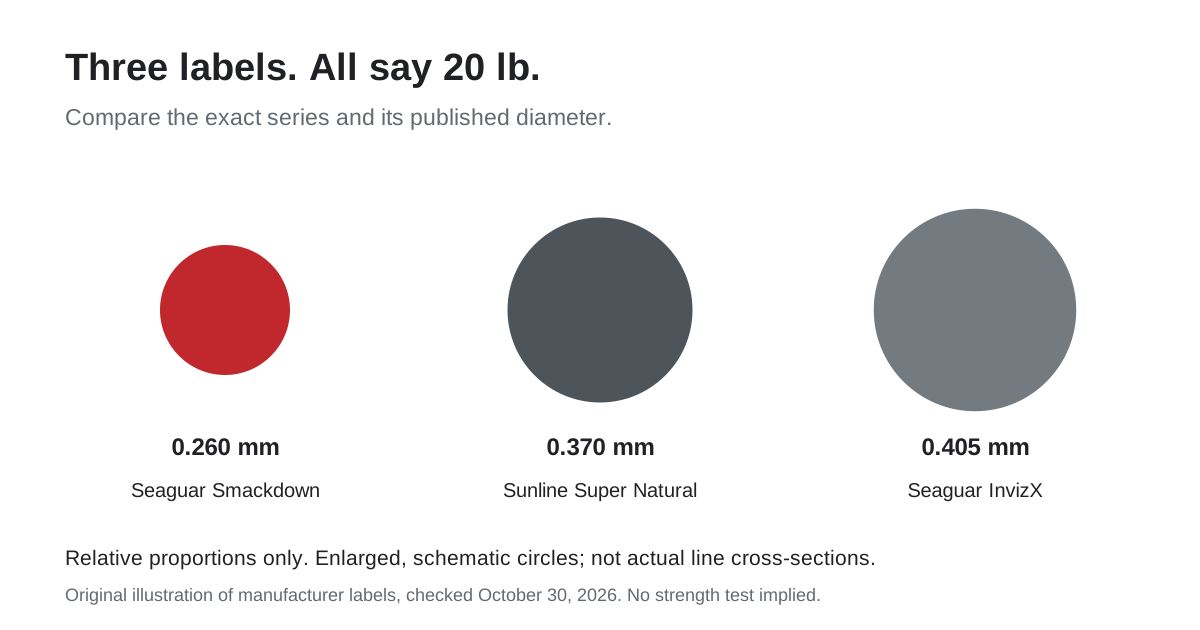
The three sampled 20 lb entries have different published diameters. The useful conclusion is to retain the series name with the number. It is not that all 20 lb braid is one diameter or all 20 lb fluorocarbon is another. A different construction or series requires a new lookup.
Use the chart for a specific decision
- Replacing a line: compare the exact old and new diameters, then check the reel’s own reference capacity.
- Choosing a leader: this chart can compare thickness labels, but it does not test knot security, stiffness, abrasion resistance, or visibility.
- Comparing braid: treat diameter as a published guide. Construction and compression can make a simple circular-volume model less predictive.
- Finding a missing entry: check the package or official specification. Do not interpolate an unlisted pound test or turn a PE number into a guessed millimeter value.
Check the product before using a saved number
Match the series, material, labeled strength, market, and package. The selected Sunline data refer to the Super Natural 330-yard product chart; the Seaguar references identify specific current US variants. A spool’s stated length is not its diameter, and a line’s labeled strength is not a result from an independent comparison here.