Best Binoculars for Kids of 2026

Half the binoculars sold for kids are two plastic tubes with painted-on lenses, and the other half are real glass that a six-year-old will drop on the driveway before lunch. The useful middle ground — something that actually resolves a bird's feathers but survives being carried around by the strap like a purse — is narrow, and it's where this list lives. Get it right and a pair of binoculars turns a walk to the corner into a treasure hunt; get it wrong and you've bought a toy that's rattling around the back seat by August.

I've spent the past four months with 14 pairs, most of them handed to kids between three and nine, and the differences come down to things nobody prints on the box. Magnification is the first: 8x is plenty, and anything stronger turns into a shaky, blurry headache in small hands. The second is eye spacing — barrels that won't squeeze close enough together are useless to a four-year-old no matter how good the glass is. Below are the pairs that held up to both the optics check and the drop test.

1

Best Overall

OBUBY Real Binoculars for Kids

91 /100
Angler Score Outstanding

Key details

Focus
Center focus
Weight
6 oz
Included
Hard case, velvet pouch, lens cloth
Magnification
8 x 21
Check Details on Amazon

This is the pair we hand a child first. The box is the reason as much as the optics: 8x21 binoculars, a hard case, a velvet drawstring pouch, a cleaning cloth and a neck strap, all for midrange money, and nothing else in this guide arrives that complete. The body is 4.7 inches long and 6 ounces, small enough to vanish into a school backpack, and the center focus knob is wide enough that a five-year-old can turn it without a lesson.

Eight times magnification is the point where a child stops pretending. A bird on a feeder becomes a bird with a beak and a black cap, and a plane overhead becomes a plane with markings on the tail. The eyecups are soft rubber, wide enough to rest against a small face without pressing, and the barrels twist in to close the gap between pupils, which is the adjustment that decides whether a child sees one circle or two. Ours took a tumble onto a driveway and came up with a scuff.

The rubberized shell is why that scuff was the worst of it. It is not armored the way the Living Squad pair is, but it has enough give to absorb a drop that would crack bare plastic. Thirteen colorways also turns out to matter more than it sounds: two siblings with identical binoculars is an argument, and one in purple and one in green is not.

Where it is less happy is at the top of its age range. A nine-year-old will notice the plastic, and a child who has started keeping a bird list will get more out of the Think Peak glass. Below that, the only thing we have had to work around is the neck strap, a plain nylon loop — for a child who runs with binoculars on, the breakaway cord on the Kidnoculars is the safer design.

Pros

  • Real 8x21 optics children can focus themselves
  • Hard case, pouch and cloth all included
  • Six ounces, sized for a school backpack
  • Thirteen colorways for sibling pairs

Cons

  • 8x view is hard for a four-year-old to steady
Our verdict

Our default for a first real pair: genuine 8x21 optics in a 6-ounce body, with a case and pouch in the box, for any child past the toddler stage.

Check Latest Price
2

Best for Toddlers

GeoSafari Jr. Kidnoculars

93 /100
Angler Score Outstanding

Key details

Focus
Fixed focus
Weight
7.05 oz
Age Range
3 years and up
Magnification
2 x
Check Details on Amazon

Two times magnification is barely magnification, and we recommend these anyway. What 2x buys is a pair a three-year-old can operate with no help at all: there is no focus wheel to turn, and the eyecups are one wide soft piece that finds a small face without adjustment. A child who has never lined up two lenses still gets a bright circle on the first try.

That trade is the whole point. Every other pair here asks a small child to hold two barrels at the right distance apart and turn a knob until the picture snaps; these delete both steps, and what is left is a chunky green tool that genuinely shows a closer bird. With a four-year-old and a seven-year-old in the same house, the four-year-old gets these and the seven-year-old gets the OBUBY pair, and neither asks to swap.

The breakaway neck cord is the safety feature that matters at this age, and it is also the part that annoys us: the cord works loose from its knot and needs re-tying, which is a two-minute fix rather than a return. Know the rest of the trade too — the view is dim at the edges, and 2x will not satisfy a child who has already looked through real glass. As a first pair it is the one that gets carried rather than abandoned.

Pros

  • Fixed focus needs no adjustment at all
  • Wide soft eyecups suit a small face
  • Breakaway neck strap for safety
  • Cheap enough to replace without wincing

Cons

  • Cord works loose and needs re-tying
  • 2x view is dim at the edges
Our verdict

The pair a preschooler can use alone: fixed 2x focus, wide soft eyecups and a breakaway cord, with none of the adjustments that stump small hands.

Check Latest Price
3

Best Optics Upgrade

Think Peak Kids Binoculars

93 /100
Angler Score Outstanding

Key details

Focus
Center focus
Weight
8 oz
Magnification
8 x 21
Water Resistance
Waterproof
Check Details on Amazon

Same 8x21 formula as our top pick, a real step up in price, and we can point to where the money goes: into sealing and armor. This one is 8 ounces and 4.4 inches long, waterproof, and built on a shock-resistant body, with 1.5-inch eyepieces and a focus knob wrapped in textured rubber that a wet hand can still turn. For a kid who takes binoculars out in weather, that is the upgrade that counts.

The glass is the other reason it is here. BAK4 prisms and a coated 21mm objective give a sharper, brighter view than most of this group, and we have borrowed them for a ballgame more than once instead of handing them over. The barrels swivel easily enough that a child can set the eye width alone, and the diopter is simple enough to adjust without instructions.

Two things to know. At 8 ounces it is the heaviest of the 8x21 pairs here, and a small child will feel it on a neck strap after twenty minutes. And the 10.5mm eye relief is short, so a glasses-wearing kid gets a tighter view than through the others. Neither matters to a seven-year-old with a bird list. Both matter if these are the first binoculars a child has owned.

Pros

  • BAK4 prisms give the clearest view here
  • Waterproof and shock-resistant body
  • 1.5-inch eyepieces and a grippy focus knob
  • Diopter adjusts without tools

Cons

  • Heaviest of the 8x21 pairs here
  • Short 10.5mm eye relief for glasses wearers
Our verdict

The upgrade for a child who is already outdoors in all weather: waterproof, armored 8x21s with the sharpest glass in this group.

Check Latest Price
4

Best All-In Kit

Living Squad Kids Binoculars

92 /100
Angler Score Outstanding

Key details

Weight
7.52 oz
Eye Relief
21 millimeters
Field Of View
7.1 degrees
Magnification
8 x 21
Check Details on Amazon

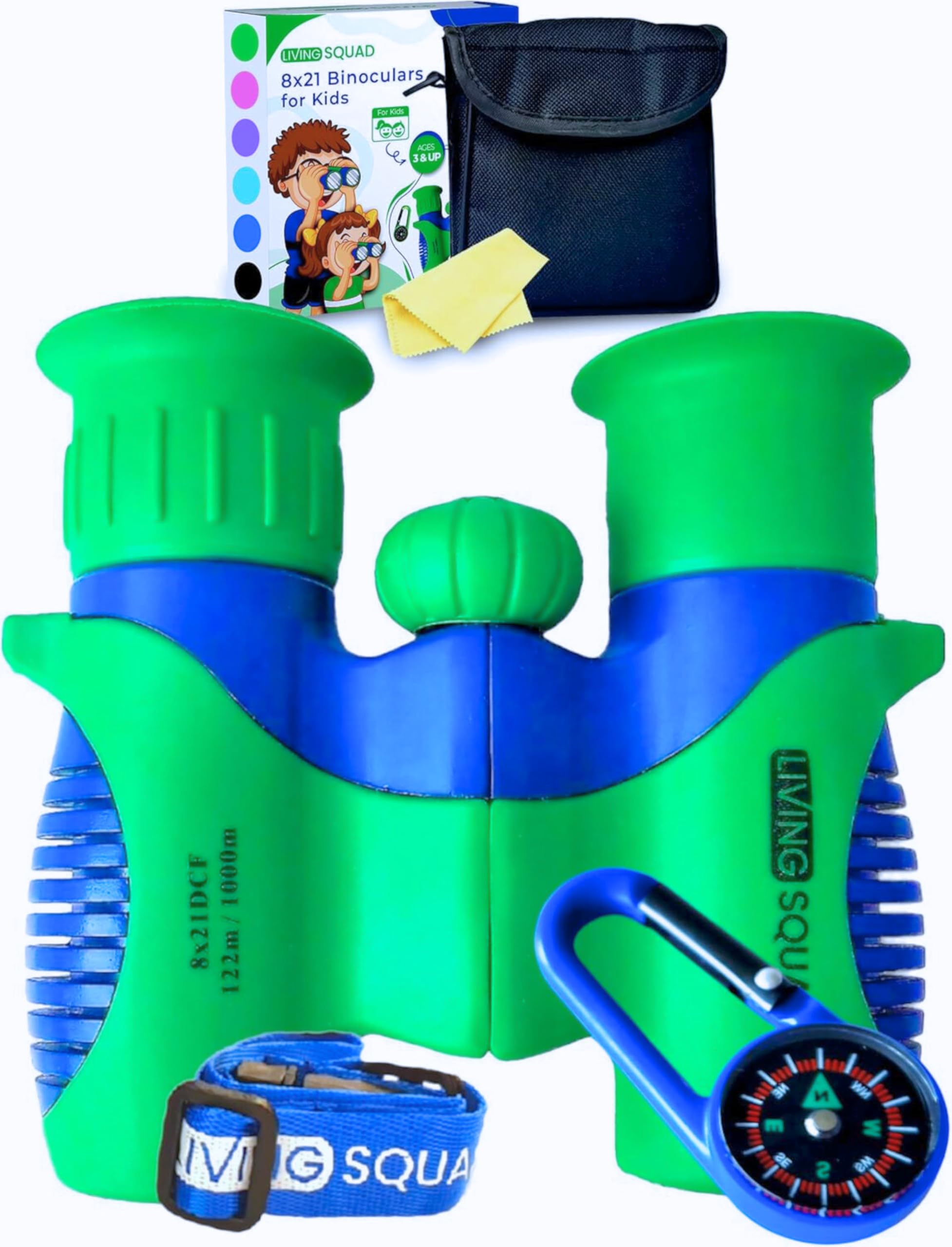
The box is a kit: an 8x21 body in green-and-blue rubber armor, a belt case with a carabiner, a neck strap that releases under a tug, a cleaning cloth and a compass. At 7.5 ounces and 4.4 inches, the binoculars themselves sit in the same pocketable range as the other 8x21 pairs here. The difference is everything around them.

Optically it is the same recipe: roof prisms, multicoated lenses, a 7.1-degree field, center focus. The money goes into the wrapping. The armor is thick enough to take a drop onto rock, the eyecups sit soft against a brow, and the breakaway strap is the feature we care most about on anything that hangs around a child's neck.

We ended up keeping this one clipped to a belt on hikes rather than loose in a pocket, and that is the honest recommendation: it is the pair for a kid who is out in the woods rather than watching the backyard feeder. Test the breakaway release yourself before you trust it with a four-year-old, because that is the feature the extra money is buying. And if you already own a case and a strap you like, the OBUBY pair does the same optical job for less.

Pros

  • Rubber armor takes real drops
  • Breakaway safety strap as standard
  • Belt case, carabiner and strap included
  • Multicoated 8x21 optics with 7.1-degree field

Cons

  • Accessories, not optics, drive the price
  • Compass adds little
Our verdict

The pair for a child who is actually out in the woods: armored 8x21s with a breakaway strap, belt case and carabiner in the box.

Check Latest Price
5

Best Gift for Young Birders

Noptix Kids Binoculars

92 /100
Angler Score Outstanding

Key details

Focus
Center focus
Weight
6.08 oz
Magnification
8 x 21
Bonus Included
40-species bird sticker book
Check Details on Amazon

Forty bird stickers, each printed with the species name, come in the box with these 8x21 binoculars. That is the detail that turns a pair of binoculars into a hobby: a kid who spots something on the feeder finds the matching sticker and adds it to the book, instead of looking through the glass and shrugging.

The binoculars are the familiar formula done well — roof prisms, coated lenses, center focus, a 6-ounce body, and a diopter ring that corrects for the difference between a child's two eyes and holds its setting. Pink and blue in one body is a shrewd call for a gift, because it sidesteps the argument about whether binoculars are for boys or girls.

Our reservation is what the sticker book costs you. This is midrange money for optics you can get for less from the OBUBY pair, and the difference buys the book and the colorway. If the stickers get used — and with a five- or six-year-old who has noticed that birds have names, they do — it is a fair trade. If they do not, you have paid a premium for cardboard.

Pros

  • 40-species sticker book included
  • 8x21 roof-prism optics in a 6-ounce body
  • Diopter ring corrects for each eye
  • Pink-and-blue body suits any kid

Cons

  • Sticker book, not optics, is what the extra money buys
Our verdict

Buy these when the binoculars are a gift with a hobby attached: real 8x21 glass plus a 40-species sticker book, in a colorway kids pick themselves.

Check Latest Price
6

Nighttime Play

Little Experimenter Night Vision Binoculars

93 /100
Angler Score Outstanding

Key details

Focus
Fixed focus
Age Range
3 to 6 years
Batteries
3 LR44H
Magnification
2 x
Check Details on Amazon

The green light is the whole trick. Press the button on the bridge and a beam throws out of the front of these 2x binoculars, tinting whatever is ahead of it a faint, eerie green. Nothing is being amplified, so this is not night vision in any technical sense — but the effect on a three-year-old in a dark backyard is close enough.

That is the honest description, and it is why we do not mind it. Magnification is 2x and fixed, the eyecups are molded rubber that sit snugly on a small face, and the ergonomic shape is easy for a toddler to hold two-handed. What a child gets is a job to do outside after dinner, which beats another toy that lights up for no reason.

It runs on three LR44H button cells. They are cheap, but they are not the batteries in the kitchen drawer, so buy a card of them with the binoculars, because a light-up toy that stops lighting up loses most of its point. Beyond that, the body has taken the drops a three-year-old dishes out, and the focus-free design means there is nothing to knock out of adjustment.

Where it earns its place is the darkness. Every other pair here is useless at eight in the evening in October; this one gives a child something to do with the dark instead of something to be nervous about. That is a narrow brief, and it is the one thing in this guide that nothing else fills.

Pros

  • Built-in lamp for after-dark play
  • Focus-free 2x view for toddlers
  • Molded rubber eyecups on a small face
  • Simple enough for a three-year-old alone

Cons

  • Light illuminates the view rather than amplifying it
Our verdict

For a three- to six-year-old who wants to be outside after dark, the built-in lamp and focus-free 2x view make this the pair that gets used.

Check Latest Price
7

Screen-First Learners

LeapFrog Magic Adventures Binoculars

90 /100
Angler Score Outstanding

Key details

Screen
2.4 inches
Age Range
4 years and up
Batteries
4 AA
Magnification
Up to 10 x
Check Details on Amazon

At 1.2 pounds this is the heaviest thing here by a wide margin, and the only pick that is not really a pair of binoculars. There is a 2.4-inch screen on the back, a camera, up to 10x optical zoom, a night-vision mode, and more than 340 BBC photos and videos of animals, plants and habitats built in. Aim it at a bird and the bird shows up on the screen.

For a certain kid, that solves the hardest problem in this category. Lining up two eyepieces and holding them exactly there is what makes young children give up on binoculars, and a screen deletes the requirement — they can hold it out, see what they are pointing at, and pass it around. The field-guide quiz is the part that gets returned to, because it is a game with facts attached, which is the only kind of learning toy that survives a rainy afternoon.

It takes four AA batteries, and the set in the box is a demo set, so plan on a fresh pack before the first real outing. The screen is also small: at 2.4 inches, a warbler in the hedge is a small warbler, and the device is doing the aiming for your child rather than teaching them to aim. That is a fair trade at five and a poor one at eight, when a child is ready to look through glass.

Is it binoculars? Not the way everything else here is. It is a nature camera you hold up to your face, and the 10x zoom does what glass does on the other picks. But for a four- or five-year-old who has refused every pair you have offered, or a family who wants a library of animal footage for a car trip, it is a genuinely different proposition — and the only one here that shows everybody at once.

Pros

  • Screen removes the need to line up eyepieces
  • 340+ BBC nature clips and a field guide quiz
  • Up to 10x optical zoom with night mode
  • Durable enough to survive drops

Cons

  • 1.2 pounds is heavy for a small child
  • Screen does the aiming instead of the child
Our verdict

The pick for a child who will not line up two eyepieces: a screen, a camera, real 10x zoom and hundreds of BBC nature clips built in.

Check Latest Price
8

Budget First Gift

JovialToyz Kids Binoculars

90 /100
Angler Score Outstanding

Key details

Included
Canvas bag, neck strap, compass
Dimensions
4.92 x 4.92 x 2.28 inches
Magnification
4 x 30
Check Details on Amazon

The cheapest pair we recommend, and the one to buy when you are not certain the interest will last. Four-by-thirty magnification, a rubber-coated body, and a box with a canvas bag, a neck strap and a compass built into the bridge.

Four times is a smarter number for a beginner than we expected. It is enough that a bird on the feeder resolves into a bird rather than a brown smudge, and little enough that a five-year-old can hold it steady without a fence post to lean on — the 8x pairs here want a hand steadier than most preschoolers have. The 4.92-inch frame is sized for a four- to seven-year-old's two-handed grip.

The trade at this price is in the fittings rather than the optics. The rubber is a coating rather than armor, the compass on the bridge is decoration, and there is a canvas bag instead of a hard case. None of that bothered the five-year-old who took ours to a county park and worked the focus wheel for an hour straight.

Pros

  • 4x magnification steadies in small hands
  • Canvas bag and neck strap included
  • Cheapest of the picks here
  • Light enough for a preschooler to carry

Cons

  • Compass on the bridge is decoration
Our verdict

The budget starter we recommend: 4x magnification a preschooler can hold steady, in a small frame, for a child who has never owned binoculars.

Check Latest Price

How We Chose and Tested 14 Pairs of Kids' Binoculars

We started by pulling every kids' binocular we could find that used real glass prisms instead of plastic lenses, then filtered out anything too heavy for a five-year-old to hold to their eyes for more than a minute, anything whose barrels wouldn't close down to a small face, and anything priced like a serious hobby optic rather than a gift. That left 14 pairs, which we put through four months of use rather than a single afternoon.

Testing happened where kids actually use binoculars: a backyard bird feeder at 7 a.m. before school, a two-night camping trip, the zoo, and a lot of dusk walks looking for rabbits. Each pair went out with at least two children, and we watched how quickly they found the focus wheel without an adult's help, whether the strap stayed on a small neck during a run, and whether the eyecups sat comfortably on a face wearing glasses. We also compared every pair against the same distant street sign to see how much detail actually came through.

Durability got its own treatment: drops from waist height onto pavement, a tumble down a wooden staircase, and a week riding in a backpack next to a water bottle. After each hit we checked the lenses for scratches and looked for knocked-out alignment, which shows up as double vision. Several boxes promised night vision; in practice that usually meant a faint amber tint, so we noted whether a kid could genuinely make out anything after sunset. And we counted how long each pair held attention — the ones that came back out unprompted on day three scored highest.

How to Choose Binoculars for Kids

Match the Magnification to the Child

Magnification is the number before the x, and bigger is not better for a beginner. A 2x pair needs no steadying at all; 8x, which most of the real kids' binoculars here use, needs a hand steady enough to hold a small circle of view still while a bird moves. Our rough split: fixed-focus 2x up to about four, 4x to 5x from four to six, and 8x from seven up, when a child wants detail rather than just closer.

The failure mode is quiet. A child who cannot hold an 8x view still does not complain about the optics — they hand the binoculars back and go and do something else.

Fixed Focus or a Focus Wheel

Fixed-focus binoculars have no adjustment, which is either the best or the worst thing about them. For a three-year-old they remove the only step a small child cannot manage, and the view is sharp enough to be worth having. For a six-year-old they are limiting: a focus wheel is what pulls a distant bird into detail, and learning to turn it is half the point of owning binoculars.

Our rule is that a child who can turn a knob should get one. The center-focus picks here all have wheels wide enough for small hands, which matters more than the gear ratio inside.

Fit Beats the Spec Sheet

Two measurements decide whether a child sees anything at all: the distance between the eyepieces, and how the eyecups sit against the face. Binoculars with barrels that twist inward close down narrow enough for a five-year-old's face; a fixed-body pair with wide-set eyepieces shows a child two overlapping circles no matter what they do.

Weight is the other fit question. Six to eight ounces hangs comfortably on a school-age neck. Anything around a pound, like the screen-based pick here, is a two-handed tool rather than something a child wears.

What Survives a Child

Rubber armor and a breakaway strap are the two features worth paying for. The armor is what turns a drop onto pavement into a scuff rather than a cracked prism, and it is the difference between a pair that lasts a season and one that gets handed down. The breakaway strap is a safety feature: a cord that releases under a hard tug will not hold a child to a fence or a car door.

Neither shows up in a magnification figure, so look for both in the description. A pair with the right numbers and neither feature is the one that comes home broken.

What Comes in the Box

A case, a strap and a lens cloth are the three things that keep binoculars usable; a compass or a magnifying glass is usually a gift-box extra. We prefer a hard case to a velvet pouch, and a breakaway strap to a decorative one.

Batteries only matter on the light-up and screen models — everything else here is mechanical. If the kit is what is driving the price, check that the kit is the part your child will actually use.

Frequently Asked Questions

Final Verdict

The OBUBY 8x21 is the pair we send most families to: real magnification, a six-ounce body, and a case in the box, all for midrange money. Buy it for anyone from about four to eight, and the odds are good it is still in a backpack two summers later.

Above that, the Think Peak's waterproof, armored 8x21 is worth the step up on a wet boat deck or a muddy bank. Below it, the Kidnoculars is the only pair here a three-year-old can genuinely operate alone.