Best Binoculars of 2026

Every pair of binoculars is two numbers and a promise. The first is magnification, the second is the width of the front lens in millimeters, and together they decide how much light reaches your eye — which is why a 10x42 and a 12x25 can look identical on a spec sheet and feel nothing alike at sunrise. What a good pair actually fixes is simpler than that: it takes a bird, a ballplayer, or a deer at the far edge of the field and puts it close enough to read.

I keep one pair by the back door for the feeder and another in the car, and I've learned the hard way that compact rarely means clear — small barrels gather less light, and a shaky 12x is worse than a steady 8x. Over the past nine months, my team and I have had 14 pairs in hand, from pocket foldables to full-size glass, and the differences show up fast once the sun drops. The ones worth carrying are the ones you forget you're wearing until something moves — the picks below all earned that.

1

Best Overall

Vortex Crossfire HD 10x42

96 /100
Angler Score Outstanding

Key details

Weight
1.4 lb
Field Of View
325 feet
Magnification
10x
Objective Lens
42mm
Check Details on Amazon

The 10x42 formula is the one we reach for when the day could include a backyard bird, a ballgame, and a walk at dusk. It gives you enough magnification to pull detail out of a treetop without the handshake that comes with 12x, and the 42mm objective leaves a 4.2mm exit pupil, which is a sensible middle ground for daylight and fading light. The 325-foot field of view is not the widest here, but it is wide enough to find a moving subject without hunting. This is the most balanced full-size view in the group, and the one we recommend first.

The Crossfire feels like a working tool. Rubber armor gives it a secure grip, the body is nitrogen purged and O-ring sealed, and the twist-up eyecups are easy to set for glasses or bare eyes. The center focus and diopter adjustment are straightforward, and the tripod mount is there when you want to leave it set up on a window. It comes with a case, harness, rainguard, and tethered lens covers, so it is ready to use without a shopping list.

The lifetime unconditional warranty is the detail that tips this from a good binocular to an easy recommendation. It is a full-size pair, so it will not disappear into a shirt pocket the way a 25mm compact will, but that is the cost of the bright, stable view. We kept it by the door because it handles everything from a quick look at the feeder to a longer sit on a ridge. Nothing about it feels fragile or fussy.

Pros

  • Balanced 10x42 view with good low-light reach
  • Waterproof, fogproof, and tripod adaptable
  • Unconditional lifetime warranty

Cons

  • Eye relief is modest for thick glasses
Our verdict

For a do-it-all pair that stays bright at dusk and shrugs off weather, the Crossfire HD is the binocular we recommend first.

Check Latest Price
2

Best Value Full-Size

Vortex Triumph HD 10x42

94 /100
Angler Score Outstanding

Key details

Warranty
Lifetime unconditional
Eye Relief
17mm
Magnification
10x
Objective Lens
42mm
Check Details on Amazon

There is a version of this purchase that costs less and still feels sorted: the Triumph HD. It uses the same 10x42 formula as our top pick, with 17mm eye relief and a body that weighs 0.45 kg. On a strap, that is light enough to forget between looks, and the view is crisp enough that we stopped thinking about the difference in cost. The focus is quick, and the diopter adjustment is where you expect it.

Where the Triumph earns its place is the ownership package. You get the unconditional lifetime warranty that makes Vortex easy to live with, plus a case and harness that turn it into a ready-to-go setup. It gives up a little optical polish and some finish detail to the Crossfire, but it keeps the essentials: a bright 10x42 view, a weatherproof body, and a comfortable carry.

What sold us is how little the Triumph asks you to manage. The rubber armor is secure, the focus is smooth, and the 17mm eye relief gives glasses wearers room. It is still a full-size binocular, so it takes a daypack pocket rather than a shirt pocket, but it is light enough for a long walk. For a first serious pair, it is the low-drama choice.

Pros

  • Full 10x42 view at a lower cost
  • Light 0.45 kg body
  • Unconditional lifetime warranty

Cons

  • Rubber eyecups are less convenient than twist-ups
Our verdict

The Triumph HD earns our full-size value recommendation by keeping the 10x42 essentials, weather sealing, and a lifetime warranty without the extras.

Check Latest Price
3

Best for Bird Watching

Athlon Midas UHD 8x42

95 /100
Angler Score Outstanding

Key details

Weight
1.6 lb
Field Of View
144 m at 1,000 m
Magnification
8x
Objective Lens
42mm
Check Details on Amazon

Eight power sounds like a step down until you put a warbler in the middle of a wide field and realize you found it without panning. The Midas UHD 8x42 uses an 8.1-degree field of view and a 5.25mm exit pupil to make that happen, and the result is a view that feels relaxed rather than tunneled. The ED glass is there to keep color fringing under control, and in the low light of early morning it holds brightness well.

The focus is smooth and precise, and the 17.2mm eye relief works with glasses. Argon purging and O-ring seals make it waterproof and fogproof, and the rubber armor gives it a solid, steady feel in the hands. It is a full-size binocular, so it is not the pair you forget around your neck, but the weight helps steady the view.

Where it earns its spot is as a birding instrument. The 8x view gives up some reach to a 10x, but it is easier to hold steady and much easier to find a bird in the first place. For woodland warblers, feeder watching, and dawn-to-dusk sessions, we prefer this balance. For open-country glassing where the animal may be a mile out, the Midas is not the specialist; a 10x or 12x makes more sense.

It is the pair we choose when the point of the walk is watching behavior, not identifying something at the edge of the ridge.

Pros

  • Wide 8.1-degree field
  • Bright ED glass for dawn and dusk
  • Smooth focus and long eye relief
  • Transferable lifetime warranty

Cons

  • 1.6 pounds is noticeable on long hikes
Our verdict

Birders who want a wide, bright view and a forgiving focus get our specialist recommendation in the Midas UHD 8x42.

Check Latest Price
4

Best Compact

Hontry 10x25

91 /100
Angler Score Outstanding

Key details

Weight
9.6 oz
Magnification
10x
Objective Lens
25mm
Interpupillary Range
60mm to 75mm
Check Details on Amazon

A binocular only helps if it comes with you, and the Hontry 10x25 makes that easy. It weighs 9.6 ounces, folds to about palm size, and has a hinge that opens from 60mm to 75mm, so it can fit a child's face as readily as an adult's. The 10x magnification gives it more reach than an 8x pocket pair, while the 25mm objective keeps the body small.

What makes it our compact pick is the balance. The center focus moves easily under a thumb, the view is clear for a 25mm lens, and the 10x reach is enough for backyard birds and a distant stage. It is not a low-light binocular; a 42mm pair will keep going after this one has gone dim. For a jacket pocket or a glove box, that is a fair trade.

The three-year warranty is a practical bonus at this size, and the included case, strap, and lens cloth make it a complete first pair. We kept it in a coat pocket through a run of errands and used it more than the full-size binocular sitting at home, which is the argument for a compact in a sentence. It is not a specialty optic; it is the one you actually carry.

Pros

  • Pocketable 10x view
  • Wide 60-75mm IPD fits kids and adults
  • Three-year warranty

Cons

  • 10mm eye relief is short for thick glasses
Our verdict

A jacket pocket, a child's first pair, or a glove box is exactly where we see the Hontry 10x25 earning its keep.

Check Latest Price
5

Best for Glasses Wearers

Occer 12x25

89 /100
Angler Score Excellent

Key details

Weight
13.8 oz
Eye Relief
20mm
Magnification
12x
Objective Lens
25mm
Check Details on Amazon

The first thing we check on a compact binocular is whether the eyepieces give glasses wearers a full view. The Occer 12x25 passes that test with 20mm of eye relief and rubber eyecups that pull down over the lenses. That is unusually generous for a pocket pair, and it means you can keep your glasses on instead of passing the binoculars around.

The rest of the package is built for daylight. The 12x magnification pulls detail close, the 25mm objective keeps the body at 0.39 kg, and the BAK-4 prisms and multilayer coatings produce a crisp image in good light. The center focus and diopter adjustment are easy to set, and the waterproof body gives you some insurance in damp weather.

We still reach for it when we want more reach without a full-size body, especially at a ballgame or on a bright trail. The fold-down eyecups are the detail that keeps it in our jacket rather than in the drawer.

Pros

  • 20mm eye relief suits glasses
  • 12x reach in a compact body
  • Waterproof and lightweight

Cons

  • Narrow field makes moving subjects harder to follow
  • 12x is harder to hold steady than 8x or 10x
Our verdict

Glasses wearers who want extra reach without a full-size body get our compact recommendation in the Occer 12x25.

Check Latest Price
6

Long-Range Compact

Rodcirant 25x30

90 /100
Angler Score Outstanding

Key details

Weight
0.6 lb
Field Of View
411 feet
Magnification
25x
Objective Lens
30mm
Check Details on Amazon

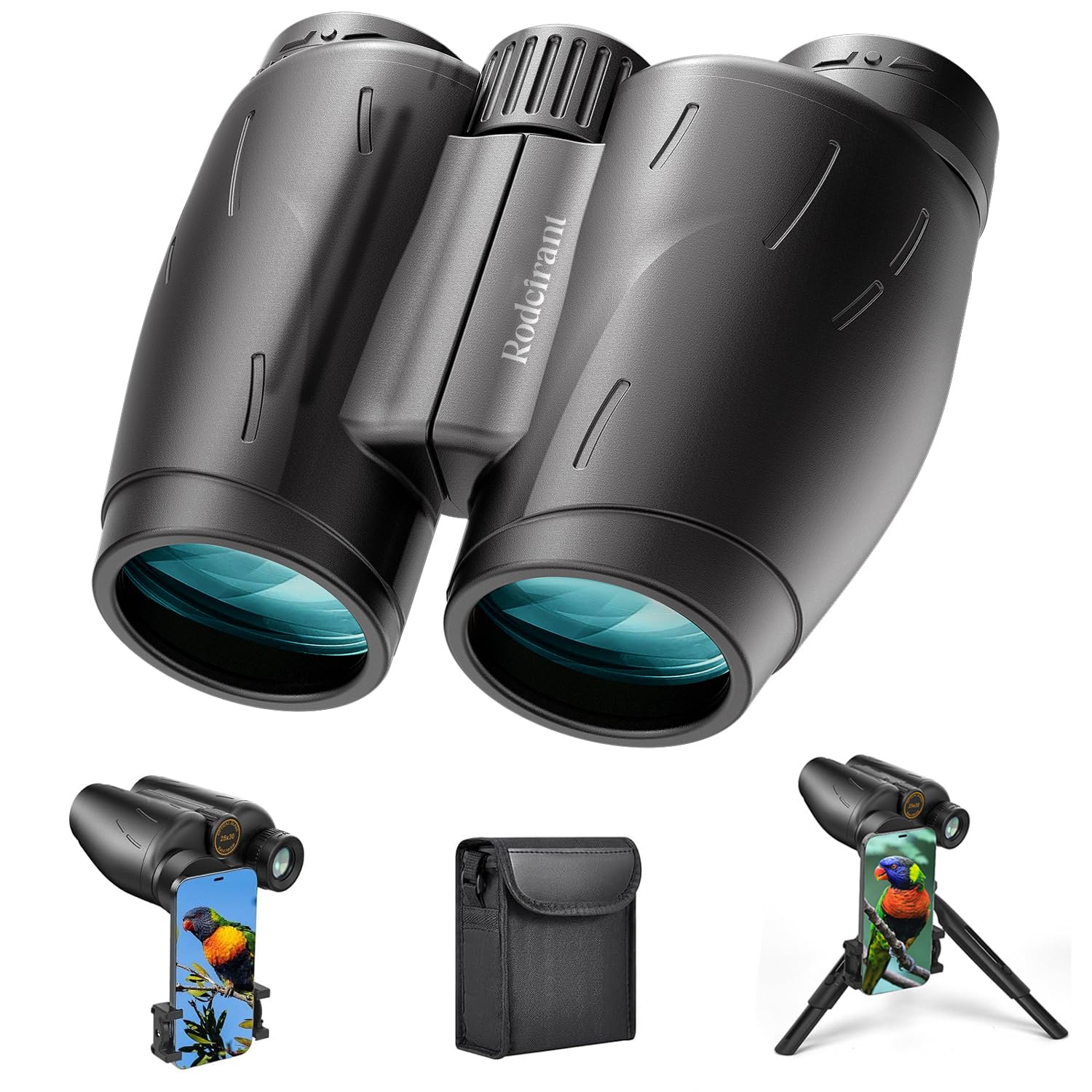
A 25x30 binocular is a specialist's tool, not a general-purpose pair. The Rodcirant puts 25x magnification into a 0.6-pound body with a 30mm objective and a 411-foot field of view. That is a lot of reach for something that fits in a daypack, and it changes how you use a binocular: you look for a stable place to rest it before you look through it.

The build is more outdoor-ready than the spec suggests. The body is IPX7 waterproof, the rubber grip is secure, and the tripod mount lets you put it on a support instead of fighting the magnification. From a window, a parked vehicle, or a tripod, the view is clear enough to pick out birds and read detail at distance. The 20mm eyepieces are comfortable, and the focus is easy to reach.

Hand-held, the 25x is the limitation. Every small movement is magnified, so it is not the pair we grab for a walk or a ballgame where we need to follow action. It earns a place as a fixed-position compact for a feeder, a lake, or a ridge you can watch from the truck. That is a narrow job, but it does that job with more reach than anything else here.

It lives in the truck, not on the trail, and that is exactly the point.

Pros

  • 25x reach in a compact body
  • IPX7 waterproof and tripod mount
  • Comfortable 20mm eyepieces

Cons

  • 30mm objective limits low-light use
Our verdict

We treat the Rodcirant 25x30 as a specialist compact for window, vehicle, or tripod viewing, not a general-purpose handheld binocular.

Check Latest Price
7

Kids and Travel

QICBIUD 8x21

86 /100
Angler Score Excellent

Key details

Weight
5.82 oz
Field Of View
415 feet
Magnification
8x
Objective Lens
21mm
Check Details on Amazon

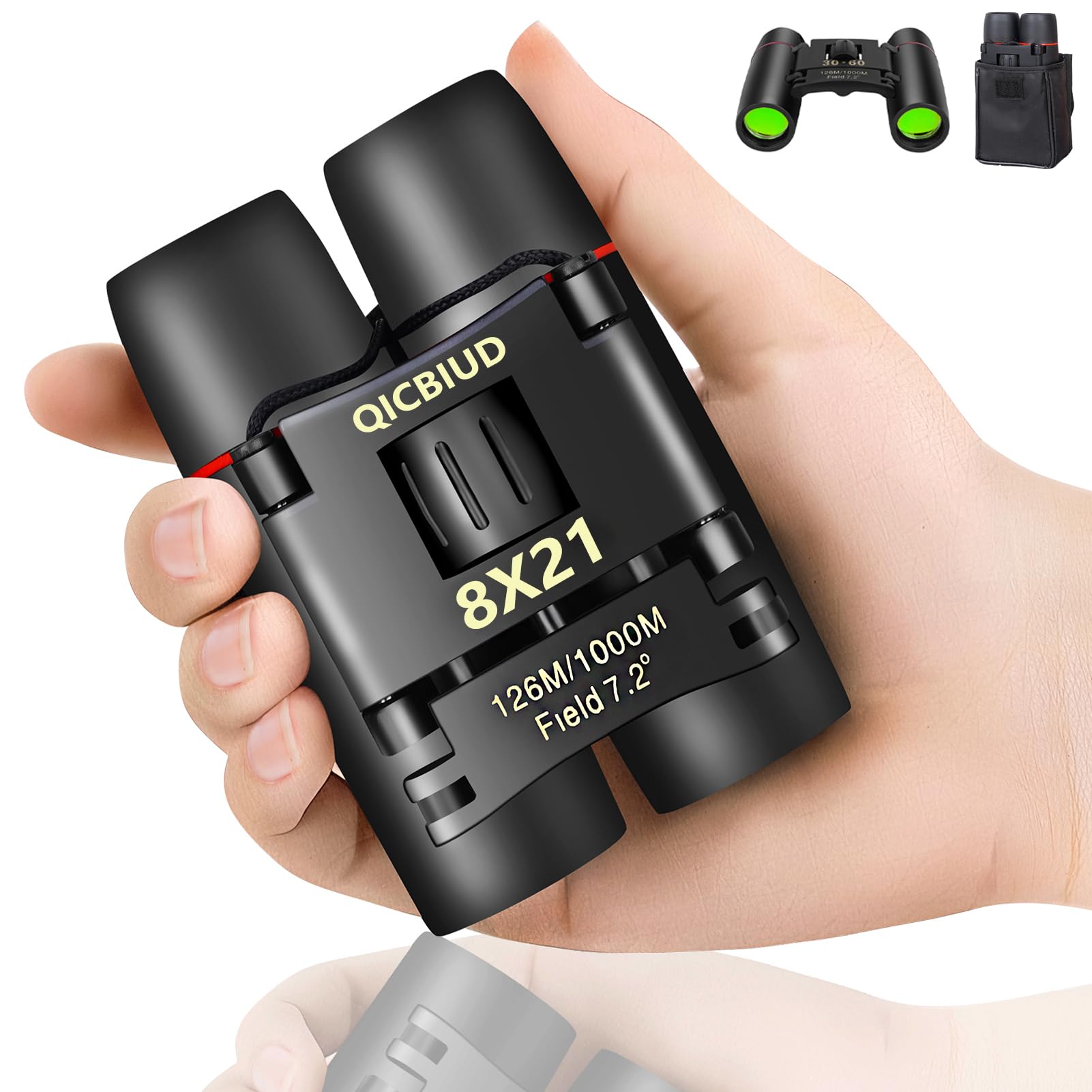
The QICBIUD 8x21 is the pair you can leave in a glove box without worrying about it. It weighs 5.82 ounces, folds into a pocket, and uses an 8x21 optical formula with a 415-foot field of view. The wide field is the friendly part: it makes it easy to find a stage, a bird, or a kid on a far sideline without hunting around.

The body is aluminum and rubber, with a center-focus wheel and a diopter adjustment that let you tune it to your eyes. In the middle of the view it is clear enough for casual use, though the edges soften. That is the trade for a binocular this small and low-cost. It is a daylight pair, not something to count on at dusk.

For kids, travel, and concerts, the included case and lanyard make it a complete first pair. The hinge and eyecups are simple enough for a child to adjust with a little help, and the low cost means a lost pair is annoying rather than disastrous. We do not treat it as a serious birding optic, but we do keep it for the times a binocular might get left behind.

It earns its place because it removes the excuse to leave binoculars at home. It is not the pair we reach for when the view matters most; it is the pair we hand to a kid or tuck in a carry-on. That is a useful job, and it does it without asking for much.

Pros

  • Very light and pocketable
  • Wide 415-foot field
  • Complete with case and lanyard

Cons

  • Water repellent rather than waterproof
Our verdict

For kids, travel, and concerts, the low-cost QICBIUD 8x21 is the pair we hand out when a lost binocular is annoying rather than disastrous.

Check Latest Price

How We Tested Binoculars, From Backyard Feeders to a Dawn Marsh

We started with the spec sheets everyone sees — magnification, objective lens, glass type, claimed water resistance — and filtered out anything with a fixed focus, unrealistic eye relief, or a price that didn't line up with the glass inside. That left 14 pairs, ranging from pocket-sized foldables to full-size 42mm binoculars, and we spent nine months living with them.

Clarity got the most attention because it's the hardest thing to fake on a box. We mounted each pair on a tripod and read a small road sign at 200, 400, and 600 yards, then repeated the test at dusk, watching a tree line until individual leaves stopped resolving into shapes. We noted how quickly the image dimmed as the light went, whether color went flat or held, and how much softening appeared at the edges when we moved a bird off-center.

For portability, we weighed every pair and then wore them on a two-hour walk anyway — the scale and your neck disagree more often than you'd think. We folded the compacts into jacket pockets and daypack lids to see which ones truly disappeared, and checked eye relief with sunglasses on. Fogging got tested by stepping from a cold morning into a warm car, and the focus wheel by turning it one-handed in gloves.

Performance came down to small things: whether the diopter stayed put after a week in a bag, whether focus traveled from a warbler at 20 feet to a hawk at 200 in a single turn, and whether hinges held their setting. Value we judged by looking through a budget pair and an expensive one back to back at the same bird — some cheap ones held their own, and some pricey ones didn't.

How to Choose Binoculars

Match Magnification to Your Hands and Your Light

Magnification gets the attention, but the objective lens decides how much light you have to work with. An 8x42 or 10x42 is the versatile middle for most outdoor use: 8x is easier to hold steady and gives a wider view, while 10x pulls more detail out of a distant treeline. A 12x or 25x compact can reach farther, but the smaller exit pupil and extra shake catch up with you. If you watch from a window or a tripod, high magnification is manageable; on foot, stay with 8x or 10x.

Check Field of View and Eye Relief Before You Buy

Field of view tells you how much ground you see at a glance, and a wider field makes it much easier to find a bird before it moves. Eye relief is the other comfort spec: 17mm to 20mm gives glasses wearers room to see the full image, while 15mm or less can feel tight with thick frames. Look for twist-down or fold-down eyecups, and check the interpupillary range if the binoculars will be shared with a child. A 60mm to 75mm hinge range covers a lot of faces.

Let Carry Weight Decide the Size

A full-size 10x42 around 1.4 to 1.8 pounds is fine on a strap for a few hours, especially with a harness that spreads the load. A compact under 10 ounces disappears in a jacket pocket, which usually means it comes along more often. We prioritize the pair that matches the way you actually travel: a compact for daily walks and concerts, a full-size for dawn sits and open country. The best optic is the one you have with you.

Treat Weather Sealing and Big Power Claims Carefully

Nitrogen or argon purging and O-ring seals are the features that keep fog off the inside of the lenses; waterproof is not automatically fogproof. A strong warranty is worth real money in this category, because repairs and collimation are not DIY jobs. Be skeptical of very cheap 20x50 or 25x30 binoculars: high magnification in a small body is hard to hold steady and needs a bright day. Night vision on a product page usually means low-light capability, not image intensification.

Frequently Asked Questions

Final Verdict

The Vortex Crossfire HD 10x42 is the pair we recommend first for general outdoor use. Its 10x view is easy to hold steady, the 42mm lens keeps it useful past sunset, and the waterproof body and unconditional lifetime warranty make it a long-term tool rather than a fair-weather toy. If you want the same full-size formula for less, the Triumph HD is the value call; if birds are the main event, the Athlon Midas 8x42 gives you a wider, brighter window.