Best Boat Covers of 2026

The first time a tarp I'd bungeed over my hull let go in a storm, I spent the next morning bailing out a boat that had no business being wet. A real cover behaves differently: it sheds water instead of letting it pool at the bow, holds tension at highway speed instead of flapping itself into ribbons, and stays put at the dock when the wind turns. What you're buying is protection for the seats, wiring, and carpet underneath — on a shape that no two boats share exactly, which is why fabric weight and fit matter more than the feature list.

Over the past eight months, my team and I have fitted 12 covers to everything from a 12-foot jon boat to a 24-foot pontoon and left them out in real weather. The pattern was clear early: the covers people end up loving have honest sizing charts and hardware that doesn't quit — a heavy fabric with flimsy straps is just an expensive tarp. The picks below are the ones that earned a second season.

1

Best Overall

YimSting 16-18.5 ft Boat Cover

92 /100
Angler Score Outstanding

Key details

Fits
16-18.5 ft
Fabric
1200D polyester, 10.2 oz
Straps
11 with quick-release buckles
Warranty
2 years
Check Details on Amazon

Ten ounces of polyester per square yard is heavy for a boat cover, and it is the number we check first when a listing claims 1200D. In hand it means fabric you can drag over a windshield frame without babying it, and a cover that holds its shape instead of snapping in a crosswind. We have pulled thinner 1200D covers that felt like a shower curtain; this is not one of them.

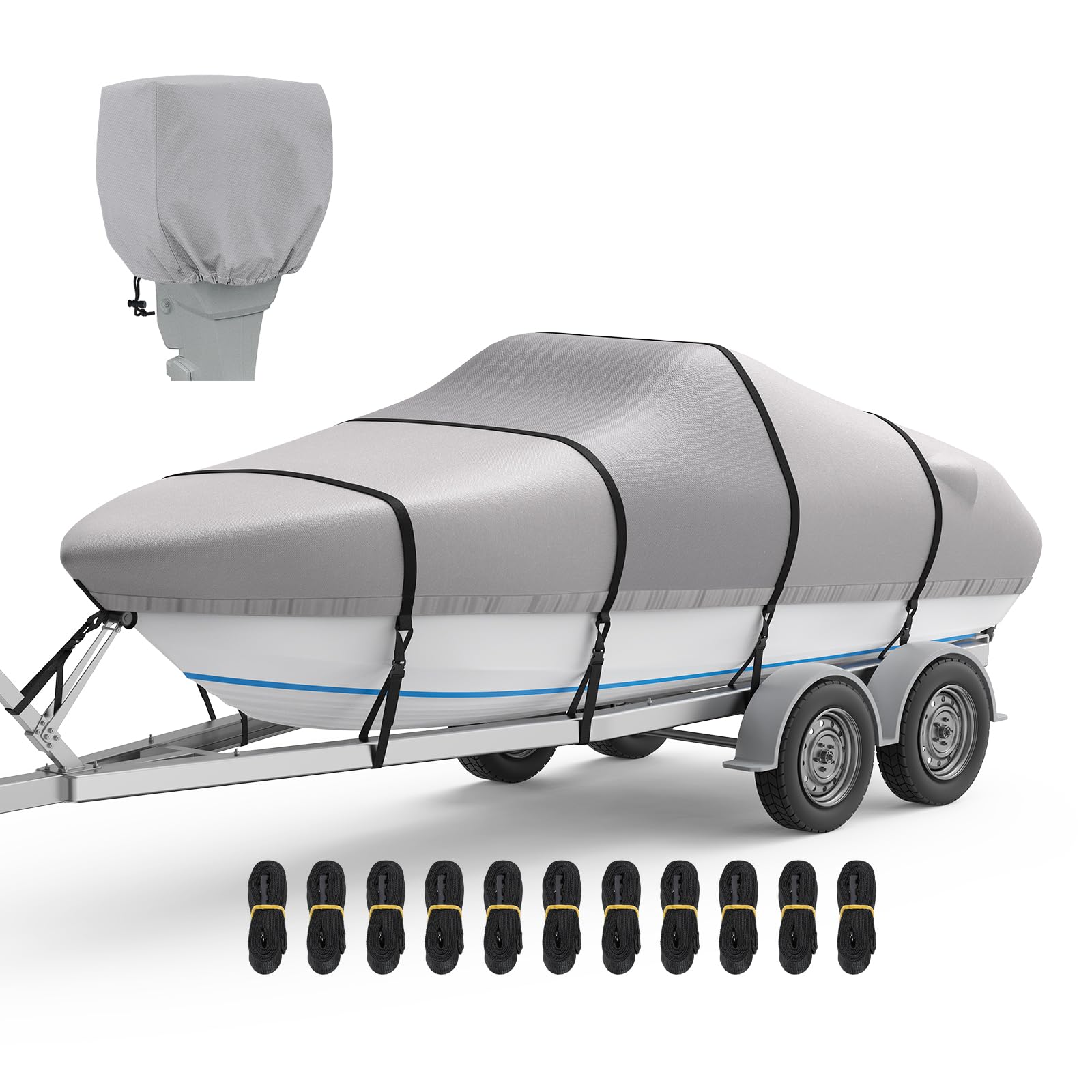
The seams are triple-folded and double-stitched, with extra layers bonded at the bow and stern corners, the two places a universal cover rubs through first. Eleven adjustable straps run through 5mm quick-release buckles, and the buckles are chunky enough to work with cold, wet fingers, which is not something we can say for every cover in this group.

Two rear vents let humid air out from under the fabric without giving rain a way in, and that matters more than it sounds, because a sealed cover turns into a greenhouse by August and the moisture settles on your seats. The thing to plan for is support. This ships as the cover alone, and any cover this size sags into a puddle between the windshield and the bow without a pole under it, so budget for one alongside the cover.

The two-year warranty sits in the middle of this group, ahead of the one-year covers and behind the premium ones. The storage bag is cut big enough to double as an outboard cover, which is one less thing to buy for a boat that lives outside. Our one quibble is the color: black is the only option, and it soaks up afternoon sun.

Pros

  • Heavy 1200D fabric with reinforced corners
  • Eleven straps with thick quick-release buckles
  • Dual rear vents reduce condensation
  • Storage bag doubles as an outboard cover

Cons

  • Sized for 16-18.5 ft hulls only
  • Offered only in black
Our verdict

We think this is the most complete package for a 16- to 18.5-foot trailered boat: heavy 1200D fabric, eleven straps, and rear vents that let it breathe.

Check Latest Price
2

Best for 20-22 Ft Bass Boats

Solim 20-22 ft Bass Boat Cover

90 /100
Angler Score Outstanding

Key details

Fits
20-22 ft, beam to 100 in
Fabric
1200D PU
Straps
14 quick-release
Warranty
1 year
Check Details on Amazon

A 22-foot hull is a different job from an 18-footer: more deck to cover, more fabric to control at highway speed, and a beam that runs to 100 inches on some bass boats. Solim cuts this cover for exactly that band, which makes it the natural next step once your boat outgrows our top pick.

Fourteen quick-release buckles make this the most heavily strapped 20- to 22-foot bass boat cover here, and we appreciate that the elastic cord runs the entire hem. It takes up slack at the bow before you have touched a strap, so the cover sits down over the hull instead of ballooning while you work backward. Two rear vents with a PE panel do the same job as the vents on our top pick, and the fabric is 1200D PU with bound, double-stitched seams.

The black fabric is the trade. It gets seriously hot in direct July sun, hot enough that you want gloves to reposition it after a morning on the trailer. Coverage runs a year, the shortest among the midrange covers here. What you get back is a two-in-one bag that doubles as an outboard cover and a coating that sheds water rather than soaking it up.

Pros

  • Fourteen straps plus a full elastic hem
  • Dual rear vents with a PE panel
  • 1200D PU fabric with bound seams
  • Cover doubles as motor cover and storage bag

Cons

  • Black fabric gets very hot in sun
  • One-year warranty trails two-year rivals
Our verdict

Fourteen straps, dual vents, and a full elastic hem make this our pick for 20- to 22-foot bass and V-hull boats.

Check Latest Price
3

Best Budget Pick

Mancro 17-19 ft Boat Cover

87 /100
Angler Score Excellent

Key details

Fits
17-19 ft
Fabric
Marine-grade Oxford
Straps
11 adjustable
Warranty
2 years
Check Details on Amazon

It is the cheapest cover here, and on paper it reads like the same deal as the covers above it: heavy marine-grade Oxford, eleven adjustable straps, an elastic hem, a two-year warranty. Most of that holds up. The part that does not is the hardware.

The buckles are plastic and they are the failure point. One can snap the first time you lean on a strap to get it really tight, and a broken buckle leaves an entire attachment point useless. The straps are sewn on well enough to hold in wind, but the stitching at those attachment points is the other spot to watch. Neither is a problem for a cover that stays parked; both matter if you tow every weekend.

Which is why we place it where we do: a 17- to 19-foot boat on a trailer from November to April, where the load on the hardware is low and the price is the point. You are buying fabric and two years of coverage at the bottom of this group's price range, and a snapped buckle becomes an annoyance rather than a failure. First fit takes a minute longer than it should, because there is no marking to tell you which end goes forward.

Pros

  • Lowest price in this group
  • Full elastic hem plus eleven straps
  • Two-year warranty at a budget price

Cons

  • Plastic buckles can snap when tightened
  • Strap stitching is a weak point
Our verdict

We keep this one for 17- to 19-foot boats that sit on a trailer most of the year, where the light buckles never get stressed.

Check Latest Price
4

Best for Jon Boats

Nukugula Jon Boat Cover 12-14 ft

88 /100
Angler Score Excellent

Key details

Fits
12-14 ft, to 70 in wide
Fabric
5-layer 1200D
Straps
13 adjustable
Warranty
1 year
Check Details on Amazon

Jon boats are the awkward ones: 12 to 14 feet long, up to 70 inches wide, low to the water and usually sitting on a utility trailer. Nearly every cover on this page starts at 16 feet, so a 14-foot jon boat has been making do with a tarp or a cover that swallows it. This one is cut for that hull.

Five layers of 1200D with a 12,000 Pa water-resistance rating is more fabric than we expect at the budget end of this group, and we are impressed by how far it runs past the transom, with the included bag doing duty as a cowling cover. Thirteen straps, nine around the hull and four at the stern, plus a full elastic hem, is a serious tie-down package for a boat this size.

Two things to know. The motor bag is oversized for a small outboard, so on a 9.9 it is a lot of fabric flapping around the cowling and you will want to cinch it down. And coverage runs a year, matching the other one-year warranties here and trailing the two-year picks. Run those four stern straps to the trailer rather than the handles; the stern is where a jon boat cover works loose first.

Pros

  • Five-layer 1200D at a budget price
  • Thirteen straps including four at the stern
  • Full elastic hem
  • Motor cover included

Cons

  • Motor bag oversized for small outboards
  • One-year warranty
Our verdict

This is the only cover here cut for a 12- to 14-foot jon boat, and we are glad it is a good one: five-layer fabric and thirteen straps.

Check Latest Price
5

Best for Center Console Boats

Classic Accessories StormPro

88 /100
Angler Score Excellent

Key details

Fits
22-24 ft, beam to 116 in
Fabric
Marine-grade polyester
Weight
20 lb
Warranty
5 years limited
Check Details on Amazon

It is the most expensive cover here, and the money goes somewhere we can point to: a five-year limited warranty, a full cut that clears bow rails and running lights, and a support pole in the box. Those three things are exactly what a center console buyer ends up purchasing separately after a cheap cover disappoints.

The cut is the real purchase. A universal cover pulled over a console boat tents on the rails, leaves the bow loose, and never sits right over the windshield. This one is patterned 22 to 24 feet long and 116 inches wide with extra room built into the shape for the hardware that gets in the way. At 20 pounds it is a two-person job in a breeze, which is worth knowing before the first windy October afternoon.

Two things do not hold up as well. The charcoal fabric fades, and a couple of seasons of strong sun leaves it noticeably lighter and keeps going from there. In a hard rain, water can still find its way in where the cover sags, usually over the console. The vents handle the moisture that builds underneath, but they do not stop a puddle forming.

Against that, the pole is included, the vents are real, and five years is the second-longest coverage in this group. For a boat that lives outside under trees and gets uncovered every weekend, that combination earns the premium. For a boat under a carport, the fading and the price are harder to justify, and one of the midrange covers will do the same job.

Pros

  • Five-year limited warranty
  • Full cut clears bow rails and lights
  • Support pole included
  • Dual rear vents

Cons

  • Charcoal fabric fades in strong sun
  • Water can seep in where the cover sags
Our verdict

It is the most expensive cover here, and for a 22- to 24-foot center console kept outside, we think the full cut and five-year warranty earn it.

Check Latest Price
6

Best for T-Top and Hard Top Boats

Budge Hard Top Boat Cover

88 /100
Angler Score Excellent

Key details

Fits
20-22 ft, beam to 106 in
Fabric
600D polyester
Weight
14.5 lb
Warranty
7 years
Check Details on Amazon

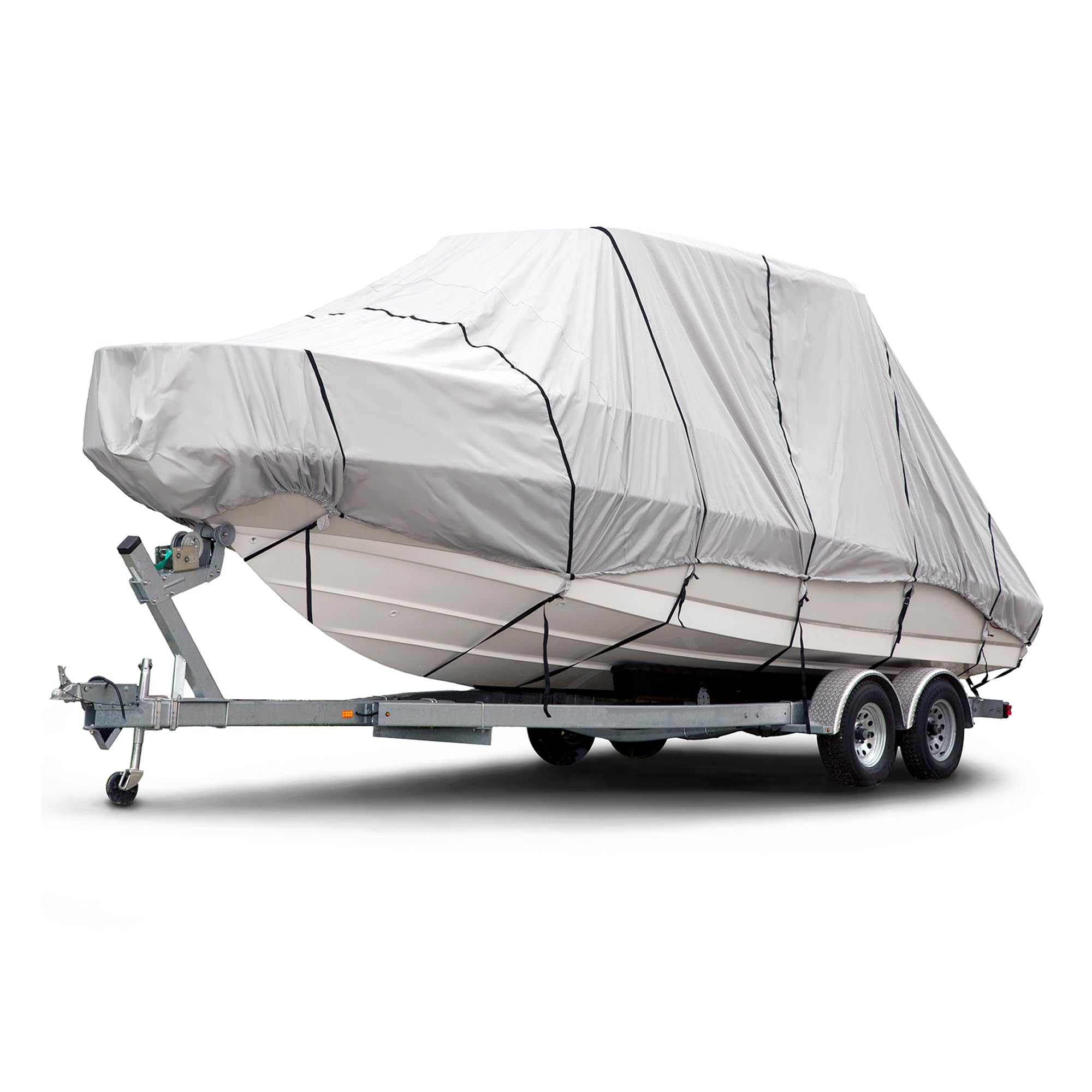
A T-top or a hard top is the hardest shape in this category to cover, because you are draping fabric over a frame that catches every gust and leaves the sides hanging. This is the only cover here cut for it, and that alone earns it a place: if your boat has a tower, universal covers fight you every time you put one on.

At 600 denier it is the lightest fabric stated here, and Budge turns that into an advantage. Fourteen and a half pounds folds into the included bag and goes on with one person, which is not something we can say about the 20-pound covers in this group. The fabric breathes, the rear vents let heat out, and a full elastic hem plus integrated straps keep it from lifting on the road.

What does not line up is the seams. Seven years is the longest warranty here by two years, but the seams are where these covers go, and they can part well inside that window. Read the warranty as a statement of intent rather than a promise, and check the stitching at the bow and around the tower cutouts before each season.

Pros

  • Cut for T-top and hard top boats
  • Seven years of warranty, longest here
  • 14.5 lb and easy for one person
  • Breathable fabric reduces heat

Cons

  • 600D is the lightest fabric stated here
  • Seams can part inside the warranty
Our verdict

If your boat carries a T-top or a hard top, this is the cover we trust to drape over the frame, and one person can install it.

Check Latest Price
7

Best for Pontoon Boats

Solim Pontoon Boat Cover 22-24 ft

85 /100
Angler Score Excellent

Key details

Fits
22-24 ft, beam to 8.5 ft
Fabric
1200D PU, 4-layer
Straps
18 sewn-on
Warranty
1 year
Check Details on Amazon

Eighteen tie-down points sounds like overkill until you have watched a pontoon cover in a crosswind. A 24-foot pontoon is a flat box with the windage of a billboard, and the straps are the only thing keeping the cover from drumming itself loose on the trailer.

The straps are sewn on rather than threaded through grommets, and that is the difference between a cover that goes on in five minutes and one that takes twenty. The elastic hem pulls the skirt under the deck edge, the 1200D fabric is stiff enough to stay there, and a storage bag comes in the box. Compared with snapping a custom cover down around every rail, it is a much faster way to close up for the week.

Which is why we rate it the pontoon pick despite two real annoyances: the buckles are plastic and they are the part that breaks, and a cover this flat needs a frame or pole underneath or the rain sits in the middle of the deck. Coverage runs a year, matching the other short warranties here. Neither issue is unusual for the category, and neither changes the recommendation for a boat that gets covered and uncovered often.

Pros

  • Eighteen sewn-on straps, the most here
  • Elastic hem grips the deck edge
  • 1200D PU with four-layer construction
  • Fits decks up to 8.5 ft wide

Cons

  • Plastic buckles can break
  • One-year warranty
Our verdict

Eighteen sewn-on straps are why we hand pontoon owners this one, along with an elastic skirt that grips the deck edge.

Check Latest Price
8

Heavy Trailering

RVMasking 1400D Boat Cover

88 /100
Angler Score Excellent

Key details

Fits
20-22 ft
Fabric
1400D center, 900D ends
Straps
11 with quick-release buckles
Waterproof Rating
12000 PA
Check Details on Amazon

Denier is the number everyone shops by, and this cover is the argument for not trusting it alone. The center panel is 1400D, the heaviest fabric in this group, and a season in Florida sun can still leave it dry and splitting. Heavy fabric resists abrasion; it does not resist ultraviolet light any better than the coating on it does.

Where the extra fabric is aimed makes more sense to us than the number itself. The bow and stern corners, three sharp points where a cover rubs on a rail, a cleat, or a trolling motor bracket, get an extra layer of 900D bonded on, and the seams are double-needle stitched throughout. Both sides of the fabric carry a PU coating rated to 12,000 PA, which is at the top of this group.

Eleven straps and two rear vents round it out, fewer tie-downs than the fourteen on the Solim 20-22. The vents sit at the tail, which is where moisture collects on a boat stored bow-up, and the elastic hem pulls the skirt down over the rub rail.

So where does it earn a place? On a boat that gets trailered a lot and stored under cover the rest of the time, the corner reinforcement is worth paying for, because those are the spots that rub through first and the extra 900D buys seasons there. On a boat that bakes in the open year-round, the heavier panel does not change the math much, and the midrange covers above are the better spend.

Pros

  • 1400D center panel, heaviest here
  • Extra 900D at bow and stern corners
  • 12000 PA dual-layer PU coating
  • Dual rear air vents

Cons

  • Sun can still degrade it within a year
  • Fewer straps than other 20-22 ft covers here
Our verdict

We point 20- to 22-foot boats that get trailered often and stored under cover here, for the reinforced corners and dual-coated 1400D panel.

Check Latest Price

How We Tested Boat Covers: Fit, Water, Wind, and Wear

We started by gathering every cover we could find that listed a real fabric weight and actual hull measurements, then narrowed to shapes that matched boats we had access to: a 12-foot jon boat, a 17-foot V-hull, a 20-foot center console, a bass boat, and a pontoon. Covers that came in only one generic size, or whose fit chart contradicted the length in the title, didn't make the cut. That left 12 covers, which all ran through the same eight months of use.

Each cover got the same first day: one person, a stopwatch, and no help. We timed the install, noted whether the tie-downs reached the trailer frame without an extension, and checked for slack at the bow, over the windshield, and around the motor. Then we towed each one about 60 miles at highway speed and looked for flapping, straps that had stretched or slipped, and scuff marks where fabric rubbed the hull.

Back in the driveway, we ran a hose over each cover for 20 minutes and watched whether water beaded and rolled off or soaked into the weave, then checked underneath 24 hours later for damp carpet and standing water in the bow. The covers stayed outside through a full summer and fall, which is how we saw which fabrics faded, which seams started to powder, and which straps went soft and lost their grip. At the end we weighed all of that against price — a cover that saves you money up front but needs replacing in two seasons isn't the cheaper cover.

How to Choose a Boat Cover

Measure the Boat Before You Read a Denier

Start with two numbers: length from bow tip to stern, and beam at the widest point including the rub rail. Every cover here is sold in a two- or three-foot band, and the fit is best when your boat lands in the middle of one. The common mistake is buying up for room. Extra fabric flaps at highway speed, scuffs gelcoat, and sags into a puddle. If you want the outboard covered, measure with the motor trimmed down, and remember that a center console or a boat with bow rails needs a cut made for those rather than a universal cover stretched over them.

What Denier and Water Ratings Actually Tell You

Denier measures yarn weight, not waterproofing. A 1200D cover is a thick, abrasion-resistant weave; a 600D cover is lighter and easier to handle. What keeps rain out is the coating on the back of the fabric, usually polyurethane, and the way the seams are finished. A 12,000 Pa hydrostatic rating describes how much water pressure the fabric resists, and a 4,500 Pa cover can still keep a boat dry if it is tensioned and the seams are sealed. For a boat stored outside, we look for 1200D and a coated back before anything else on the listing.

Straps and Buckles Are What Survive the Highway

An elastic hem holds a cover at the dock. At highway speed the straps do the work, and the buckle is the part that fails first. Plastic quick-release hardware is the weak link across this category, including covers we otherwise recommend. Count the straps, but look at where they attach too, because sewn-on webbing at the stern is what stops a cover lifting. Run the straps to the trailer frame rather than the boat's cleats, and check tension after the first few miles, since a universal cover seats itself once it has been in the wind.

Give the Water Somewhere to Go

No flat cover sheds water on its own. Every one of these will sag into a puddle between the windshield and the bow unless something holds it up, and standing water is what eventually finds a seam. Vents handle condensation, the damp air that builds under a cover on a sunny morning, but they do not fix pooling. A support pole or a simple ridge frame solves it, and only one cover here includes a pole. On a pontoon, plan on a frame across the deck from the start.

Frequently Asked Questions

Final Verdict

Buy the YimSting if your boat measures 16 to 18.5 feet and lives outside. The 1200D fabric, eleven straps, and rear vents address the three things that end a cover's life early, and it costs no more than the midrange covers around it.

If your hull is longer, the Solim 20-22 is the same idea with fourteen straps and room for a 100-inch beam. Everything else here is a hull-type decision, whether that is a T-top, a center console, or a pontoon, rather than a step down in quality.