
Best Boat Drift Socks of 2026

The first time I tried to hold a drift in a stiff crosswind, I burned through a trolling motor battery in under an hour and still slid right past the marks on my screen. A drift sock is the least expensive speed control you can add to a boat: it hangs off the bow or stern, fills with water, and drags you down to a pace the fish will actually follow. Set it up correctly and a windy afternoon becomes fishable instead of a scramble to get off the lake.

Diameter gets all the attention, but the harness, the tow line, and the dump line decide whether a sock is a pleasure or a wrestling match at the transom. My team has fished 14 of them over the past seven months, from kayaks to a deep-V walkaround, watching how each one sets, tracks, and comes back aboard when a fish hits. What's below are the ones that held a steady drift, adjusted without fuss, and emptied fast enough to keep you fishing.

1

Best Overall

Minn Kota MKA-27 Drift Sock Pro

89 /100
Angler Score Excellent

Key details

Fabric
420D ripstop nylon
Straps
Four 1 in nylon straps
Deployment
Weights and floats sewn in
Dimensions
34 x 22 x 34 in
Check Details on Amazon

Weights sewn along the bottom hem, floats around the mouth: throw the Minn Kota over the side and it is already open. That sounds like a small thing until you have wrestled a wet parachute open one-handed while the boat slides off the structure you wanted to fish. It is the single best reason this sock sits at the top of our list.

At 34 inches deep and 22 inches across, it is sized for boats from the mid-teens upward. On the water the drag is enough to turn a brisk wind drift into a slow, fishable crawl, and it holds the stern into the waves instead of letting the hull lie beam-on and roll. That is the difference between fishing a jig and dragging it.

Four one-inch nylon straps spread the load into the 420D ripstop rather than pulling on a single seam, and the one-inch yellow pull strap is the part we use most. Haul it and the mouth collapses, so the sock comes in limp instead of full of water — the difference between a quick reset and a long wrestle at the rail. The cloth does not hold water, it collapses into a locker, and Minn Kota backs it with a one-year warranty.

Where it stops making sense is at the small end. A 22-inch mouth on a 12-foot cartopper is more brake than the hull needs, and an 18-inch sock does the same job for less. From the mid-teens up, though, this is the one we hand people.

Pros

  • Opens on contact
  • One-inch pull strap collapses it fast
  • Four 1-inch straps spread the load
  • Backed by a one-year warranty

Cons

  • The priciest sock in this guide
Our verdict

Weights and floats do the work, so this is the sock we reach for first: it opens on contact, collapses with a pull, and holds a fishable drift on boats from the mid-teens up.
Check Latest Price
2

Best Heavy-Duty Pick

BLUEWING 32 in Sea Anchor

86 /100
Angler Score Excellent

Key details

Size
32 in for 15-20 ft boats
Fabric
840D nylon rip-stop
Weight
1.8 lb
Included
Sea anchor only
Check Details on Amazon

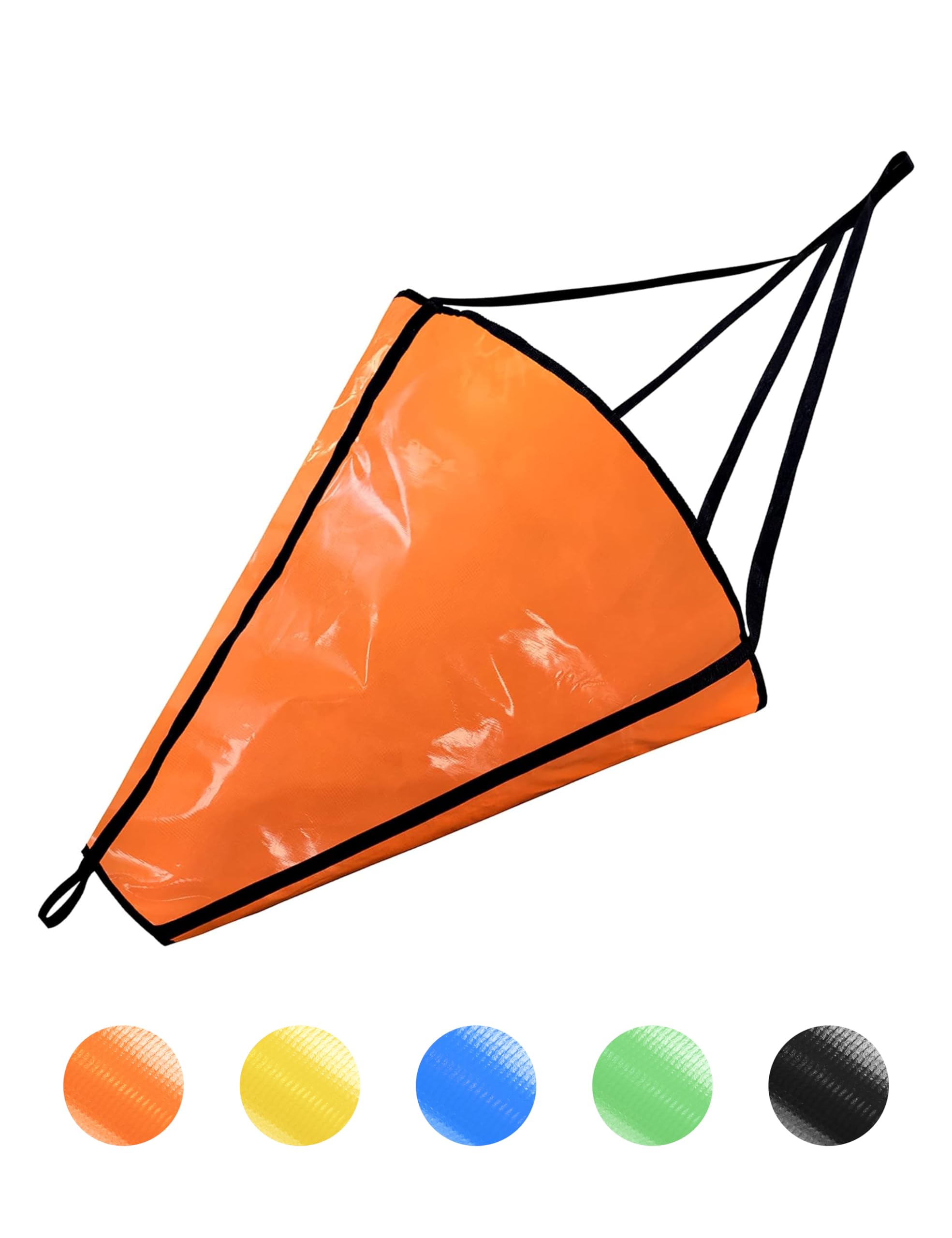
Point the BLUEWING into a breeze and the drift goes nearly dead — the sort of speed where a bait fishes properly instead of trolling along behind you. The reason is the cloth: 840D nylon ripstop, the heaviest fabric in this roundup, cut into a 32-inch sock rated for 15- to 20-foot boats. It is bright orange, which matters more than it sounds when you are trying to find it in a chop.

That makes it the pick for one specific job: stopping the boat rather than steering it. We like it on a breezy day over open water, where you want one slow pass after another across the same piece of structure. It is less appealing on days when you still want to cover ground, because a sock this heavy keeps you parked on a line instead of drifting down it.

The reinforced webbing strap at the mouth takes the pull from your line rather than the cloth, which is the right place for it. Two things we noted on the water: the floats at the mouth are modest, so in a steep chop the sock can dive and lose its fill, and a short line keeps it submerged and pulling. Give it a long line in light air and it will skip along the surface instead.

Pros

  • 840D nylon holds shape and drags hard
  • Slows a 15-20 ft boat to a near-dead drift
  • Bright orange is easy to spot

Cons

  • Sold as the sock alone
Our verdict

Buy it when you want the drift close to dead rather than halved: the heaviest cloth here drags a 15- to 20-foot boat down to a crawl.

Check Latest Price
3

Best All-In-One Kit

MOOCY 35 in Drift Sock Kit

86 /100
Angler Score Excellent

Key details

Size
35 in for 16-20 ft boats
Included
Sock, dump line, harness, buoy ball, float rope
Package Weight
1.68 lb
Package Dimensions
12.6 x 9.53 x 3.66 in
Check Details on Amazon

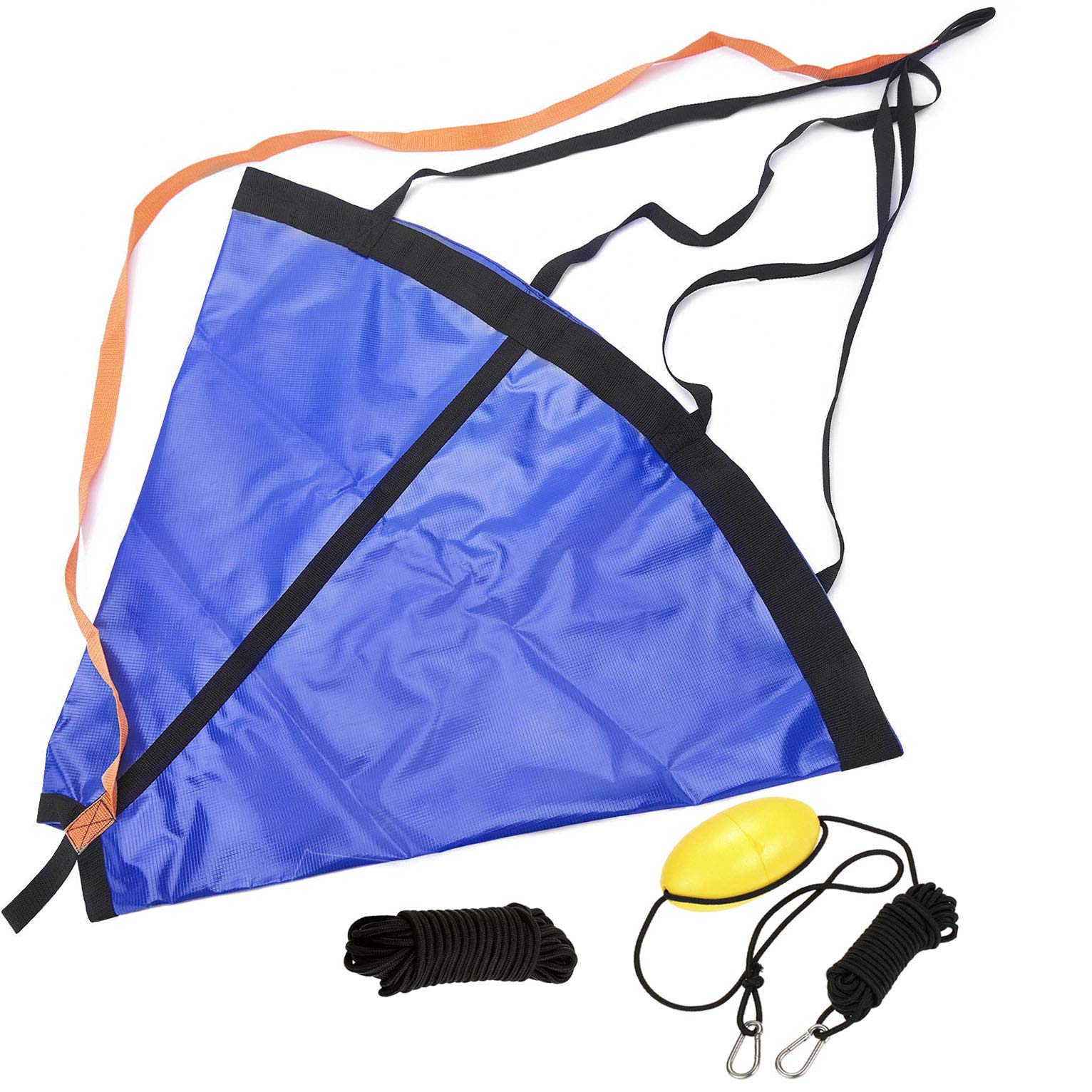
Most drift socks arrive as a bag of nylon and leave the rest to you. This MOOCY kit is the exception: the sock comes with a dump line, a harness, a high-visibility buoy ball and a floating rope, which is roughly the list of things you would otherwise buy one at a time and forget at least one of.

We think that is the whole case for it. The buoy is the piece people skip and then miss — it marks where the sock is and gives you something to grab — and the floating rope means the line does not sink out of reach when you cut the motor. The harness spreads the pull across the back of the sock instead of one attachment point, and the dump line lets you collapse the mouth and bring it in without dragging a full parachute.

It is a 35-inch sock rated for 16- to 20-foot boats, and the whole thing packs into about 12.6 by 9.5 by 3.7 inches at 0.76 kg, so it lives in a locker without an argument. Set-up is a clip and a cleat; there is nothing to assemble, which is the point of buying the bundle rather than the sock.

Pros

  • Sock, dump line, harness, buoy and rope in one box
  • Buoy and floating rope keep retrieval simple
  • Packs to 12.6 x 9.53 x 3.66 in at 0.76 kg

Cons

  • Sized for 16-20 ft boats; too much brake for a kayak
Our verdict

The one to buy if you own no drift gear yet — sock, dump line, harness, buoy and floating rope in a single box for a 16- to 20-foot boat.

Check Latest Price
4

Best for Tight Storage

Lindy Drift Control 24 in

0 /100
Angler Score Fair

Key details

Size
24 in
Design
Tangle- and spin-resistant
Weight
1.01 lb
Included
Drift sock only
Check Details on Amazon

A drift sock you never bring along is no use, and this Lindy is the one that keeps finding a corner of the boat. Twenty-four inches across, 0.46 kg, and it dries quickly enough that a damp morning does not turn into a mildewed locker.

What we appreciate is how little fuss there is to it. The cut is tangle-resistant and spin-resistant, so it fills and pulls instead of wrapping itself around the line, and the nylon sheds water rather than turning into a wet sack at the bottom of a hatch. On a breezy drift it is the sock we grab when the boat is already full of rods and coolers.

What it is good at is being the one that is always aboard: a spare under a seat, a second sock for the days the forecast gets it wrong, or the one you hand a guest while you sort out the bigger chute. It is also the easiest of these to pack for a trip where boat space is decided by how many rods are coming.

Pros

  • Light at 0.46 kg and packs small
  • Tangle- and spin-resistant cut
  • Dries fast between trips

Cons

  • Sock only; line and hardware are extra
  • Modest brake for big, light hulls in strong wind
Our verdict

For a cramped locker and a boat in the mid-teens, this light 24-incher packs small, dries fast and stays out of the way until the wind picks up.

Check Latest Price
5

Best for Kayaks and Canoes

MOOCY 18 in Drift Sock

89 /100
Angler Score Excellent

Key details

Size
18 in
Strap
Reinforced webbing
Fabric
PVC rip-stop
Storage
Stows flat
Check Details on Amazon

Kayaks and canoes are where drift socks usually go wrong: a big sock is unmanageable from a seated position, and hauling one in against the current is worse than the drift you were trying to fix. At 18 inches this MOOCY is the size that actually works from a low seat — small enough to throw, small enough to haul back over your lap.

The reinforced webbing strap gives you something solid to tie to, and the sock stows flat, so it slides under a seat or into a crate with the rest of the kayak gear. From a canoe in a crosswind it does what a drift sock should: slows the hull enough that you can fish a shoreline instead of blowing past it, and gives you better control when you are back-trolling into the wind.

It is the cheapest pick here, which makes it easy to keep a spare in the truck or to buy one for the kayak and one for the canoe and stop swapping gear between them. For a first drift sock on a small boat, that is about as low-risk as this gets.

Pros

  • 18 in is manageable from a kayak or canoe
  • Reinforced webbing strap gives a solid tie point
  • Stows flat when not in use
  • The cheapest pick here

Cons

  • Too small to slow a full-size fishing boat
Our verdict

For a kayak, canoe or small tender this is the sensible size: easy to throw and haul from a low seat, and the cheapest way into drift control.

Check Latest Price

How We Tested Drift Socks in Real Wind

We started with a list of more than 30 drift socks and cut anything that shipped without a dump line, used plastic clips on the bridle, or came in one size with no guidance on matching it to hull length. That left 14, from bare-bones 18-inch drogues to full kits with a buoy and a storage bag. Two of us split the fleet across a seven-month stretch that ran from spring walleye into fall stripers.

Every sock went on the same 16-foot aluminum boat first, on water where we could repeat the same drift line in a known wind. We ran GPS-tracked passes with and without the sock, then again with the tow line set at three different lengths, logging the speed each one produced so we could compare real speed reduction instead of what the packaging claimed. We also timed deployment and retrieval solo from the driver's seat, because a sock you can't handle alone in 15 mph of wind is one you'll stop bringing.

From there the fleet moved to a kayak, a pontoon, and a 22-foot walkaround, where suitability is the whole story: a size that tames a kayak barely registers behind a deep-V hull. We re-rigged each sock at every bridle attachment point to see how much the angle changed tracking, noted whether it ran straight or spun, and rinsed and re-checked the clips and swivels after saltwater trips. Value came down to what actually arrived in the box, since a sock that needs a harness, a line, and a bag bought separately rarely ends up cheaper.

How to Choose a Boat Drift Sock

Size the Sock to the Hull, Not to the Wind

Most socks are sold against a boat-length range: 18 inches for kayaks, canoes and tenders, 32 inches for 15- to 20-foot boats, 35 inches for 16- to 20-foot hulls. Take that range seriously. A sock that is too big for the hull kills the drift completely and puts a hard, snatchy load on whatever you tie it to; one that is too small skips along the surface and does almost nothing.

If you are between sizes, size for the wind you fish in most weeks rather than the gale you see twice a season. A second, smaller sock for calm days costs less than one oversized sock that only works when it is blowing.

Deployment and the Dump Line

The difference between a sock you use and one that stays in the locker is usually the retrieval gear. A sock with weights at the hem and floats around the mouth opens the instant it lands, and a dump line collapses the mouth so you can pull it in without dragging a water-filled parachute against the current. The Minn Kota does the same job with a one-inch pull strap.

If the sock you buy arrives without one, rig a length of line to the tail before your first trip. It is the cheapest improvement you can make to any drift sock.

Fabric Weight, Straps and Where They Fail

Denier is the number to look at. 420D ripstop is light and packs small; 840D nylon is heavier cloth that holds its shape in current and drags harder for every inch of diameter. Fabric is rarely what fails first, though — straps and stitching take the load, and a single attachment point concentrates all of it in one seam.

Four one-inch straps spread across the hem, as on the Minn Kota, are the sturdier arrangement, and a reinforced webbing strap at the mouth is better than a line sewn straight into the cloth. Rinse after saltwater use and dry it before it goes back in the locker.

What Should Come in the Box

A sock on its own is the cheapest way in, and it is fine if you already carry line and clips aboard. Otherwise the extras are what you end up buying anyway: a harness spreads the pull, a high-visibility buoy marks the sock and gives you a handle, a floating rope does not sink out of reach, and a dump line makes retrieval quick.

The MOOCY kit bundles all of it for a 16- to 20-foot boat, which is why it is our pick for a first drift rig. Check the packed size as well — a sock that fits a locker is a sock that comes along.

Frequently Asked Questions

Final Verdict

The Minn Kota MKA-27 is the sock we point most boat owners to, because it removes the two annoying parts of drift fishing: getting the sock open and getting it back in. It deploys on contact, collapses with a pull, and the four-strap build takes the load where a single seam would.

If your boat is 15 to 20 feet and you want the drift close to dead rather than halved, the BLUEWING's 840D cloth is the heavier brake. Starting from nothing? The MOOCY kit arrives with the line, harness, buoy and dump line you would otherwise buy one at a time.