Best Compact Binoculars of 2026

Compact binoculars are a compromise you either accept or fight: the pair that disappears into a jacket pocket is usually the one that goes grainy the moment the light fades. But what a good compact pair really fixes is simpler than a spec sheet suggests — it's the difference between binoculars that come with you to the feeder, the ballpark, or the coast and glass that stays home because it's too heavy. Over the past seven months, a dozen pairs have been passed around my family, stuffed into glove compartments, and hauled up hills.

Nobody warns a first-time buyer that the second number on the box, the objective lens, decides whether the view stays bright at dusk far more than the magnification does. Crank the power too high in a small body and you inherit shake. I've come to care more about a crisp image and glass that survives a knock on gravel than about the biggest number on the lid. The picks ahead are sorted by what each one is genuinely good at.

1

Best Overall

Hontry 10x25 Compact

91 /100
Angler Score Outstanding

Key details

Weight
9.6 oz
Field Of View
362 ft at 1,000 yd
Magnification
10x
Objective Lens
25mm
Check Details on Amazon

The Hontry hits the balance we want in a compact: 10x pulls detail out of a hedge, while the 362-foot field gives us enough room to find the bird before it moves. We kept it in a jacket pocket for a week of errands and short walks, and it was the pair we reached for without thinking. That is the highest compliment for a compact binocular.

At 9.6 ounces, it has enough heft to settle against our brow but not enough to drag on a neck strap. The 60- to 75-mm interpupillary range is generous for a small binocular, so it shares well between adults and older kids. We also like the center-focus wheel’s light action and the right-eye diopter, which let us sharpen one side without fighting the other. Bak-4 prisms and fully multi-coated lenses produce a bright, neutral view in daylight, and the included case and cloth are basic but useful.

The 25-mm objective shows its limit in deep shade, so late evenings are not its strength. We also noticed the 10x view magnifies hand shake when we glassed a distant treeline; brace on a rail for long looks. For a compact that lives in a jacket, those are fair limits, and the wide field still makes it the easiest of these to use all day.

Pros

  • Balanced 10x view with a 362-ft field
  • Light 9.6-oz body and generous 60–75mm IPD
  • Bright, neutral BAK-4 optics in daylight
  • Three-year warranty and included case

Cons

  • Tight 10-mm eye relief for thick glasses
Our verdict

We recommend the Hontry as the default compact binocular: its 10x view is bright and wide enough for birds and ballgames, and it remains small enough to carry daily.

Check Latest Price
2

Best for Eyeglass Wearers

Occer 12x25 Compact

89 /100
Angler Score Excellent

Key details

Weight
13.8 oz
Eye Relief
20mm
Magnification
12x
Objective Lens
25mm
Check Details on Amazon

Glasses and binoculars usually fight for the same few millimeters. The Occer gives that space back: its rubber eyecups fold down over 20 mm of eye relief, so we could keep our specs on and still see the full field. The large eyepieces make the whole thing feel less like peering through a keyhole.

The 12x magnification is the other reason to choose it. At a pond, the extra reach let us read the markings on a distant duck without moving closer, and the center focus snapped into place quickly. We did not need to refocus much while panning across the water. For a compact aimed at glasses wearers, that combination is more useful than a paper-thin body.

The trade-off is a narrow 273-foot field. Finding a fast-moving bird takes more scanning than with the Hontry, and at a crowded feeder we spent extra seconds getting on target. The 0.39-kg body is still easy to carry, and the large eyepieces make it comfortable for a long look.

Pros

  • 20-mm eye relief works with glasses
  • 12x reach in a compact 0.39-kg body
  • Large eyepieces and quick center focus
  • BAK-4 prisms and full multi-coating

Cons

  • 2.5-mm exit pupil dims early at dusk
  • Plastic shell feels less premium than the optics
Our verdict

If you wear glasses and want more reach, we point you to the Occer: 20mm eye relief and 12x magnification make it easier to use without removing your specs.

Check Latest Price
3

Best Optics

Leupold BX-1 Rogue 10x25

92 /100
Angler Score Outstanding

Key details

Weight
12.6 oz
Eye Relief
15mm
Magnification
10x
Objective Lens
25mm
Check Details on Amazon

The Leupold is the pair that makes a compact feel serious. Its 10x25 view is crisp across the center, with the kind of contrast that separates a heron’s gray back from a gray sky, and the image stays clean at the edges. We expected a small Porro binocular to feel chunky; the inverted design keeps it narrow enough for a jacket pocket, even if it is not a shirt-pocket trinket.

At 12.64 ounces, it is heavier than the Hontry, and we felt that on a long walk with the strap around our neck. The payoff is a steady, bright image and 15 mm of eye relief that works for many glasses wearers without a struggle. The turn-and-slide eyecups and adjustable diopter are easy to set, and the focus wheel has just enough resistance to stay where we left it. A full lifetime guarantee backs the optical build.

The rubber armor is grippy, but the eyecup and strap attachment are the parts we check after rough handling; they feel less robust than the glass. The 10x view needs bracing for long looks, which is the usual compact trade-off. If you want the best view in this group and can live with the weight, this is the one; if you need a pocketable backup, the Nikon or POXXU make more sense.

Pros

  • Crisp, high-contrast 10x view
  • Compact inverted-Porro body
  • Waterproof and fogproof sealing
  • Full lifetime guarantee

Cons

  • Premium cost for a compact
  • 25-mm objective limits low-light use
Our verdict

We choose the Leupold when image quality matters more than saving space or money: its 10x25 view is crisp, bright, and backed by a serious warranty.

Check Latest Price
4

Best Rugged Build

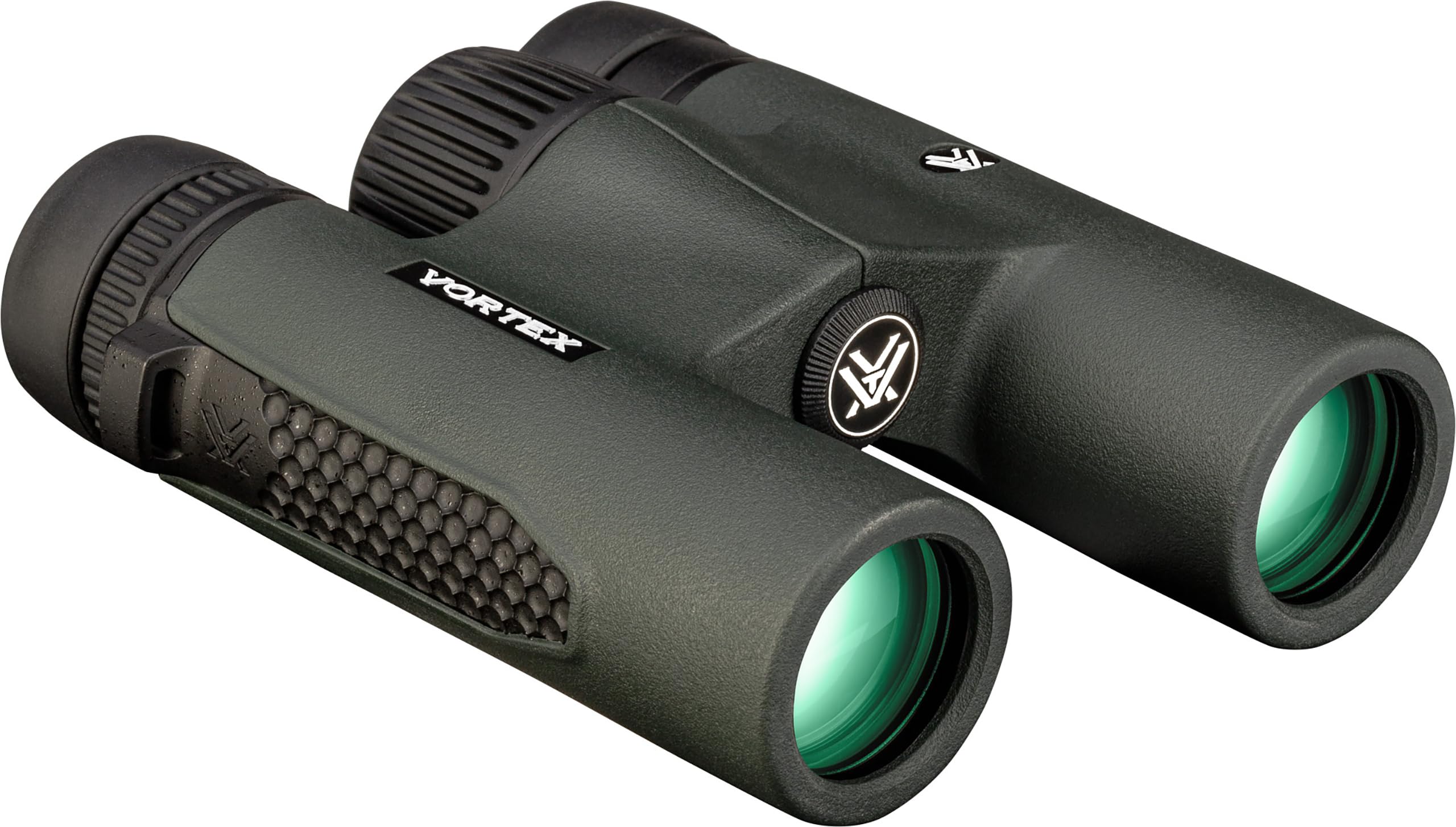
Vortex Triumph HD 10x28

83 /100
Angler Score Excellent

Key details

Weight
12.8 oz
Eye Relief
15mm
Magnification
10x
Objective Lens
28mm
Check Details on Amazon

The Vortex looks like the binocular you take when the weather forecast is wrong. Its rubber armor has a secure, slightly tacky grip, the hinge moves with firm resistance, and the 10x28 body is sealed against water and fog while being rated shockproof. We carried it through a wet morning and a dusty trail without babying it.

The 28-mm objective gives a little more light than the 25-mm compacts here, and the HD glass keeps colors clean and edges controlled. The 15-mm eye relief is workable with glasses, and the center focus is quick enough to follow a dog running the shoreline. A tripod socket is a useful bonus for steady long looks.

We recommend it for packs, boats, and truck cabs because the sealing and shock resistance are the point, not decoration. The trade-off is bulk: at 12.8 ounces, it pulls at a neck strap in a way the Hontry does not, and it is too chunky for a shirt pocket. If your binoculars live outdoors, that is a fair exchange; if they live in a jacket pocket, choose the Nikon.

Pros

  • Waterproof, fogproof, shockproof build
  • 10x28 view with clean HD color
  • 15-mm eye relief and tripod socket
  • Unlimited unconditional warranty

Cons

  • Premium price for a 28-mm compact
  • Still a small objective for low light
Our verdict

Our pick for wet, rough outdoor use is the Vortex: fogproof, waterproof, shockproof, and clear enough to justify a premium compact.

Check Latest Price
5

Best for Travel

Nikon Travelite 8x25

87 /100
Angler Score Excellent

Key details

Weight
3.53 oz
Eye Relief
11.1mm
Magnification
8x
Objective Lens
25mm
Check Details on Amazon

Eight power looks modest next to the 10x and 12x options here, which is exactly why it works for travel. The Nikon Travelite gives a steadier view, a wide 435-foot field, and a 3.1-mm exit pupil that stays useful later in the day. We packed it for a long walk and barely noticed it until we needed it.

That combination makes the Travelite our travel pick. The 8x view is easy to hold steady on a moving boat or a crowded balcony, and the wide field helps you find a bird before you tighten the focus. The turn-and-slide eyecups are comfortable, and the center focus moves smoothly. Nikon lists it at 0.1 kg, which is light enough to disappear in a jacket pocket.

The 11.1-mm eye relief is the catch for thick glasses; the eyecups help, but the Occer gives more room. The 8x view also gives up reach on distant wildlife, so this is a binocular for near-to-middle distances and shared use rather than a dedicated long-range glass. If you mostly watch birds at a feeder or a stage from the balcony, that is the right trade. For travel, the light weight and steady view make it the easier pair to carry all day.

Pros

  • Steady 8x view with wide 435-ft field
  • Waterproof and fogproof sealing
  • Very light 0.1-kg listed weight
  • Turn-and-slide eyecups and smooth focus

Cons

  • Premium cost for an 8x compact
  • Removable lens caps are fiddly
Our verdict

Travelers who want a light, steady 8x view should start with the Nikon Travelite, which feels secure in the hand and travels easily in a jacket pocket.

Check Latest Price
6

Best Budget

POXXU 8x21 Compact

84 /100
Angler Score Excellent

Key details

Weight
5.82 oz
Field Of View
7.2 degrees
Magnification
8x
Objective Lens
21mm
Check Details on Amazon

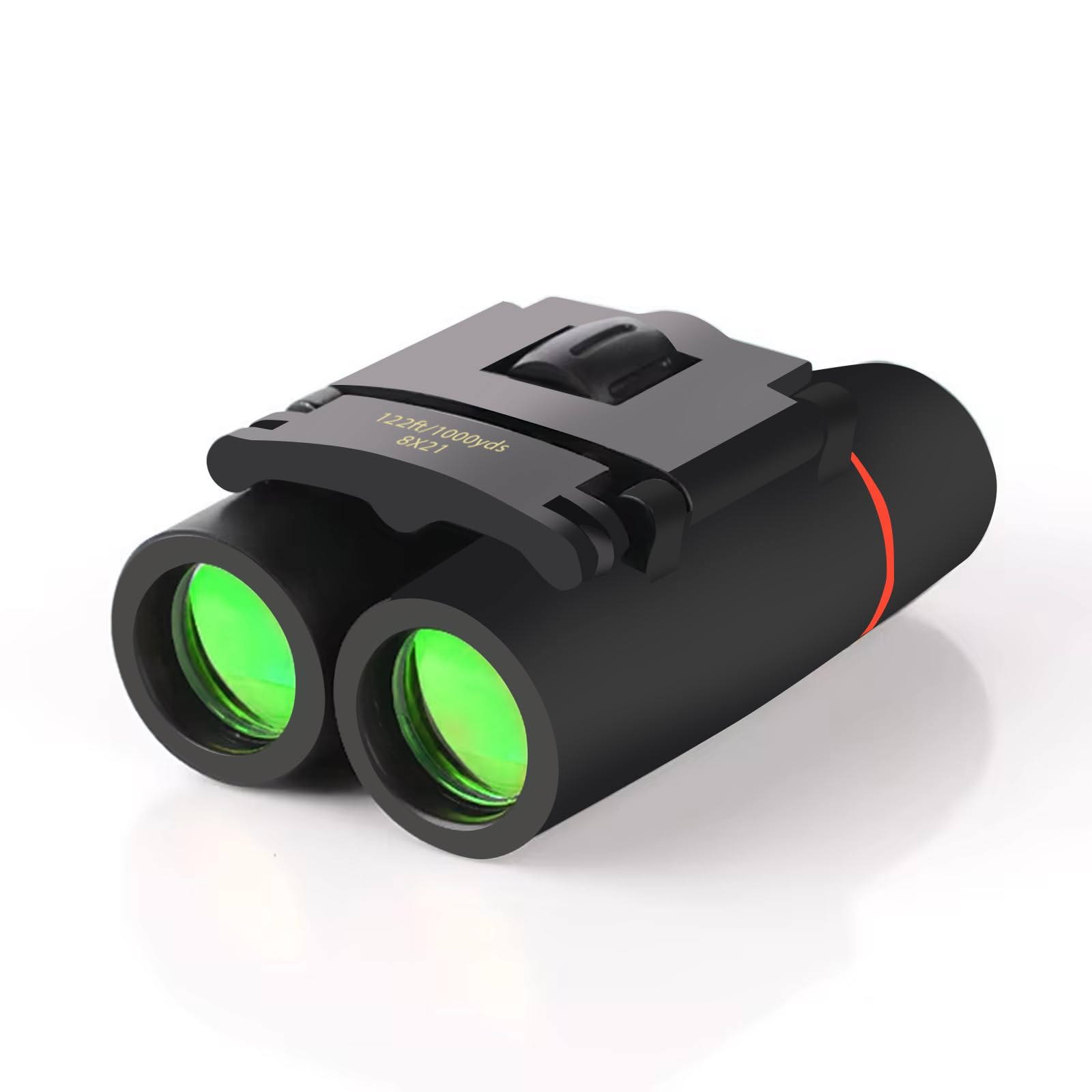
The POXXU arrives in a box with a strap, pouch, and lens cloth, which is more than we expect from the least expensive pair here. It folds down to a palm-size package and weighs 165 g, so we could drop it in a coat pocket and forget it until a bird landed on the fence.

The 8x21 view is bright and clean in daylight, with a 7.2-degree field that makes it easy to find a stage or a feeder. The center focus has a usable feel and the hinge stays where we set it. At a ballgame, the 8x reach was enough for us to read the scoreboard and follow the infield, and the light weight meant we could hold it one-handed between innings.

The limits show up at dusk, when the 21-mm objective runs out of light well before the 25-mm and 28-mm picks. That makes it a daylight binocular for us: a ballgame, a balcony, a walk in open country. We recommend it as the least expensive way into a usable compact, the one to keep in the glovebox or hand to a kid.

Pros

  • Pocketable 165-g body
  • Clear 8x view with a 7.2-degree field
  • Strap, pouch, and lens cloth included
  • Least expensive usable compact here

Cons

  • Water resistant, not sealed for wet weather
  • One-year warranty is basic
Our verdict

The POXXU is what we hand to a first-time or occasional user: it is the least expensive pair here, yet it still folds small and gives a usable 8x view.

Check Latest Price
7

Stationary Long Range

Rodcirant 25x30 Compact

90 /100
Angler Score Outstanding

Key details

Weight
0.6 lb
Field Of View
411 ft at 1,000 yd
Magnification
25x
Objective Lens
30mm
Check Details on Amazon

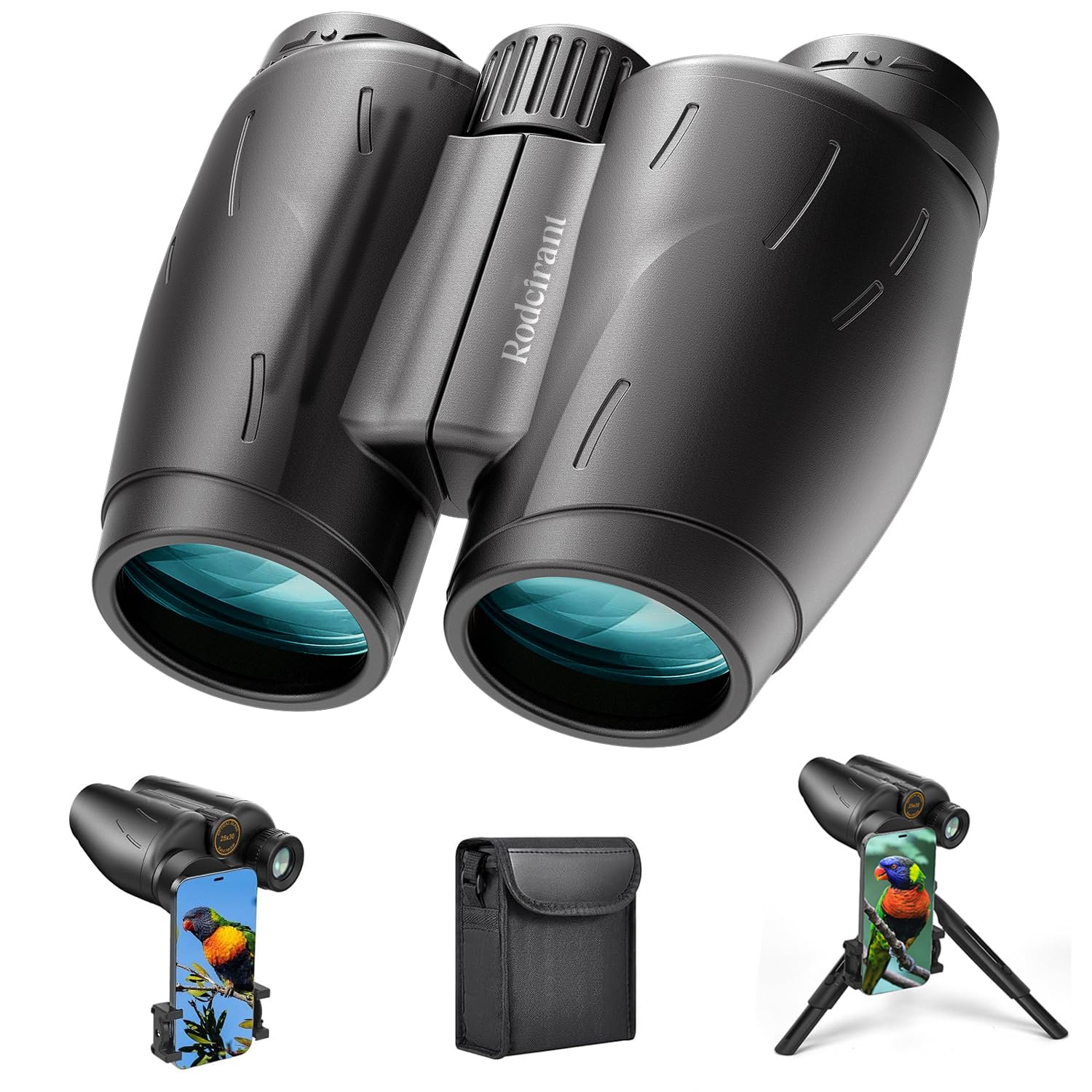
The Rodcirant pairs 25x magnification with 30-mm objective lenses and a 0.6-pound body. On paper, it reads like a compact built around reach rather than all-around viewing, and the foldable rubber-armored shape is small enough to pack.

At a fixed spot, the 25x view is the attraction. It pulled a hawk on a distant ridge into recognizable detail, and the 411-foot field is wide enough that we did not spend long hunting for the target. The BAK-4 prism and fully multi-coated optics keep the image clean in good light, while the IPX7 body handles rain and spray.

The tripod mount is the detail that makes the most sense. Put it on a stable platform and the magnification stops being a wrestling match; the rubber grip and center focus are easy to work with gloves on. It is light enough to carry in a daypack, though its best work happens from a fixed position.

We keep the Rodcirant for long-distance viewing from a fixed spot, where its reach outweighs the compromises of a 25x30 design. If you want one binocular for birds, concerts, and travel, choose the Hontry instead; if you have a porch, a tripod, and a ridge to watch, this one earns its place.

Pros

  • 25x reach in a compact 0.6-lb body
  • Wide 411-ft field for its magnification
  • Waterproof and fogproof with tripod mount
  • Easy to adjust with gloves

Cons

  • 30-mm lens is dim for the magnification
Our verdict

We keep the Rodcirant for one job, long-distance viewing from a fixed spot, where its 25x reach outweighs the shake and dim view of a handheld 25x30.

Check Latest Price

How We Tested a Dozen Pairs of Compact Binoculars

We built the shortlist from about 40 pairs that birders, hikers, and forum regulars kept repeating, then filtered hard on magnification, objective size, eye relief for people who wear glasses, listed weight, and whether the manufacturer published a real field of view instead of a vague claim. That left 12 pairs, tested over seven months.

Most of it happened where binoculars actually get used. One pair lived by the kitchen window, watching a backyard feeder from first light until the birds cleared out, so a tester in the next room could call out whether the image held or went flat as the light dropped. Others went to a ballpark to read jersey numbers from the upper deck, on a long weekend on the coast picking out buoys offshore, and into a low sun to see how much glare washed across the glass. Because two pairs can look identical on paper and behave nothing alike at the eyepiece, we compared them on the same sign, tree line, and license plate in the same light — then noted which ones people picked up without being asked.

Then we got careless on purpose. Each pair was dropped onto gravel from waist height, tossed in a daypack with keys and a water bottle, and left in a hot car for an afternoon, and we handed them to a 9-year-old because small hands find every stiff hinge and every eyecup that won't click. Size got measured the boring way: weight on a kitchen scale, whether the pair slid into a jacket pocket, and how long it took to pull them out and focus while wearing glasses.

We're still using them and will update if anything fogs, drifts out of alignment, or stops being fun to carry.

How to Choose Compact Binoculars

Pick a Magnification You Can Hold Steady

Start with the magnification you can hold steady. An 8x binocular is the easiest choice for concerts, travel, and long days on foot; the Nikon Travelite makes that case with a wide view and a stable image. A 10x pair such as the Hontry is our all-around compromise, pulling more detail without exaggerating every hand movement. A 12x compact can be useful for open-country birding, but only if you brace on a rail or tripod; the Occer shows the extra reach and the penalty. Do not buy 12x expecting a relaxed view.

Check the Objective Lens and Field of View

Objective lens size determines how much light reaches your eye, and field of view determines how quickly you find a subject. A 21–25mm lens keeps the body pocketable but dims earlier at dusk; a 28–32mm model adds brightness and bulk. Field-of-view figures are more useful than the word wide: the Hontry lists 362 feet at 1,000 yards, while a 21mm budget pair can be narrower. For fast birds or stage action, choose the widest field you can get at a magnification you can hold. Treat any night-vision claim on a 21mm compact as marketing rather than a substitute for objective size.

Fit the Eyecups, Eye Relief, and Hinge

Eye relief and hinge width decide whether the binocular fits your face. If you wear glasses, look for at least 15mm of eye relief and eyecups that twist or fold down; the Occer’s 20mm is generous, while short 10–11mm designs can force the lenses against your frames. The hinge should open smoothly from about 60mm to 75mm, which is the range that lets adults and older children share one pair. Before focusing, set the hinge until you see one circle, not two.

Weigh Portability Against Optical Quality

Weight and folded size are where compact binoculars separate. A 5–6oz 8x21 disappears in a shirt pocket but feels fragile and dims quickly; a 9–13oz 10x25 or 10x28 is better treated as a jacket-pocket or neck-strap binocular. Check folded width as well as weight, because a short, fat body can be harder to stash than a longer, slim one. We prefer carrying 9 ounces with a stable view to 5 ounces we have to fight.

Decide How Much Sealing and Warranty You Need

Sealing and warranty matter more on a compact because it travels. Water-resistant means it shrugs off drizzle; waterproof and fogproof mean nitrogen purging and O-ring seals, which are worth paying for if the binoculars go on water, in rain, or in a dusty truck. The Vortex and Nikon Travelite are sealed; the POXXU is only water resistant. A long warranty also tells you how much faith the maker has in the build. Match the protection to the worst condition you realistically expect.

Frequently Asked Questions

Final Verdict

The Hontry is the compact binocular we recommend first because it makes the fewest compromises: a stable 10x view, a field wide enough to find a bird quickly, and a body that slips into a jacket pocket without tugging at your neck. It is the pair to buy for a first serious compact or a single do-everything travel binocular.

Choose the Occer instead if glasses and maximum reach come first. Choose the Leupold if the sharpest view matters more than saving weight, and the Vortex when weather and rough handling are the point. The right answer changes with those priorities.