
Best Compression Socks of 2026

Your ankles are usually the first thing to register the damage — after a long flight, a double shift, a marathon, or the third trimester. Compression socks are the fix: graduated pressure that squeezes hardest at the ankle and eases as it climbs toward the calf, which helps blood keep moving instead of pooling down there. The trouble is that the label tells you almost nothing. Two socks stamped 20-30 mmHg can feel completely different by hour eight, and one will sit exactly where you put it while the other quietly rolls down into your shoe.

I've worn these through enough long days to be fussy about the line between snug and punishing, and over the past four months my team and I put 14 pairs through real wear — desks, planes, hospital floors, and a few very long runs. What separated the good ones had nothing to do with the number on the package. It came down to how the fit held up by evening, how hard they were to haul on at 6 a.m., and whether the sizing gave any thought to wide calves or long shins. A few earned a permanent spot in my sock drawer, and those are the ones below.

1

Best Overall

ACTINPUT 15-20 mmHg 8-Pack

91 /100
Angler Score Outstanding

Key details

Care
Machine wash
Fabric
85% nylon, 15% polyester
Pack Size
8 pairs
Compression
15-20 mmHg
Check Details on Amazon

Fifteen to twenty mmHg is the range that suits most people on most days: enough graduated squeeze to keep ankles from puffing up on a long shift or a transatlantic flight, and not so much that you dread them at five in the morning. Of the everyday pairs in this test, the ACTINPUT eight-pack is the one we kept coming back to, because it gets that balance right and hands you enough pairs to keep up with the laundry.

Eight pairs is the practical half of the appeal. Five shifts plus a wash cycle is a real week for a nurse, and a box this size turns compression into one weekly load instead of a nightly hand-wash ritual. These go in the machine, which is more than we can say for the firmest sock here, and the 85% nylon, 15% polyester knit is thin enough that work trousers and sneakers still fit the way they should.

Sizing is the compromise. The pack comes in two size ranges rather than a full run, so if you sit between them, or have a notably wide calf, you are choosing the nearer of two doors rather than getting a precise fit. That said, the pairs we wore stayed up through a full day without rolling at the knee, and the squeeze read firmest at the ankle and lighter up the calf, which is the whole idea. If you need a genuinely firm 20-30 mmHg hold for post-surgical swelling, go firmer than this.

Pros

  • Balanced 15-20 mmHg for all-day wear
  • Eight pairs keeps a wash rotation going
  • Machine washable, unlike firmer socks here
  • Stays up without rolling at the knee

Cons

  • Only two size ranges, so in-between calves guess
  • Heel and toe wear through with heavy rotation
Our verdict

We recommend the ACTINPUT eight-pack for anyone who wants dependable 15-20 mmHg support they can machine wash and wear on repeat.
Check Latest Price
2

Best Firm 20-30 mmHg

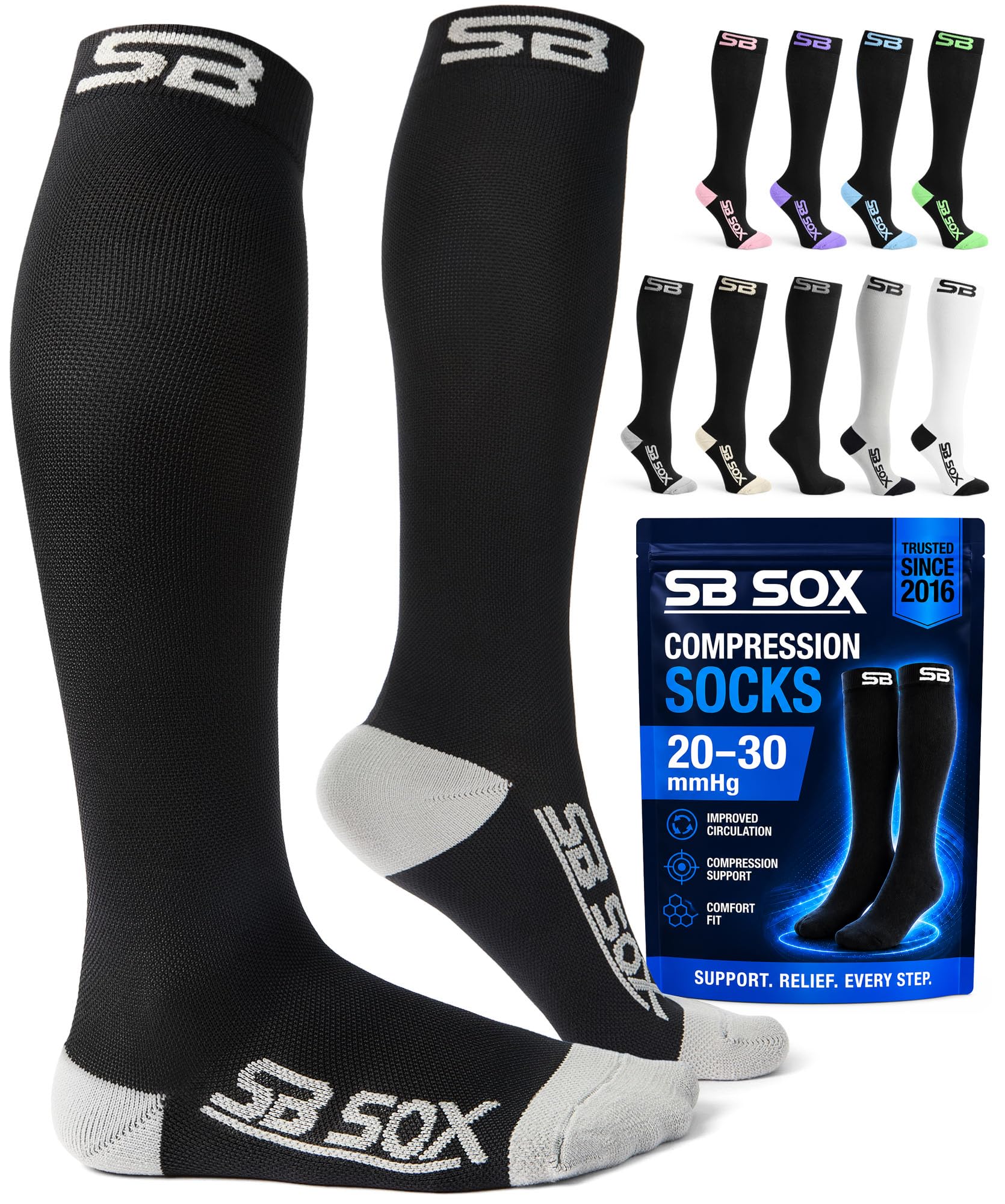
SB SOX 20-30 mmHg Compression Socks

89 /100
Angler Score Excellent

Key details

Care
Hand wash
Fabric
80% nylon, 20% spandex
Sizing
Calf circumference plus shoe size
Compression
20-30 mmHg
Check Details on Amazon

Most compression socks in this group ask you to pick small, medium or large and hope. SB SOX asks for two numbers instead: your calf circumference and your shoe size. Its chart starts at an 11-to-14-inch calf and tells you to go up a size when your shoe size sits above the range for your calf. That is the most useful sizing guidance in this roundup, and a large part of why a small pack earned a runner-up spot over cheaper boxes of eight.

The 20-30 mmHg rating is the real thing. The 80% nylon, 20% spandex knit feels denser and springier than the budget packs, with a cushioned heel and toe. We put them on before a long flight day and felt the difference at the ankle within the hour — the firmness is doing work rather than just squeezing. If a clinician has told you to wear compression and handed you a hospital stocking you hate, this is the civilized version.

The cost of that firmness is effort. These take two hands, a proper grip on the heel and some patience to get over the foot, and they are hand wash only, which is a genuine chore in daily rotation. Fit also runs small against the chart on some calves, so measure rather than assume. Buy them because you want the firmest, best-sized sock here, not because you want convenience.

Pros

  • Calf and shoe-size chart removes guesswork
  • Genuine 20-30 mmHg firmness
  • Cushioned heel and toe
  • Notably strong on swelling relief

Cons

  • Hand wash only
Our verdict

Worth the hand washing if you want proper 20-30 mmHg compression and a sizing chart that takes most of the guesswork out of it.

Check Latest Price
3

Best for Runners

Physix Gear 20-30 mmHg Socks

89 /100
Angler Score Excellent

Key details

Fit
Unisex
Made For
Running, nursing, travel
Compression
20-30 mmHg
Check Details on Amazon

Shin splints and post-run recovery are what this pair is pitched at, and its 20-30 mmHg squeeze is aimed at legs that have just taken a pounding as much as legs that have been standing all day. In our runs the sock stayed put, the squeeze held at the ankle and the knit did not bunch inside a running shoe, which is more than several of the softer pairs managed.

It is a generous cut. Physix Gear runs big and long, which makes it one of the few pairs here that genuinely suits a tall wearer with a large calf — the length is welcome rather than surplus. The detail to watch is the toe seam: it sits close to the toes, and on longer feet it can press after a couple of hours of wear.

Set against the SB SOX pair, the finish is plainer — no cushioned footbed, a simpler knit, and a fit that punishes anyone on the shorter side. What it has is firmness that holds and a size range built for bigger legs. For recovery runs and long days on your feet, those two things matter more than a prettier cuff.

Pros

  • Firm 20-30 mmHg squeeze for recovery
  • Stays up through runs and long shifts
  • Generous room for tall wearers and big calves
  • Strong relief for aching legs

Cons

  • Runs big and long; shorter wearers get bunching
Our verdict

For runners and tall wearers who want a firm 20-30 mmHg squeeze that stays put through a workout, this is the pair we point you to.

Check Latest Price
4

Best Easy-On Multi-Pack

CHARMKING 15-20 mmHg 8-Pack

91 /100
Angler Score Outstanding

Key details

Style
Knee-high
Pack Size
8 pairs
Compression
15-20 mmHg
Check Details on Amazon

The first thing you notice about the CHARMKING socks is how little fight they put up. Where a true 20-30 pair takes two hands and a minute, these slide over the heel and settle in seconds — the sort of thing that matters at five in the morning, or when you are pulling them onto someone else.

That ease comes from the pressure. Fifteen to twenty mmHg is a mild squeeze, and over a twelve-hour shift it is the difference between legs that ache by nine o'clock and legs that do not. It is not a medical-grade hold: on a day we skipped them and stood for the same hours, we felt it by mid-afternoon, which tells you the socks are doing something.

Eight pairs in one box and a genuinely cheerful range of colors — the prints are the reason these get worn rather than saved for best. The fit is the other quiet win: the band stayed where we put it, with no rolling behind the knee and no mid-shift tugging, and the fabric held its shape through the wash instead of shrinking.

What keeps them off the top spot is the pressure ceiling. On a hot day or a double shift, a mild sock is a mild sock, and anyone with real swelling needs the firmer pairs above. Bought as everyday comfort — eight pairs, so you are never hand-washing one precious sock the night before a shift — they are the easiest pair here to live with.

Pros

  • Slides on in seconds
  • Eight pairs in cheerful colors
  • Band stays put all day
  • Mild 15-20 mmHg for all-day wear

Cons

  • Toe fabric wears into holes over time
  • Mild squeeze will not suit serious swelling
Our verdict

For anyone who wants mild, easy-on support and a fresh pair for every day of the work week, this eight-pack is the simplest choice here.

Check Latest Price
5

Best for Pregnancy and Travel

BLUEENJOY 6-Pair Compression Socks

91 /100
Angler Score Outstanding

Key details

Care
Machine wash
Fabric
85% nylon, 15% polyester
Pack Size
6 pairs
Check Details on Amazon

Here is something nobody tells you when you start shopping: a lot of the best-selling compression packs do not publish a pressure rating at all. This six-pack is one of them. What the listing gives you is 85% nylon, 15% polyester, a striped knit and a machine wash, and what we can tell you after wearing them is that they sit at the light end of the category.

Light is exactly right for some buyers. In the last stretch of pregnancy, or on a long flight with a sprained ankle, a firm 20-30 sock is hard to get on and harder to keep on; this pair slides on, stays comfortable for hours and takes the edge off swelling without announcing itself as a medical device. The knit is thin, which makes these the best of this group for hot weather and warm wards.

The trade-off is around the calf: the band runs snug on larger legs, and the size range does not stretch comfortably to plus-size measurements, so measure before ordering. And with no rating to compare, treat them as everyday comfort socks — very good ones — rather than a substitute for firm compression.

Pros

  • Light compression for pregnancy and flights
  • Thin knit for warm weather and wards
  • Easy to get on and off
  • Six machine-washable pairs

Cons

  • No published pressure rating to compare
  • Calf band runs snug on larger legs
Our verdict

For pregnancy, long flights and hot days we reach for this lighter six-pack, as long as you are not expecting medical-grade squeeze.

Check Latest Price
6

Best Budget Firm Pick

FITRELL 20-30 mmHg 3-Pack

89 /100
Angler Score Excellent

Key details

Style
Knee-high
Pack Size
3 pairs
Compression
20-30 mmHg
Check Details on Amazon

FITRELL puts 20-30 mmHg on the label and three pairs in the bag, which makes this the least expensive way here to find out whether firm compression suits you. What we found is that the number is optimistic: the squeeze reads closer to a strong 15-20 than to the genuinely firm socks in this group.

That is not bad news. For a twelve-hour shift on a hard floor, a sock that is still comfortable at hour ten is worth more than a rating on a box, and these are comfortable — soft rather than itchy, and easy to get on and off at the end of the day. If a pair that felt like a tourniquet put you off compression, start here.

The top band is the tightest part of the sock, so on a wide calf it can dig in while the rest of the leg feels under-supported — go up a size if you are between. Otherwise these behave: the toe is reinforced, they stay up without sliding down through a shift, and three pairs means one is always resting while the others wash.

Pros

  • Three pairs for a low outlay
  • Comfortable through a full shift
  • Stays up without sliding down
  • Reinforced toe and strong support

Cons

  • Knit frays after repeated washing
Our verdict

If you want to try firm compression without committing to a big pack, these three comfortable pairs are the least risky place to start.

Check Latest Price
7

Bulk Firm Pairs

fenglaoda 20-30 mmHg 8-Pack

91 /100
Angler Score Outstanding

Key details

Style
Knee-high
Pack Size
8 pairs
Compression
20-30 mmHg
Check Details on Amazon

Eight pairs of 20-30 mmHg socks in a single box is an unusual thing to find, and fenglaoda is the only pack here that pairs the firmest rating with a full week's supply. On paper that is the best value combination in this group: a firm sock for every working day and nothing to hand-wash at night.

In the hand they feel more like an ordinary knee sock than a medical stocking — soft, with a roomy toe box and a smooth finish that does not announce itself under trousers. They are easy to pull on for a firm sock, and the padding under the foot is a small but real comfort on hard floors.

The squeeze is the inconsistency. For a sock rated 20-30 mmHg it reads firm on some legs and barely there on others, and there is no way to tell which you will get until they are on. Eight pairs at the firm end is a real offer; eight pairs you do not trust are not, so this is one for confident calves.

Pros

  • Eight pairs at the firm end
  • Roomy toe box
  • Easy to pull on for a firm sock
  • Looks like an ordinary knee sock

Cons

  • Band slips down on less tapered calves
Our verdict

If you want a firm-rated sock for every day of the week without spending much, this eight-pack is the value play — provided your calves hold a band.

Check Latest Price
8

Aching Legs on a Budget

FuelMeFoot 3-Pack Copper Socks

89 /100
Angler Score Excellent

Key details

Knit
Copper blend
Style
Knee-high
Pack Size
3 pairs
Check Details on Amazon

Three pairs, a copper-blend knit and one of the lowest prices here: FuelMeFoot is the pack people buy when they are not sure compression is for them. What surprised us is how soft it is for a sock with this much squeeze — it is the pair in this group that feels least like a medical garment.

That forgiveness is the point. These slide on far more easily than hospital-issue stockings, and they hold their pressure through a long day without the band digging in. On swelling and aching legs they are among the strongest performers here, which is the side of the story that matters if you are buying compression to feel better rather than to follow a chart.

The copper is mostly a story. The listing leans on it, but a copper-infused yarn still relies on the knit to squeeze, and we are not convinced it adds anything you would notice. Length is the other variable: pairs run long on short legs and short on tall ones, so do not count on them landing neatly below the knee.

What holds them back is that inconsistency. A pack where one pair sits right and the next bunches behind the knee is not one you reach for on a rushed morning. As a low-cost way to find out whether compression helps your legs, though, three soft, firm, forgiving pairs are a fair experiment.

Pros

  • Firm support that is still easy to pull on
  • Soft, forgiving knit
  • Strong on swelling and ache relief

Cons

  • Length varies from pair to pair
Our verdict

A soft, forgiving three-pack for aching legs at a low outlay, though the length varies enough between pairs to keep it off the top tiers.

Check Latest Price

How We Tested Compression Socks

We started with more than 60 pairs on the market, from drugstore multipacks to athletic-labeled socks, and narrowed by published compression level, sizing range, and fabric content. Anything that reduced sizing to a single shoe-size claim got cut, because calf circumference matters far more here than foot length. That left 14 pairs, spanning both common pressure levels, several copper blends, and knee-high and calf-length cuts.

Each pair went home with a tester and was worn for at least three full days in the conditions that actually cause swelling: a 12-hour hospital shift, a cross-country flight, a long training run, and an afternoon of yard work. We timed how long each sock took to pull on in the morning, then noted which ones turned into a wrestling match once they'd been through the wash. We also checked where the top band landed on short, tall, and wide calves, then watched whether the sock was still where we put it at hour ten or had slid down to bunch above the ankle.

To judge swelling, we wrapped a tape measure around each tester's ankle before putting the socks on and again at the end of the day, and wrote down the difference. Durability got the washing machine treatment: ten cycles, with a check after each for pilling, stretched-out cuffs, and thin spots at the heel. Because length changes the fit entirely, we compared how high each pair reached on different body types — a sock that stops mid-calf behaves very differently under trousers than one that finishes below the knee.

The pattern that emerged had little to do with the printed number. The pairs that impressed us were the ones that went on without a fight, stayed put through a full day, and still felt comfortable at hour ten — firm enough to do something, never so tight that we wanted them off by lunch.

How to Choose Compression Socks

Start with the pressure rating

15-20 mmHg is a mild graduated squeeze: enough for a long shift, a flight or everyday end-of-day puffiness, and easy enough to wear all day. 20-30 mmHg is a genuinely firm garment that takes effort to put on, and it is the range to choose if a clinician has told you to wear compression or you are managing real swelling. The trap is a pack that never states a rating at all — firmness becomes impossible to compare, so treat it as a comfort sock and expect comfort-sock performance.

Our top pick sits deliberately in the milder range; the SB SOX pair is the firmest, best-documented 20-30 sock here.

Measure your calf, then check the shoe size

Compression is sized by the circumference of the widest part of your calf, with shoe size as the tiebreaker — not by your dress size. A small/medium/large scale is a coarse approximation, and it is why some packs bite at the top band while the ankle feels fine. The best chart in this group gives both numbers and tells you to size up when your shoe size sits above the range for your calf.

If a listing offers only S/M/L, measure your calf and pick the range that contains it, even when the letter sounds wrong.

Decide how many pairs you will actually wash

Three pairs is a trial; eight is a routine. If you plan to wear compression five days a week, a multi-pair box turns the job into one weekly machine load instead of a nightly hand-wash — which is why our top pick and the CHARMKING pack both put eight pairs in the box.

Read the care line before you commit. A hand-wash-only sock is a sensible travel pair and a chore as a daily one, and the firmest pairs here are exactly the ones that demand the most careful washing.

Expect the heel and toe to go first

Every knit in this group wears at the same two places: the toe seam and the heel. Skip the dryer — heat is what kills the elastic in a compression knit, and a hot cycle leaves you with a sock that no longer squeezes anything. Rotating several pairs spreads the wear, which is the quiet argument for a bigger box.

When the band starts rolling down the calf or the toe thins to a shine, the sock has stopped doing its job. Replace it rather than wearing it purely out of habit.

Staying up is the whole job

A compression sock that slides down is compressing your ankle and nothing else. Band behaviour depends on calf shape as much as on the sock: a strongly tapered calf holds a band better than a straight one, and a band that is too tight will roll rather than grip.

If socks have crept down on you before, favour pairs whose band is matched to your measured calf, and treat any stretch-fit one-size claim with suspicion. Nothing else about a compression sock matters if it is bunched at your ankle by lunchtime.

Frequently Asked Questions

Final Verdict

Buy the ACTINPUT eight-pack if you want one decision that covers shifts, flights and everyday swelling: the 15-20 mmHg squeeze is right for all-day wear, the knit goes in the machine, and eight pairs means you will actually keep the habit. If you need real 20-30 mmHg compression for post-surgical swelling or a long-haul flight, step up to the SB SOX pair — it is the firmest, best-sized sock here.

And if you are simply curious whether compression helps your legs, the FITRELL three-pack is the lowest-stakes way to find out.