Best Dry Bags of 2026

A dry bag has one job, and it's the kind of job where mostly dry counts as broken. I've opened a roll-top after a day on the river to find my phone and car keys sitting in a puddle the fabric swore would never happen — the bag looked fine, the roll looked fine, everything inside was soaked. What a good one buys you is boring and enormous: your sleeping bag, your spare layers, your phone, and your keys come out exactly the way they went in, whether the day involved a capsize, a downpour, or a wave over the bow.

Over the past five months, my team and I have put 14 dry bags through river days, rainy trailheads, and more than a few kitchen-sink soaks to see which ones actually hold. Here's what nobody tells a first-time buyer: the fabric is almost never the failure point. Most leaks trace back to a seam, a buckle that pops open, or a bag that's so stiff and awkward to roll that you never quite seal it right with cold, wet hands. The picks below are the ones that came out dry every single time.

1

Best Overall

Earth Pak 20L Dry Bag

95 /100
Angler Score Outstanding

Key details

Carry
Adjustable 24 to 42 inch shoulder strap
Capacity
20 liters
Included
IPX8 waterproof phone case
Material
500D PVC
Check Details on Amazon

Reaching for the car keys should not mean unrolling your whole dry bag on a windy beach. The zippered front pocket on Earth Pak's 20-liter is the feature we reached for all day: keys, a knife, a lighter, and a phone in the included IPX8 case come out without breaking the seal on the main compartment. No other bag here gives you that, and it is the main reason this one sits at the top of the list.

Twenty liters is the size we recommend to anyone who asks, because it swallows a towel, a change of clothes, sunscreen, snacks, and a phone and still leaves enough fabric above the load to roll the top down properly. The 500D PVC shell came through a day of gravel, boat decks, and being sat on without a mark that worried us, and at 13.6 ounces it feels like a bag that will still be in the truck in five years.

It is also a simple bag, which we count in its favor. One compartment, a roll-top you press and clip, a strap that adjusts from 24 to 42 inches so the bag rides cross-body on the walk down the ramp, and a waterproof phone case in the box. Pack it, roll it, clip it. There is nothing to learn, and nothing to go wrong that a few seconds of care will not prevent.

Pros

  • Front zip pocket for keys and phone
  • Abrasion-resistant 500D PVC shell
  • IPX8 waterproof phone case included
  • Adjustable 24 to 42 inch shoulder strap

Cons

  • Backpack straps only from the 30L size up
Our verdict

The dry bag we tell most people to buy: 20 liters, a 500D PVC shell, and a front pocket that saves you unrolling everything for your keys.

Check Latest Price
2

Best Value

MARCHWAY Floating Dry Bag

95 /100
Angler Score Outstanding

Key details

Carry
Adjustable, cross-body, removable shoulder strap
Sizes
5L to 40L
Weight
10.6 oz
Capacity
10 liters
Check Details on Amazon

A round bottom is the most useful thing about this bag, and it has nothing to do with how it looks. Spread the base open, drop your gear in, and trap a pocket of air before you roll the top down three to five times and clip it. That trapped air is what keeps the MARCHWAY floating beside a tube instead of heading for the bottom, and for the money it is the bag we hand friends who want one dry sack and no homework.

The shell is a multi-layer PVC with welded seams, and the 10-liter we used weighs 10.56 ounces and rolls down small enough to live in a hatch between trips. Sizes run from 5L to 40L, and the strap changes with them: the 5L and 10L get a removable cross-body strap, while 20L and up switch to backpack straps. The size you order changes how you carry it as much as how much you carry.

What we appreciated most is how little fuss there is at the water's edge. The buckle threads and presses without a fight, the wide opening means you are not posting a towel through a slot, and the material wipes down and dries fast. It is not the toughest shell in this guide, but for day trips it is the value pick of the group, and it leaves room in the budget for the trip itself.

Pros

  • Round bottom traps air so it floats
  • Welded seams in multi-layer PVC
  • Removable cross-body strap on 5L and 10L
  • Sizes from 5L to 40L

Cons

  • Plastic buckles are the first wear point
Our verdict

A round bottom that traps air, welded seams, and a removable strap: this is the value pick we hand to anyone who wants one simple dry sack.

Check Latest Price
3

Best for Big Loads

Earth Pak 55L Dry Bag Backpack

95 /100
Angler Score Outstanding

Key details

Weight
2.7 lb
Capacity
55 liters
Included
IPX8 waterproof phone case
Warranty
Five years
Check Details on Amazon

Fifty-five liters is where a dry bag stops being something you sling over a shoulder and starts being luggage. A two-person tent, a camp chair, a sleeping bag, and a change of clothes go in with enough room left to roll the top down. This is the bag for the float trip where you are camping at the other end, not the one for a two-hour paddle.

It is built like the rest of Earth Pak's line: an abrasion-resistant 500D PVC shell, a zippered front pocket for the headlamp and the keys, and an IPX8 phone case in the box that fits phones up to 6.5 inches. The backpack straps the 30L-and-up sizes get are the difference between carrying a heavy load and lugging one, and the five-year warranty is the longest backing on anything in this guide.

What convinced us to give it a slot is consolidation. One bag holds the tent, the stove, the sleeping bag, and the clothes, which means one thing to carry from the ramp to the campsite and one thing to keep sealed when the weather turns, instead of three. At 2.7 pounds empty it is a commitment, and it is a bag you pack for a trip rather than a bag you keep in the truck for the afternoon.

Pros

  • Holds a tent, chair, and sleeping bag
  • Backpack straps spread a heavy load
  • Five-year warranty
  • Front zip pocket and IPX8 phone case

Cons

  • Wide, stiff straps compared with a hiking pack
Our verdict

Buy this one when the dry bag has to double as luggage: 55 liters, backpack straps, and the longest warranty we found here.

Check Latest Price
4

Best for Beach Days

Skog Å Kust DrySak 5L

95 /100
Angler Score Outstanding

Key details

Carry
Adjustable, removable shoulder strap
Weight
9.52 oz
Pockets
Exterior splash-proof and slip pockets
Capacity
5 liters
Check Details on Amazon

Dry bags are usually the least interesting thing in the photo, which is part of why the DrySak sells: it comes in tie-dye and bright prints, and on a beach full of identical black sacks that is how you find yours before someone else picks it up by mistake. The exterior splash-proof pocket is the practical half of the same idea, with a phone, keys, and a card sitting outside the roll-top and within reach.

Five liters holds more than we expected. Two beach towels and a change of clothes went in with room to roll, the removable shoulder strap let us carry it hands-free down to the water, and the vinyl has enough body that the bag stands up when you set it down full instead of collapsing into a puddle of plastic. That last part matters more than it sounds: a bag that stays open is a bag you can pack one-handed.

The size is where the limits start. Five liters is a beach bag, good for towels, sunscreen, a phone, and a paperback, and it is not a paddling day bag. If you want one bag for a full day on the water, the 20L Earth Pak is the better shape of bag. For the pool, the boat, and the sand, the DrySak is the one we reach for, because it is the one that looks like it belongs there.

Pros

  • Bright prints are easy to spot
  • Exterior pocket keeps phone and keys handy
  • Removable shoulder strap
  • Holds two beach towels at 5 liters

Cons

  • Exterior pocket is splash-proof, not waterproof
Our verdict

The one we grab for sand and sun: prints you can spot from the beach and a 5-liter body that takes two towels and a change of clothes.

Check Latest Price
5

Best Budget

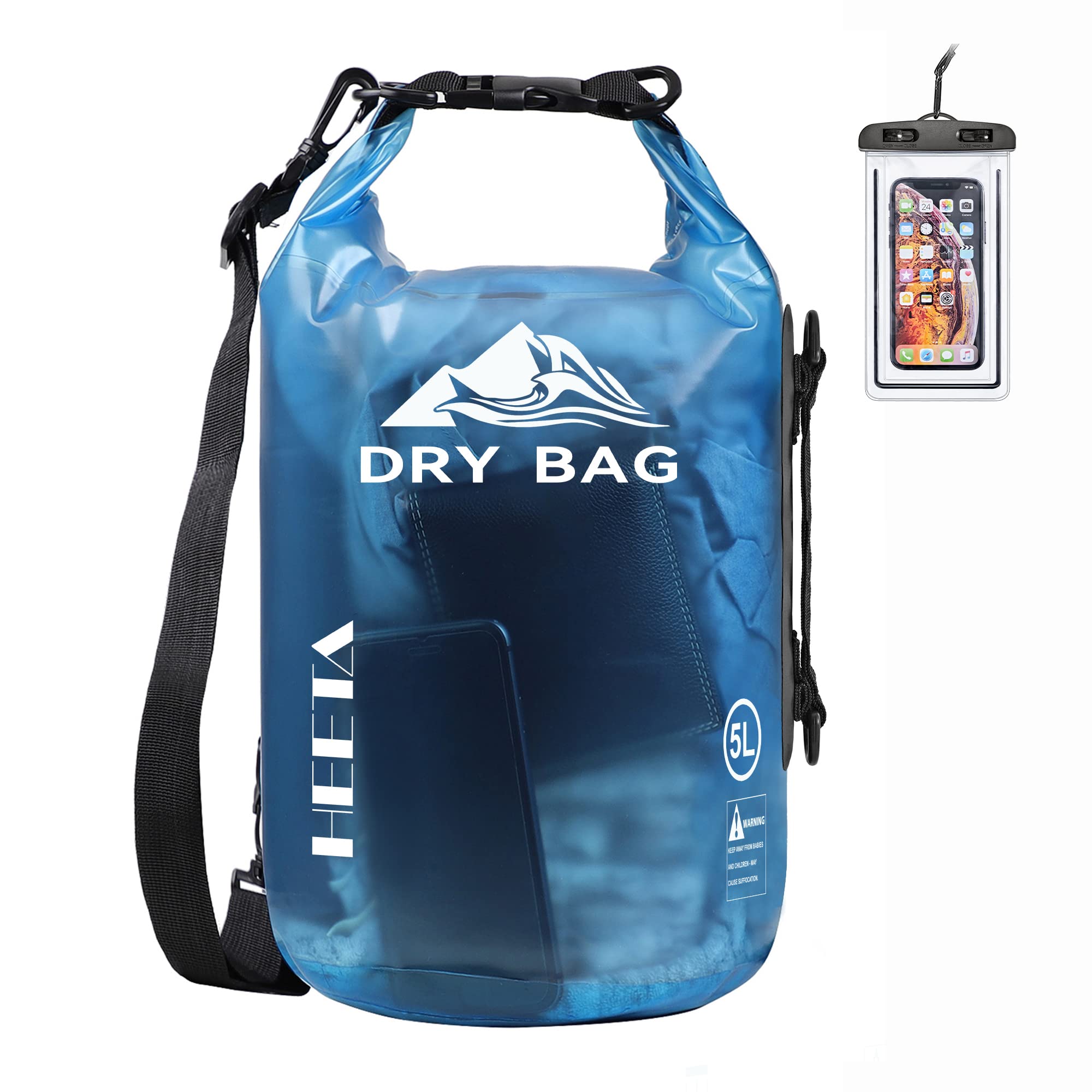
HEETA 5L Dry Bag

93 /100
Angler Score Outstanding

Key details

Body
Transparent
Carry
Shoulder strap and side handle
Capacity
5 liters
Material
PVC, 0.6 mm base and 0.3 mm sides
Check Details on Amazon

A transparent dry bag sounds like a gimmick until you are digging for sunscreen in a bag you cannot see into. The HEETA is see-through, so a glance tells you whether the towel, the snacks, and the phone are where you left them, and we found that worth more day to day than any feature on a heavier bag. It is also the least expensive way into a proper roll-top here, which is why it carries the budget slot.

The PVC runs 0.6 mm at the base and 0.3 mm on the sides, which is enough to keep the bag upright when it is full and lets it fold flat when it is not, and the whole thing wipes clean with a rinse. In the 5-liter size it takes a large water bottle, sunscreen, a small first aid kit, a book, and a phone, which is a full day at the pool or a short paddle. An adjustable shoulder strap and a side handle mean you can carry it cross-body or grab it one-handed off the deck.

What surprised us is how often it gets used. The narrow 5L shape slides under a deck bungee or into a hatch, takes up less room in a car than a bucket, and lives in the trunk with a towel and a spare layer in it, ready for whatever the afternoon turns into. Given what it costs, it is the one we suggest buying two of: one for the boat, one for the car.

Pros

  • Transparent body shows what is inside
  • Shoulder strap and side handle
  • Wipes clean after sand and salt
  • Lowest-cost roll-top here

Cons

  • Thin side walls are less abrasion-resistant
Our verdict

We recommend this one when the budget is tight: see-through PVC, a shoulder strap, and a side handle on a 5-liter body.

Check Latest Price
6

Best for Small Items

Unigear 2L Dry Bag

93 /100
Angler Score Outstanding

Key details

Weight
6.7 oz
Capacity
2 liters
Material
Ripstop 500D PVC
Check Details on Amazon

Two liters is a strange size for a dry bag until you have carried one. It takes a phone, keys, a wallet, a fishing license, and a spare battery, it weighs so little you forget it is clipped to the boat, and it solves the problem that actually sinks a day on the water: the small things that cannot get wet going into the same bag as the wet things.

Unigear builds it from ripstop 500D PVC with welded seams, the same approach as the bigger bags here, and the buckle has D-rings on either side for clipping to a pack or a deck line. At 0.19 kg it disappears into a daypack and rolls down small enough to live in a glovebox or a pack lid between trips. Two liters is the smallest size in a line that runs to 40L, so the same construction grows with you.

Where it earns a place is as the second bag. Toss it inside a 20L with the things you cannot replace, such as a phone, keys, and documents, and a badly rolled top or a nick in the outer shell does not end your day. If your whole load is a phone, a key, and a sandwich, it can be the only bag you bring, and it will take up less room in the boat than a water bottle.

Pros

  • Ripstop 500D PVC with welded seams
  • 0.19 kg and rolls down small
  • Buckle with D-rings for clipping on

Cons

  • Too small for clothes or a towel
Our verdict

For the small stuff, this is what we carry: a 2-liter ripstop PVC sack that swallows a phone, keys, and wallet.

Check Latest Price
7

Pack Organization

Osprey Ultralight Dry Sack

94 /100
Angler Score Outstanding

Key details

Shape
Rectangular base
Weight
1.12 oz
Capacity
6 liters
Water Rating
IPX5, not submersible
Check Details on Amazon

Osprey rates this sack to IPX5, which is splash-and-rain protection rather than swimming. That single number decides whether it is your bag. It is not the one to tie to an inner tube, and it is not the one to trust if a kayak rolls.

Everything else about it is aimed at a different job. The fabric is thin and coated, the seams are sealed, and the whole 6-liter sack weighs 1.12 ounces. The rectangular base, unusual in a category where most bags are round, packs against the back of a daypack without wasting space, and the D-ring lets you hang the sack off a pack or clip it to a belt.

We used ours for the things that need to stay dry inside a pack rather than outside it: a camera, a spare layer, a map, a phone. That is the role it is built for, and it does it without adding weight or bulk you would notice on a day hike, which is more than most bags here can claim for that job.

So this is not the bag for kayaking, boating, or a river float, and it is not trying to be. As a pack liner it is the neatest thing in this guide: thin enough to stuff into a side pocket, quick to dry when everything else in your pack is damp, and light enough that you stop counting it as gear at all.

Pros

  • Featherweight at 1.12 ounces
  • Rectangular base packs without wasted space
  • Coated, seam-sealed fabric
  • D-ring for hanging and attaching

Cons

  • Thin fabric will not shrug off abrasion like PVC
Our verdict

Rated IPX5, so it is for rain and splashes rather than swimming: the sack we tuck inside a hiking pack to keep a camera dry.

Check Latest Price
8

Separating Gear

Wise Owl 3-Pack Dry Bags

93 /100
Angler Score Outstanding

Key details

Sizes
5L, 10L, 20L (three bags)
Weight
0.2 kg for the set
Closure
Roll-top with buckle clip and D-ring
Material
190D ripstop nylon
Check Details on Amazon

Three bags in three sizes solves something one bag cannot: keeping clean clothes, lunch, and a wet swimsuit from sharing the same air. The 5L takes a wallet, glasses, and a phone; the 10L a lunch and a layer; the 20L a towel and a change of clothes.

They are 190D ripstop nylon with a coated back, so each one packs down to nothing and the set weighs 0.2 kg. The roll-top seals with a buckle clip, there is a D-ring on each bag for hanging, and the seams are taped the way a tent's are. Nothing here feels overbuilt, and at this weight that is the point.

The material sets the limit. These are nylon sacks, not PVC: fine in rain, a splash, or the bottom of a canoe, and not what you want if the bag spends an afternoon in the river. Nylon this thin can wet out in a real soaking, so treat the set as protection for gear inside a pack rather than a substitute for a roll-top PVC bag.

Where the set earns its place is organization. Hand one to each person on a group trip, keep a sleeping bag in the 20L and food in the 10L, and nothing has to be opened all the way to find anything. The 5L is the one that ends up in the daypack on every hike, holding a phone, a wallet, and a pair of glasses while the big bags stay in the truck.

Pros

  • Three sizes for separating gear
  • 190D ripstop nylon packs down small
  • Taped seams and a D-ring on each bag

Cons

  • No strap on any of the three bags
Our verdict

We like these for splitting a pack into dry compartments: three taped nylon sacks in 5, 10, and 20 liters.

Check Latest Price

How We Tested Dry Bags: Sinks, Pools, and One Very Wet Weekend

We started by rounding up every roll-top dry bag we could find between 2 and 55 liters, then filtered the field by construction — welded seams over glued, buckles that click and stay clicked, and a shoulder strap or harness that looked like it could carry real weight. We also cut anything whose stated capacity seemed wildly out of step with its dimensions. That left 14 bags, which we used for five months across kayak trips, beach days, a soaked spring hike, and a lot of time in a filled bathtub.

Water resistance came first. We packed each bag with a folded bath towel wrapped around a paper towel, rolled and clipped the top the way the instructions specified, weighted the bag down, and left it underwater in the tub for ten minutes. Then we loaded them up and floated them in a pool for an hour, shoved them under, and hauled them out by one strap to see if the roll held. We noted where water pooled inside the collar, whether seams wicked, and whether the paper towel came out damp at the corners. Nothing was graded on the label's claims — only on what the towel said.

For size and function, we packed an identical weekend kit into each one: a sleeping bag, a puffy, a phone, keys, and snacks. That told us quickly whether a 20-liter bag fits 20 liters of actual gear, and whether the bag was still carryable once full. We walked a mile of trail with each loaded bag and paid attention to strap dig and buckle slip, then opened and reclosed every roll-top 50 times, including a round with wet gloves on, to see which closures fought back.

Drying and durability got the ugly tests. After each soak we turned the bags inside out and timed how long the interior took to stop feeling clammy, since a bag that stays wet inside just moves the problem to your gear. Finally, we dragged each loaded bag over wet gravel and a concrete boat ramp 20 times, then checked the coating, seam tape, and strap anchors for scuffs and separation. Along the way we tallied what each one cost per liter of usable space and whether the hardware felt like it would outlast a season — value showed up in buckles and stitching far more than in fabric thickness.

How to Choose a Dry Bag

Match the seal to the water

Two different products get sold as dry bags. One is a roll-top sack in PVC or heavily coated fabric with welded seams, built to go into the river and come up dry. The other is a splash-rated packing sack, often labeled IPX5, which keeps rain and spray off gear inside a pack and nothing more. The Osprey sack here is the second kind and is very good at that job; the Earth Pak, MARCHWAY, and Unigear bags are the first kind.

Decide which you need before anything else. If the bag will sit on a deck, ride a tube, or take waves over the bow, buy the roll-top with welded seams and a thick shell. If it lives inside a hiking pack and never sees open water, the lighter splash-rated sack saves weight and space, and there is no reason to carry PVC.

Size it for the trip, not the shelf

Capacity is measured to the top of an open bag, and the roll-top eats a few inches of it, so a 20-liter bag does not hold 20 liters of gear. Roughly: 5 to 10 liters covers a phone, keys, sunscreen, a towel, and a lunch; 20 liters is the day-trip default and takes a towel, a change of clothes, snacks, and a phone; 30 liters and up is overnight or boat gear.

The common mistake is buying the biggest bag on the page. A half-empty 55L has nothing to roll against, so the top folds into a loose bundle that will not seal, and the bag flops around in the boat. Buy the smallest bag your usual trip fills, and if you need more room, go up one size rather than two.

Decide how you will carry it

Small bags hang off one shoulder. The 5L and 10L sizes here come with a removable cross-body strap, and 20L bags generally still use a single shoulder strap: fine from the car to the launch, less fine on a long portage with a full bag pulling on one side.

From 30L up you get backpack straps, which is the point where a dry bag starts behaving like luggage. Some sacks ship with no strap at all, like the Wise Owl set, because they are meant to go inside a pack rather than on your back. If you will walk more than a few minutes with it, prioritize two straps.

Look at the shell and the seams

The heavy 500D PVC shells here resist abrasion and shrug off gravel, truck beds, and rock shelves, at the cost of weight and packed size. The coated 190D to 210T nylon sacks weigh a fraction as much and compress to nothing, but they are thinner, and thin nylon wets out under a real soaking.

Seams matter as much as fabric. Welded or thermowelded seams are stronger and more watertight than stitched ones, and taped seams are the minimum on a light nylon sack. On every bag, the buckle and clip are what wears out first, so check that yours closes with a solid click and does not need forcing.

Pockets, color, and finding your gear

A front zippered pocket you can reach without opening the roll-top is worth more day to day than an extra liter of capacity. A transparent body does the same job differently: you see what is inside without unpacking. Bright colors and prints are not vanity on the water either, since a bag that goes overboard should be easy to spot from the bank.

One caution: an exterior pocket is not automatically a dry compartment. Some are splash-proof only, so a phone kept in one still needs its own case before it goes anywhere near a wave.

Frequently Asked Questions

Final Verdict

If you want one bag for kayaking, boating, beach days, and the back of a truck, buy the Earth Pak 20L. The front pocket keeps the roll-top sealed for the small stuff, and the 500D PVC survives a season of gravel launches.

Two exceptions are worth knowing. If the bag has to carry a tent and a sleeping bag, the 55L Earth Pak brings backpack straps and a five-year warranty. And if the bag is going inside a hiking pack rather than into the water, the Osprey 6L does that job at just over an ounce.