Best Handheld Marine Radios of 2026

A handheld VHF is the gear you carry hoping it never leaves the clip on your belt — until the fog thickens, the engine turns over twice and quits, and you need someone to hear you. That's when range, a battery that hasn't quietly drained in the sun, and a speaker you can understand over wind stop being spec-sheet trivia. Most radios look nearly identical in a listing; what a good one buys you is a mayday that becomes a conversation instead of a hope.

My team and I have spent the past eight months carrying 12 of them — basic floating models through DSC- and GPS-equipped units — through exactly that kind of morning, plus a lot of unremarkable ones. A few went swimming, one got dropped on a dock, and every single one had to be operated with wet hands and a spray hood up. The picks below are the radios that still made sense at the end of all that, whether you're running a tender, a kayak, or a 30-foot center console.

1

Best Overall

Uniden Atlantis 275

90 /100
Angler Score Outstanding

Key details

Weight
1.5 lb
Display
Large dual-color LCD
Transmit Power
6 W maximum
Waterproof Rating
IPX8, floats
Check Details on Amazon

Six watts, a floating IPX8 body, and a screen you can read in sun or dark: that combination is why the Atlantis 275 is our default handheld for coastal boaters. The 6-watt transmit power sits at the top of this group, and the selectable lower settings let you save battery when you're talking to a nearby marina or another boat in the same anchorage.

What we appreciate most is the display. It's large for a handheld, with a paper-white backlight for daylight and a red backlight for night, so you can check channels without shading the screen with one hand. The radio floats, clears water from its speaker after a dunk, and covers the USA, Canadian, and international marine channels plus NOAA weather. That's the core safety kit without paging through menus.

Battery life is the part to plan around. A long day of monitoring and transmitting can eat into the charge; top it up at the dock rather than assuming it will last a full weekend. The belt clip is the other point to watch, and the lanyard is the better way to keep it attached when the water turns rough.

For a small boat, a kayak, or a backup on a larger vessel, this is the one we reach for first. It has the power to be heard, the flotation to survive a fumble, and controls that don't require a manual in a squall.

Pros

  • Six watts with selectable lower power
  • Floats and survives IPX8 submersion
  • Large dual-color display
  • Covers NOAA weather and all channels

Cons

  • Belt clip is the weak attachment point
Our verdict

For most boaters, the Atlantis 275 is the handheld to buy: 6 watts, a readable screen, and true flotation in one straightforward radio.

Check Latest Price
2

Best with GPS and Bluetooth

Uniden MHS338BT

82 /100
Angler Score Excellent

Key details

Connectivity
Bluetooth
Transmit Power
6 W
Safety Features
GPS, DSC, strobe
Waterproof Rating
IPX8, floats
Check Details on Amazon

GPS, DSC, Bluetooth messaging, and a water-activated strobe in a floating handheld: the MHS338BT is the handheld we choose when the radio needs to do more than talk. The built-in GPS lets the radio put a position with a DSC distress call, and the Bluetooth link pairs with Uniden's app for setup and text messages to other compatible radios. That matters on a boat where the fixed VHF is below deck or the crew splits up.

We like the physical safety details more than the app. The radio floats, the strobe and flashlight trigger when it hits water, and the orange backlit LCD is readable at night without blinding you. The MOB function lets you lock onto a position, which is the kind of feature you hope never to use but want already set up. The body is compact enough for a jacket pocket, and the controls are arranged for one-handed use.

This is a more complex radio than the rest of the group, and that complexity is the trade-off. You'll want to set up DSC and the app before you leave the dock, not in a chop, and the extra electronics mean you should treat charging as part of the pre-departure checklist. If you mainly need simple talk and weather, the Atlantis 275 is the easier recommendation. For a bigger boat with a crew and a need to stay locatable, the MHS338BT earns its place.

Pros

  • Built-in GPS with DSC calling
  • Bluetooth messaging through Uniden app
  • Floats with water-activated strobe
  • Six watts and noise-canceling audio

Cons

  • Charging cradle is bulkier to pack
Our verdict

If you want GPS, DSC, and Bluetooth messaging in a floating handheld, the MHS338BT is the safety-focused pick for a crewed boat.

Check Latest Price
3

Best Battery Life

Icom IC-M73

86 /100
Angler Score Excellent

Key details

Channels
128
Battery Life
18 hours
Transmit Power
6 W
Waterproof Rating
IPX8
Check Details on Amazon

The IC-M73 is the handheld we hand to someone who wants a radio to work without a tutorial. It puts 6 watts, 128 channels, and an IPX8 submersible body into a case that feels solid in the hand, with a simple keypad and a display that gets out of the way. The hourglass shape is easier to grip with wet hands than the slab-sided radios here, and the front buttons are big enough to work with gloves.

Battery life is the headline: 18 hours is the longest rating in this group, and it changes how you use the radio. You can leave it on for a full day of monitoring without watching the bars, and you're less likely to be caught with a dead pack when plans run long. The 6-watt transmit power is the same top setting as our top pick, so range is in the same conversation; the difference is that this one keeps it simple.

The IC-M73 is not trying to be a navigation device. It keeps its screen for radio basics, and that restraint is why it feels so easy to pick up. If you already have DSC, GPS, and a chartplotter on the boat, this is a sensible handheld for the ditch bag or the flybridge. If you want the handheld itself to carry the connected safety features, look at the MHS338BT instead. For pure communication and long days, this is the one we trust.

Pros

  • Eighteen-hour battery life
  • IPX8 submersible body
  • Six watts and 128 channels

Cons

  • Charger and 12V adapter take up more room
Our verdict

For a no-nonsense handheld with an 18-hour battery and a tough, simple build, the IC-M73 is the premium communicator.

Check Latest Price
4

Best for Noisy Engines

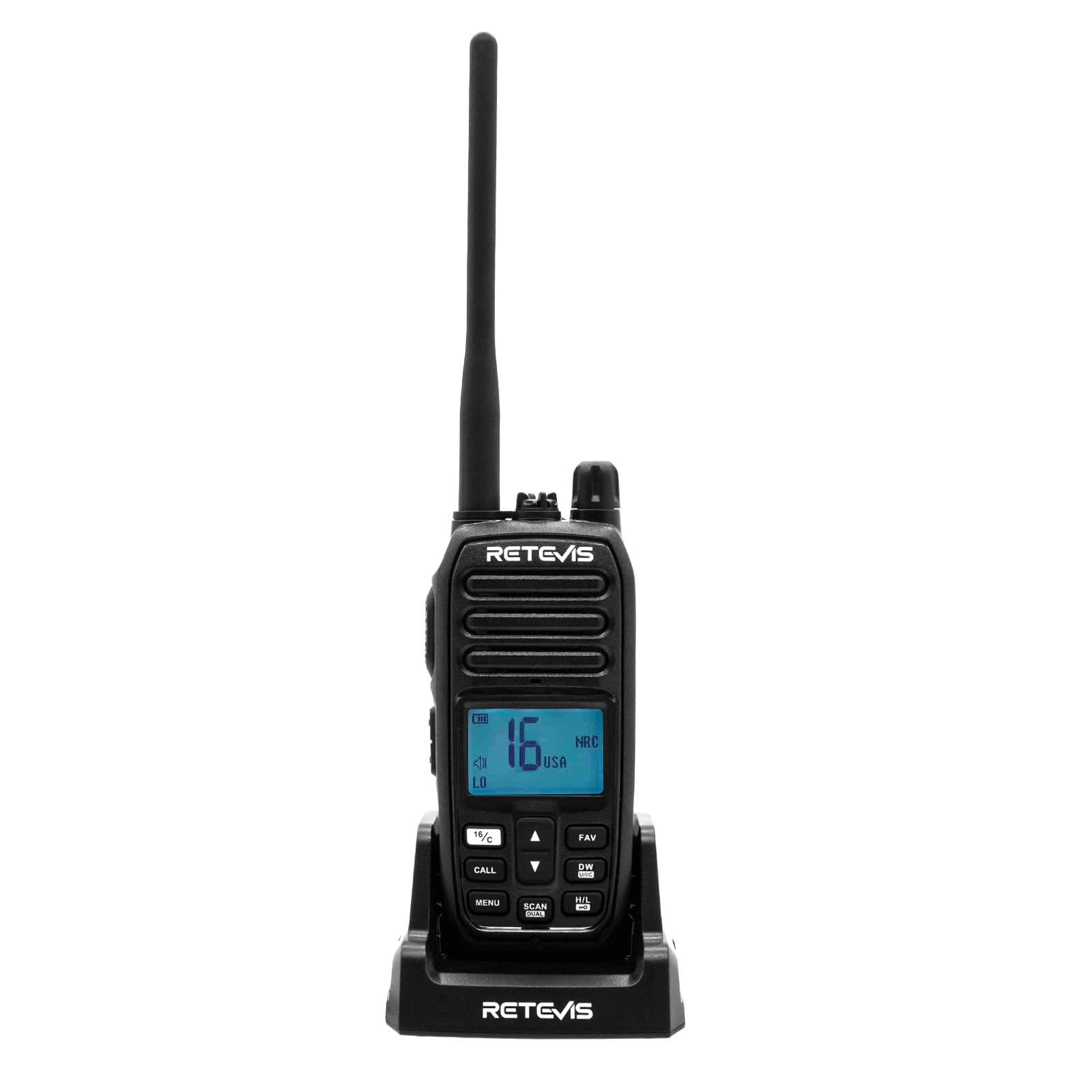
Retevis RM21

85 /100
Angler Score Excellent

Key details

Battery Life
10 hours
Transmit Power
5 W (5/3/1 W)
Waterproof Rating
IP67, floats
Noise Cancellation
One-button AI
Check Details on Amazon

Engine noise, wind, and waves are the enemy of a handheld radio, and the RM21 is built around clearing them up. Its one-button AI noise cancellation is the feature we noticed first: it cuts the background racket on both transmit and receive without making you dig through a menu. The 5-watt transmit power is a step below the 6-watt leaders, but on a small boat the difference matters less than a signal you can understand.

The 1800 mAh battery is rated for 10 hours, and the radio floats with IP67 protection; a red water-drop warning light flashes if it goes overboard. We like that the safety cue is visual as well as audible, because a radio bobbing in chop is easier to spot than to hear. The 88 channels and NOAA weather coverage cover the usual inshore and coastal traffic, and the seven-color backlight is a small nicety for night running.

The extra capability is aimed at working boats and center consoles, where the engine is always talking and the radio lives in a pocket or console tray. The body feels purposeful in the hand, and the controls are easy to work with one hand. For a cockpit where clarity beats a fraction of a watt, the RM21 is the pick.

Pros

  • One-button AI noise cancellation
  • Five watts and 88 channels
  • Floats with IP67 protection and warning light
  • Ten-hour battery

Cons

  • Heavier than the compact picks
Our verdict

If engine noise drowns out voices on your boat, the RM21's noise cancellation and clear audio make it the one to reach for.

Check Latest Price
5

Best USB-C Charging

Cobra BlueBound 350

86 /100
Angler Score Excellent

Key details

Charging
USB-C
Battery Life
12 hours
Transmit Power
6 W (1/3/6 W)
Waterproof Rating
IPX7, floats
Check Details on Amazon

USB-C charging on the radio itself is the detail that makes the BlueBound 350 easy to live with. You can top it up from the same cable you use for a phone or a power bank, without a cradle or a car charger taking up space. That's a small thing until you're packing a small boat or a kayak, where every charger and cable earns its place.

The rest of the package is properly thought out for coastal use. It transmits at 6 watts, floats, and covers 98 channels with NOAA weather alerts and tri-watch for channels 9, 16, and one you choose. The day/night display is legible in sun and dark, and the 12-hour battery rating is enough for a normal day on the water if you're not transmitting constantly. At just over nine ounces, it disappears in a jacket pocket.

The BlueBound 350 is not the radio for someone who wants DSC, GPS, or AIS. It's a straightforward communicator with one genuinely modern convenience, and that's the point. If your boat already has a fixed VHF and you want a compact second radio that charges like your phone, this is the one we grab.

Pros

  • Six watts with selectable power
  • Floats with IPX7 protection
  • USB-C charging on the radio
  • Twelve-hour battery and 98 channels

Cons

  • IPX7 is a step below IPX8
Our verdict

For a compact, floating 6-watt radio that charges by USB-C, the BlueBound 350 is the easy pick for small boats.

Check Latest Price
6

AIS-Equipped Boats

Icom M94D

85 /100
Angler Score Excellent

Key details

Battery Life
10 hours
Transmit Power
6 W
Safety Features
AIS, DSC, MOB
Waterproof Rating
IPX7, floats
Check Details on Amazon

AIS in a handheld is the reason to look at the M94D. It receives nearby vessel traffic and shows it on screen, so you can see who is out there before you cross a busy channel or round a headland. The radio also does DSC individual calls and distress alerts, and it can store up to 50 waypoints for fishing spots or destinations. That's a lot of navigation and safety in something that floats and flashes if it goes overboard.

The 6-watt transmit power and 1500 mW speaker are built for noisy marinas and open water; the audio has enough punch to be heard over an engine without holding the radio to your ear. We like the Float'n Flash and MOB function for the same reason we like a strobe on a life jacket: if the worst happens, the radio is easier to find and the distress call is easier to place. The IPX7 body is submersible, and the controls are arranged for quick access to the distress button.

This is a specialist's radio. If you run in shipping lanes or cross open water regularly, the extra awareness is worth the bulk and the premium. If you mostly stay inshore, the Atlantis 275 is simpler and easier to live with. The M94D earns its place as the handheld for the boater who already thinks in AIS targets and wants one more layer of visibility.

Pros

  • Built-in AIS receiver
  • DSC calling and 50 waypoints
  • Six watts and 1500 mW audio
  • Float'n Flash and MOB function

Cons

  • AIS details are cramped on a small screen
  • Battery life is modest for all-day use
Our verdict

For a boat that spends time in traffic and wants AIS in a handheld, the M94D is worth the premium; it's a specialist, not the default.

Check Latest Price

How We Tested These Marine Radios, On the Water and Off

We built the shortlist from the things a shopper can actually compare: transmit power, channel sets, IP rating, whether the radio genuinely floats, and whether DSC, GPS, or AIS is built in. Anything with a battery door that looked like a leak waiting to happen, anything that couldn't be charged away from its own cradle, and anything priced well past what its features justified got cut. That left 12 radios, which we ran for eight months.

Each one lived clipped to a life jacket or a belt for those eight months. We logged battery level at the start and end of every outing, timed recharges from dead, and left two units powered on in a hot car to see what heat did to the cell. We also pulled each radio one-handed off a PFD strap with wet gloves on, to find out whether the clip let go of the radio or the radio let go of us, and carried each one in a jacket pocket to judge how it sat against a body in motion.

Range we tested the honest way, making boat-to-shore and boat-to-boat calls at measured distances over open water and noting the point where a voice went from clear to gravel. Audio was judged beside a running outboard and into a headwind, with volume left where we'd actually set it. For durability, each radio got dropped from waist height onto a dock, dunked and shaken off, and worked with wet thumbs — including finding channel 16 in the dark. The ones that stayed on the list were the ones we'd hand to a guest without explaining anything first.

How to Choose a Handheld Marine Radio

Waterproofing and Flotation Come First

A marine radio will get wet; the question is whether it survives a dunk and whether you can find it afterward. IPX7 means it can handle temporary immersion, while IPX8 is tested for deeper or longer submersion, and a floating body is a separate feature. We put flotation ahead of a higher waterproof rating for a handheld because a radio that sinks is gone no matter how well its seals work. Look for a high-visibility case or a water-activated strobe, and use the lanyard every time.

Watts Are Not Miles

Transmit power is the easiest number to compare, whether 3, 5, or 6 watts, but it is not a range guarantee. VHF is line-of-sight, so antenna height, terrain, weather, and the other station's antenna matter more than the last watt. A 6-watt radio is the better choice for open coast and boat-to-shore calls; a 3-watt model can be fine for a lake, kayak, or dinghy. Don't buy a higher-watt radio expecting a fixed-mount conversation from a handheld. Test your usual route before you rely on it.

Battery and Charging Decide How Often It's Ready

Battery life ratings range widely, and the way you use the radio changes the real number: cold, constant monitoring, and long transmissions all shorten it. More important is how you recharge. USB-C on the radio is the simplest for travel because one cable can top it up from a power bank; a charging cradle is convenient at a dock but adds bulk to a ditch bag. A car charger only is a trap if you plan to charge at home. We prioritize a radio you can charge wherever you keep it, plus a spare power source for long days.

Safety Features and Everyday Handling

Every radio here covers the marine channels and NOAA weather, so the useful differences are in the safety layer and the controls. DSC can send a distress call with your identity, GPS adds a position, and AIS shows nearby traffic; those features are worth paying for if you run offshore or in shipping lanes, but they add setup and battery drain. On deck, a large display, big buttons, and a belt clip or lanyard matter more than a long feature list. Choose the radio you can operate with cold, wet hands.

Frequently Asked Questions

Final Verdict

Most boaters should start with the Uniden Atlantis 275. It has the 6-watt power and readable display to handle routine boat-to-boat and boat-to-shore calls, and it floats, which matters more than a long feature list when the radio goes over the side. If you want GPS, DSC, and Bluetooth in the handheld itself, the MHS338BT is the better fit for a crewed boat. For the longest battery life and the simplest controls, choose the Icom IC-M73.