Best Fly Fishing Forceps of 2026

The part of fly fishing nobody photographs is the ninety seconds after the fish is in the net: cold hands, a hook buried past the barb, and a trout that would rather be anywhere else. A pair of forceps is the smallest tool in your vest and the one you'll reach for most — if it grips hard enough to hold a hook, locks when you squeeze, and reaches into a throat your fingers can't. The right pair turns that fumbling minute into a clean, quick release, which is easier on the fish and a lot easier on your nerves.

I've carried the same pair on a lanyard for years, and I've borrowed plenty of bad ones — jaws that splay apart under pressure, a ratchet that takes two hands and a prayer to open. Over the past four months my team and I fished 16 different pairs, from multipacks of surgical-style hemostats to purpose-built fly tools, and the gap between good and frustrating came down to unglamorous details. Most forceps are hemostats with a logo stamped on them, so the steel and the jaw alignment matter far more than the packaging. A few earned a permanent spot on the lanyard; the rest are in a drawer.

1

Best Overall

Loon Rogue Quick Draw Forceps

87 /100
Angler Score Excellent

Key details

Jaws
Serrated, with scissor
Length
6.25 inches
Attachment
Carabiner finger loop
Extra Tool
Eye clearing needle
Check Details on Amazon

Three tools ride on the Rogue Quick Draw's 6.25-inch frame. There's the pair of serrated jaws you expect, a small scissor set into the jaw for trimming tippet, and an eye-clearing needle for reopening a hook eye you just flattened. In a group of plain hemostats, that's the difference between a tool you carry and a tool you reach for: the fly that comes off a fish can be re-rigged without unclipping anything else.

The carabiner finger loop is the detail we appreciate most. It clips straight onto a zinger or a pack loop, so the forceps ride where your hand already goes when a fish is thrashing, and it hangs the tool jaws-down instead of letting the tips poke through a vest pocket. In the hand it feels like more tool than the budget pairs, and the weight explains why: 3 ounces against the A2Z's 0.6.

The pivot can arrive stiff; a drop of oil and a few dozen open-and-close cycles free it, so work it in at home rather than discovering it with a fish on. What makes the tool easy to live with is Loon's guarantee — a pair that rides a vest and gets dropped on gravel is one you want replaced without an argument, and this is the only tool here carrying that promise.

Pros

  • Scissor jaw trims tippet without a second tool
  • Eye needle reopens a crushed hook eye
  • Carabiner loop clips to a zinger or pack
  • Maker's guarantee backs it however hard it's used

Cons

  • Highest price of the five picks here
Our verdict

If you want one tool that unhooks a fish, trims tippet, and clears a crushed eye, this is the pair we hand a fly angler first.

Check Latest Price
2

Best Value

A2Z Scilab 5" Curved Hemostat

93 /100
Angler Score Outstanding

Key details

Length
5 inches
Weight
0.63 oz
Locking
Three tension positions
Jaw Shape
Curved, fully serrated
Check Details on Amazon

The ratchet is the part that gives out on an inexpensive hemostat, and it's the part the A2Z gets right. Three interlocking positions click in, hold a size 16 hook while you back it out of a lip, and release with a thumb. The curved, fully serrated jaws meet along their length, and the black finish is quiet enough to read as boring rather than tactical — which is exactly what we want clipped to a vest.

Weight is where it wins over the premium pick: 0.634 ounces against 3, so it swings from a zinger without dragging your vest down and disappears in a shirt pocket. The non-stick surface is a smaller advantage that turns out to matter, since fish slime and dried blood wipe off with a thumb instead of needing a scrub at the sink. It's fully autoclavable, a claim you can ignore for fishing that still tells you it survives a rinse.

Five inches is a trout length. It reaches a hook sitting in the scissors of a rainbow's jaw and not much beyond, so if you fish big hooks or fish that swallow, the 6-inch MJW or the 8-inch pair in the Apical set buys you the room. For small-hook river fishing, the A2Z is hard to argue with.

Pros

  • Lock clicks into three positions and releases cleanly
  • Non-stick jaws wipe clean in the hand
  • Featherweight on a zinger at 0.634 ounces

Cons

  • No tippet cutter or eye needle
Our verdict

A 5-inch curved hemostat whose lock actually holds, light enough to forget on a vest, and our pick when one simple pair has to do.

Check Latest Price
3

Best Set

Apical 6-Piece Hemostat Set

90 /100
Angler Score Outstanding

Key details

Sizes
8, 6.25 and 5 inches
Pieces
6, straight and curved
Locking
Three-position
Material
Stainless steel
Check Details on Amazon

Eight inches is a lot of reach, and it's the reason to look at this box: the longest pair gets your knuckles outside a pike's teeth and reaches a hook that's disappeared down a bass's throat. The rest of the set runs 6.25 and 5 inches in both straight and curved tips, six tools in all.

Every pair carries the same three-position lock and serrated jaws, so the sizes are what separate them. That makes this a distribution set as much as a fishing one: the 8-inch lives in the boat, the 6.25 rides the vest, and the 5-inch ends up in the glovebox or a kid's first tackle box. You aren't choosing a length here — you're getting the lengths.

Our reservation is the smallest pair, which is where the lock gets vague; test that one first and send the box back if it won't latch cleanly. What settles it for us is the range. Six pairs covering everything from a size 20 midge to a 4/0 pike fly is a box you buy once and stop thinking about.

Pros

  • Three lengths from 5 to 8 inches in one box
  • Eight-inch pair reaches deep hooks
  • Straight and curved tips for different jobs
  • Size variety is the strength of the set

Cons

  • Plain stainless can rust if stored wet
  • Bulkier to carry than a single pair
Our verdict

Buy this set to spread forceps across a vest, a boat, and a truck rather than to own the single best pair.

Check Latest Price
4

Deep-Hooked Fish

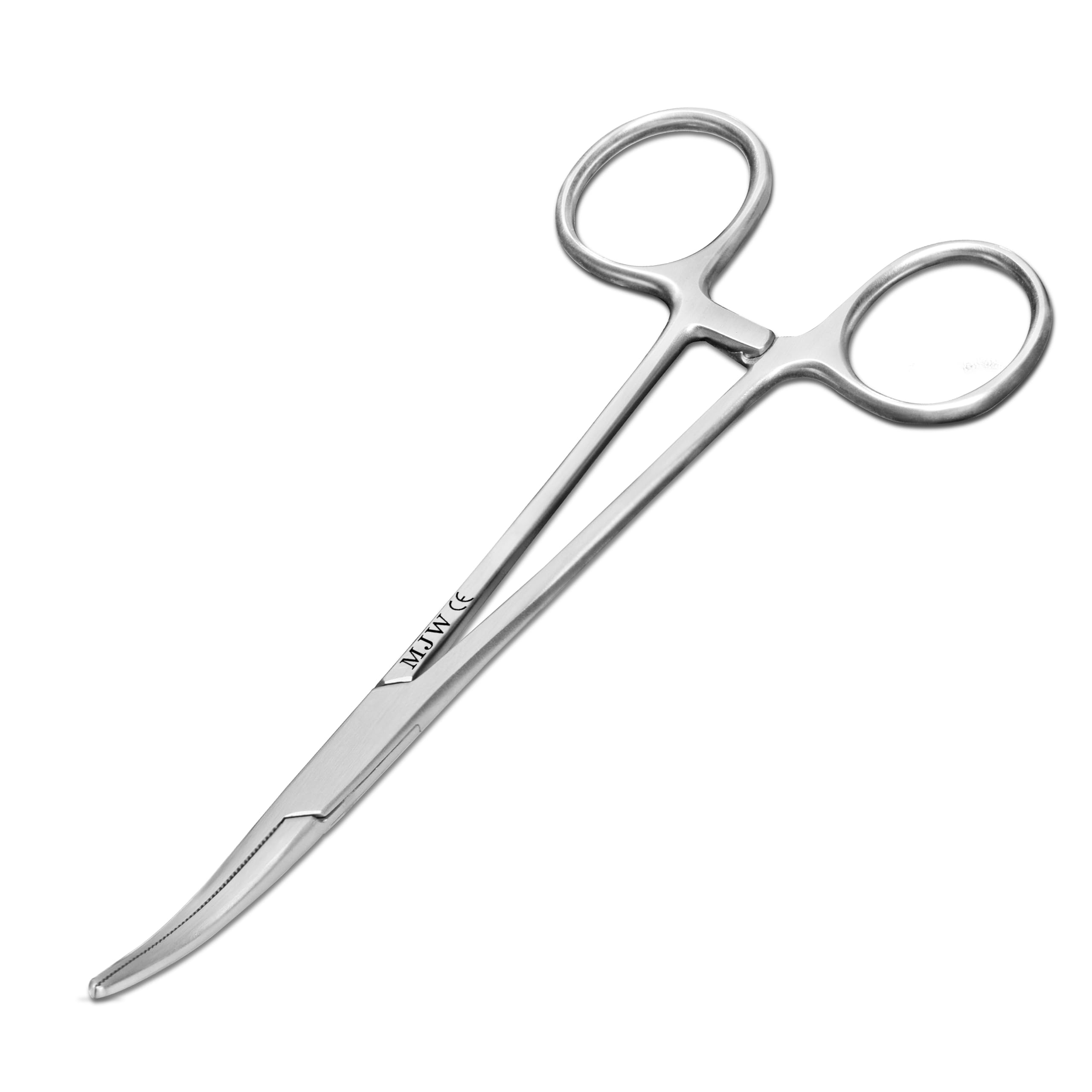
MJW 6" Curved Forceps

92 /100
Angler Score Outstanding

Key details

Tip
Curved, serrated
Length
6 inches
Locking
Three-step
Material
Stainless steel
Check Details on Amazon

A hook that's gone past the bend is the case for a six-inch pair, and this is the least expensive way to get one. MJW tapers the serrated tips into a fine curve that slides along a hook shank, and the three-step lock clicks in with either hand, which matters when you're holding a fish and reaching over your own wrist.

This is the no-frills reach pick, and we like it for exactly that. No coating, no cutter, no carabiner loop — just stainless, a lock, and a pivot. It's light enough to sit in a shirt pocket, and the curved tip does the one job without ceremony.

The serrations are fine, and that's the boundary of what this one is for. Thin tippet slips between the jaws instead of being held, so treat the MJW as a hook tool and keep a knot tool somewhere else. If your fish are big enough that the hook disappears, six inches of reach is a fair trade for that.

Pros

  • Six-inch curved reach for swallowed hooks
  • Three-step lock works with either hand
  • Light and compact in a shirt pocket

Cons

  • Curved tip only, with no straight pair
Our verdict

The reach pick for deep hooks: six inches of curved stainless, a working lock, and no extras to pay for.

Check Latest Price
5

Vest and Boat Pair

Apical 5.5" Forceps 2-Pack

89 /100
Angler Score Excellent

Key details

Set
Curved and straight pair
Length
5.5 inches
Locking
Three-position
Material
Stainless steel
Check Details on Amazon

Two pairs, one curved and one straight, both 5.5 inches — the point of this set isn't the tool, it's the habit. Keep the curved pair on the vest and the straight one in the boat box and you stop walking back to the truck for the forceps you left clipped to yesterday's shirt. We like the straight one more than we expected: it's the better shape for flattening a barb and for plucking a fly out of a compartment.

The lock is the weak spot. On the pair that holds, the three positions click in and let go the way they should; on the one that doesn't, the handles pop apart under a squeeze. Clamp a hook and flick the tool before you trust it, and don't wait until a fish is in your hand to find out which pair you got.

At 5.5 inches they sit between the 5-inch A2Z and the 6-inch MJW, which is a good place to be for trout and panfish — enough reach for most hooks without turning the tool into a two-hand job. The straight pair is the sleeper of the two, and it's the one that ends up in the fly box rather than on the vest.

Pros

  • Curved and straight pair in one purchase
  • Serrated jaws grip small hooks
  • 5.5-inch length suits most trout work

Cons

  • One pair can arrive with a weak lock
  • Finger rings run small for wide hands
Our verdict

Two pairs to leave in two places, and the sensible buy if a spare matters more to you than a premium tool.

Check Latest Price

How We Tested 16 Pairs of Fly Fishing Forceps

We started with a list of about 40 pairs — fly-shop forceps, surgical-style hemostats sold in multipacks, and the cheap ones that live in a bin by the register — and cut anything with plastic jaws, no ratchet, or a length that wouldn't sink into a chest pack. Sixteen made the cut.

Testing ran from April through July, mostly where the tool actually lives: unhooking trout on a spring creek, in the boat, and at the tying bench in my garage. Every pair rode a lanyard for at least a week of real fishing, and between trips we used them for trimming thread, pinching down barbs, and pulling a splinter out of a thumb.

In the hand, we noted whether the lock held under a firm pull or slipped, and whether we could pop the ratchet with one thumb while the other hand held the fish. At the bench, we closed each pair on a sheet of paper and looked at the tip — jaws that crossed or left a gap got marked down, since those are the ones that slide off a hook shank. Every pair spent a night in a vest pocket soaked in salt water, then sat out a week to see what bloomed; we also hung each one from its lanyard hole and gave it a shake, and squeezed the handles until the jaws flexed. Size got judged by the pocket test, because a pair that pokes out of a chest pack is a nuisance however well it grips, and versatility came down to whether one tool could handle a hook, a thread end, and a splinter without a swap. Then we weighed what each cost against all of it — an inexpensive set that locks cleanly beats a pricier one with a wobbly tip. Appearance came last, but four months of sun and water is a fair test of finish.

How to Choose Fly Fishing Forceps

Length and Jaw Shape Come First

A 5-inch curved pair handles most trout work: short enough to control with your fingertips, curved enough to reach around the bend of a small hook. Step up to 6 or 6.25 inches when you chase bigger fish or fish that swallow, and to 8 inches when your knuckles need to stay outside a pike's jaw.

Curved tips are for backing a hook out; straight tips are better for flattening a barb and picking flies out of a compartment. If you carry one pair, make it curved and somewhere between 5 and 6 inches.

The Lock Is the First Thing to Test

A three-position ratchet lets you clamp a barb, hold a fly while you tie, or grip a hook shank hands-free, and it is the part that disappoints most often on inexpensive forceps. Test it the day it arrives: clamp the jaws on a hook shank, hold the tool by one handle, and flick it.

A good lock holds. A weak one pops open, and it will pop open at the worst moment. The same check shows whether the tips meet squarely, which decides whether the jaws grip at all.

Rings, Loops, and One-Handed Handling

Finger rings are the traditional way to hold forceps, and they're fine until you're wearing gloves or the pivot stiffens. A carabiner loop, like the one on the Loon, clips straight to a zinger or pack strap and hangs the tool jaws-down where your hand already goes.

Weight matters more than the spec sheet suggests. A coated hemostat around 0.6 ounces swings from a zinger without drag, while a 3-ounce tool wants a real clip. If the pivot arrives stiff, a drop of oil and a few dozen open-and-close cycles free it.

What the Extras Are Worth

A scissor in the jaw and an eye-clearing needle replace two other things in your vest, and they're the reason a fly-specific tool costs more than a plain hemostat. Whether that's worth it depends on how often you re-rig: trimming tippet with a separate nipper is fine until you're doing it with wet hands in a wind.

Coating is the other upgrade to weigh. A non-stick finish wipes clean with a thumb, while plain stainless needs drying and can spot with rust if it goes away wet.

Frequently Asked Questions

Final Verdict

The Loon Rogue Quick Draw is the pair we recommend first, and the reason is simple: it's the only tool here that unhooks a fish, trims the tippet, and reopens a crushed eye without a second reach into a pocket. For an angler who wants one tool on a zinger, nothing else in this group covers that much.

If you want plain, dependable, and inexpensive, the A2Z is the pair we hand people who fish a few times a month. And if your hooks disappear past the bend, buy the length: the 8-inch pair in the Apical set or MJW's 6-inch curve solves a problem the 5-inch tools can't.