Best Fly Fishing Nippers of 2026

Forty feet of tippet, a size 20 midge, and a nipper that won't cut is a combination that ends with teeth on fluorocarbon — I've done it on a tailwater with the light going flat, and I don't recommend it. A fly fishing nipper is a small thing that carries most of the day: you clip tag ends on every knot, trim tippet after every fly change, and saw through braid on the spinning rod you brought as a backup. The good ones do all of that without chewing up your fingertips or hiding in the bottom of a pocket.

What separates a good one from a pretty one isn't branding. It's whether the blades meet cleanly on 6X, whether the jaws stay shut instead of opening into a spike in your vest, and whether the pivot still feels tight after a season of getting dunked and dropped on limestone. My team and I have fished 14 nippers over the past five months, and the gap between a genuine workhorse and a decoration is wider than most people expect.

1

Best Overall

Dr. Slick Cyclone Nipper

89 /100
Angler Score Excellent

Key details

Frame
Gold and green aluminum
Attachment
Steel retention ring
Blade Material
Tungsten carbide
Replacement Cutters
Included, with screws
Check Details on Amazon

Tungsten carbide is the reason the Cyclone sits at the top of this list. The cutting faces are a harder material than the stainless steel on most of the picks here, and the box includes a spare set of cutters, the screws that hold them, a hex key, and a steel retention ring. That combination is the whole argument: the part that wears out on every other nipper here is a part you can change yourself.

Cutting is where it earns that. Braid is the line that exposes a dull edge fastest, slick enough to slide between blades that are pinching rather than shearing, and the Cyclone goes through it cleanly, with the same easy action on tippet and fine mono. We paid close attention to the cutting face, because it is straight rather than offset, and that is what gives you a square cut close in toward the knot. The spring is light enough to work with a thumb, which matters more than it sounds when your hands are wet.

What you do not get is a tether. There is a retention ring, so any lanyard, zinger, or cord you already like will work, but nothing in the box clips it to your vest. For us that is a fair trade, because a good blade on a cord we chose beats a mediocre cutter with a built-in leash. The gold-and-green aluminum frame is light enough that you forget it is there, and the ring sits flat against a vest loop instead of standing off it.

Pros

  • Tungsten carbide cutters slice braid and tippet cleanly
  • Spare cutters, screws, and hex key included
  • Steel retention ring takes any lanyard or zinger
  • Straight cutting face trims close to the knot

Cons

  • Among the priciest nippers in this group
  • Tiny spare screws and hex key are easy to lose
Our verdict

We think the Cyclone is the nipper to buy if you fish often: tungsten carbide blades, a spare set in the box, and a clean cut on braid that the cheaper picks struggle to match.

Check Latest Price
2

Best Built-In Tether

Boomerang SNIP Line Cutter

94 /100
Angler Score Outstanding

Key details

Blades
Stainless steel
Attachment
Built-in retractable tether
Line Types
Braid, mono, fluoro
Check Details on Amazon

The SNIP answers a question most of this list ignores: what happens when you drop it. The cutter rides on a built-in retractable tether that clips to a vest, a belt loop, or a boat bag, so it hangs out of the way until you pull it up and goes back on its own when you let go. No lanyard to untangle, no digging in a pocket, no second nipper bought because the first one is somewhere on the riverbed.

The one-handed part is what makes it worth carrying. Pull, snip, release, all with the rod still in your other hand, and the blades come back to the same spot every time. We were also impressed by how well it handles braid for a stainless blade, because the longer cutting faces are easier to line up on a slick line than the stubby faces on a pocket nipper. It cuts mono and fluorocarbon just as cleanly, and it is the pick we reach for at the bench when we are trimming a whole leader.

The cord is the piece with a clock on it. It is what holds the tool to you, so when it frays through, the whole thing loses its attachment, and that is the one real risk in the design. If you fish a couple of seasons out of a nipper, it will not matter much; if you want a decade out of one, the Cyclone's replaceable blades and simple ring will outlast it. For a drift boat or a vest with a D-ring, the convenience is worth the trade.

Pros

  • Built-in retractor keeps it on your vest
  • Cuts braid, mono, and fluoro cleanly
  • Longer blades are easier to line up on braid

Cons

  • Spring can hang up and leave the blades shut
Our verdict

If you have ever walked away from a nipper on a log, this is the one: the retractable tether keeps it on your vest, and the longer blades make short work of braid.

Check Latest Price
3

Best All-In-One

HOOK-EZE 3-in-1 Line Cutter

89 /100
Angler Score Excellent

Key details

Body
Zinc alloy
Included
Retractable zinger
Warranty
2 years
Blade Material
Stainless steel
Check Details on Amazon

A cutter, a hook-eye cleaner, a knot-tying tool, and a retractable zinger in one purchase. The HOOK-EZE is the closest thing here to a complete vest setup in a single box, with a zinc alloy body, stainless blades, a textured grip, and a folding form that sits in a pocket between uses.

Sharpness is where it holds up. It goes through monofilament and braid without the sawing motion you learn to tolerate on a dull nipper, and the hook-eye cleaner is slim enough for small flies, which is where you actually need one, clearing paint or glue out of a size 18 eye before you thread it. The third arm is a knot tool for the usual line-to-hook and line-to-line joins, and the fold keeps the cutting face covered while it rides on your vest.

The zinger is what tips it for us. Plenty of multi-tools leave you to buy the retractor separately, and this one arrives ready to clip to a vest loop with nothing else to sort out. A two-year warranty covers it, which is more backing than most of this list carries. If you want one tool on the vest and no lanyard to think about, this is the pick, and the extra bulk over a bare nipper is the price of having the other two tools along.

Pros

  • Cutter, eye cleaner, and knot tool in one
  • Zinger included, ready to clip on
  • Sharp on braid and mono
  • Two-year warranty covers the tool

Cons

No notable drawbacks to flag.

Our verdict

Buy this one if you want a single tool on the vest instead of three: it cuts, cleans hook eyes, ties knots, and the zinger comes in the box.

Check Latest Price
4

Best Budget Nipper

Loon Classic Nipper

87 /100
Angler Score Excellent

Key details

Blades
Stainless steel
Extras
Eye-cleaning needle
Handle
Comfy grip
Check Details on Amazon

Strip away the tungsten, the tethers, and the knot tools and you reach the Loon Classic, which is what a nipper needs to be and not much else: two stainless blades, a soft yellow grip, and an eye-cleaning needle on the end. For a lot of anglers that is the right answer, and it is the one we point budget-minded shoppers toward when they do not want to think about the purchase twice.

The grip is the part we appreciate most. It is a soft, slightly tacky material that stays put when your fingers are wet and cold, and the yellow is easy to find when it slides to the bottom of a boat. The blades are sharp enough for tippet and fine mono, and the eye needle is thin enough for the small flies most of us actually fish, which is not true of every cleaner on this list.

The attachment is a simple wire ring, so a lanyard or a zipper pull loops straight through and you are done. There is no retractor and no knot tool; if you want those together in one package, the HOOK-EZE bundles both. What is left is a light, honest little tool that disappears on a vest until you need it, and that is a fair description of what most days on the water ask for.

Pros

  • Comfortable grip works with wet, cold hands
  • Sharp on tippet and fine monofilament
  • Eye needle handles small flies
  • Simple wire ring takes a lanyard

Cons

  • Not the tool for braid or heavy line
Our verdict

Our pick for a first nipper or a spare: the Loon Classic is sharp on tippet, comfortable in cold hands, and inexpensive enough to keep one in every vest.

Check Latest Price
5

Best Ultralight

SAMSFX Mini Line Cutter

86 /100
Angler Score Excellent

Key details

Body
Aluminum
Blade
Tungsten carbide
Weight
About 25 g
Rated Cut
Up to 100 lb braid
Check Details on Amazon

At about 25 grams and eight centimeters long, the SAMSFX Mini disappears on a vest or a hat bill, which is the point of it. The body is aluminum, the blade is tungsten carbide, and it arrives with a carabiner retractor, so there is nothing else to buy before you can clip it on and fish.

The claim worth testing was the cutting. SAMSFX rates this one for braid up to 100-pound test, which is a serious number for a tool this small, and the cutting slot holds the line in a channel rather than on an open jaw so the strands cannot slide out sideways. It handles braid and heavier mono without the crush-and-fray finish you get from blades that are not up to it. The concealed blade also means no open edge to catch on a fly box or a jacket sleeve.

One thing to check before your first trip: that the blade is seated the right way round and the slot lines up, because a misaligned set will not cut close to a knot. The strap is long enough to reach from a leaning post or a seat back, so it works on a kayak or a boat as well as a vest. As a second nipper, one for the vest and one for the boat bag, it is an easy call.

Pros

  • About 25 grams, clips to a hat or vest
  • Tungsten carbide blade rated to 100 lb braid
  • Carabiner retractor included
  • Aluminum body with a concealed blade

Cons

  • Blade must be seated correctly to cut close
Our verdict

For a featherweight nipper that clips on and stays out of the way, this is our pick: tungsten carbide, a 100-pound braid rating, and a retractor in the box.

Check Latest Price
6

Best Multi-Tool

Dr. Slick Nipper with Knot Tyer

84 /100
Angler Score Excellent

Key details

Steel
High-grade Japanese steel
Extras
Knot tyer, hook file, eye pin
Nipper Size
2 inches
Check Details on Amazon

This is the only tool here with a nail-knot tool built into the body, and that single feature decides whether it belongs in your vest. If you join fly line to leader with a nail knot, or you are still doing it with a doubled-over loop and a lot of swearing, the little barrel on this tool holds the coils while you pull the tag through.

Everything else is built to the same standard. The nipper is two inches, the blades are high-grade Japanese steel, and they handle tippet and heavier mono without complaint. There is a hook file on the back for touching up a point and an eye-cleaning pin on the end, so it covers the three small jobs that come up most often on the water in one body.

The trade is bulk. Four tools in a two-inch body means more to keep clean and more to snag on a shirt loop, and the cutting faces are a leader-and-tippet design at heart, so heavy braid is not what it was built for. The knot tool is the part we kept coming back to, and it is a good one, but it is a specialty feature and the tool is priced accordingly.

Buy it for the knot tool, not as a general-purpose nipper. If nail knots are part of your setup, nothing else here saves you the same trouble, and the nipper, file, and pin come along for the ride. If they are not, the Cyclone does the cutting half better for less.

Pros

  • Nail-knot tool built into the body
  • Hook file and eye-cleaning pin included
  • High-grade Japanese steel blades

Cons

  • Costs more than any other pick here
Our verdict

If you tie nail knots, this earns its keep: the built-in knot tool does a job that usually takes two hands, and the nipper, file, and pin are all solid.

Check Latest Price
7

Saltwater and Fly Boxes

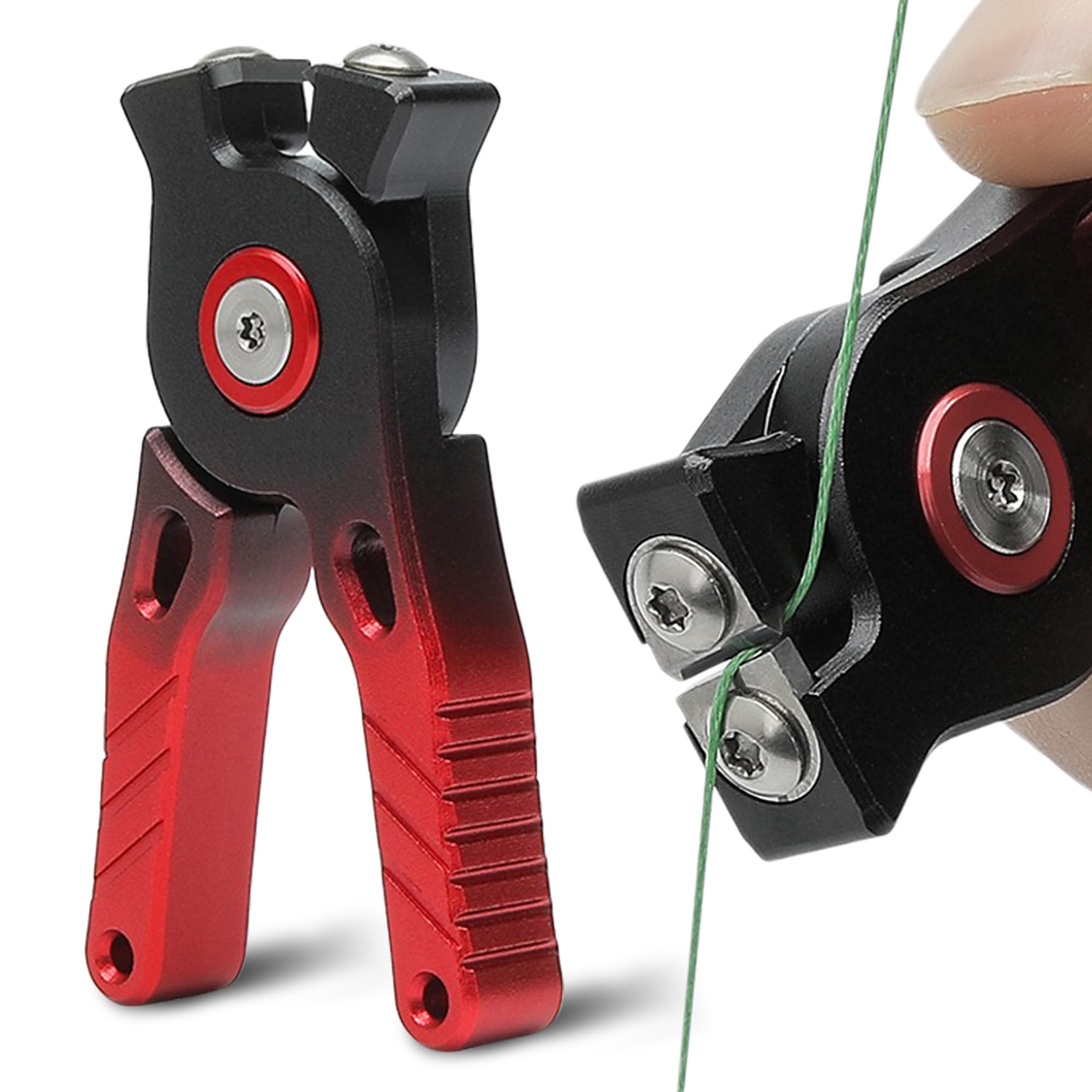
mpeter Tungsten Line Cutter

87 /100
Angler Score Excellent

Key details

Size
2.6 x 1.6 x 0.5 inches
Blade
Tungsten alloy
Weight
1 oz
Warranty
2 years
Check Details on Amazon

The cutting edge on the mpeter sits in the middle of the anvil rather than at the outer edge, and that geometry is the whole story of this little tool. It is what lets the blade bite down on heavy line without the line sliding out of the jaws, and it is also why a flush trim tight against a knot takes a bit of angling.

Tungsten alloy blade, tungsten steel body, 2.6 by 1.6 by 0.5 inches, one ounce. It handles heavy monofilament and fluorocarbon, the 40- and 50-pound stuff you spool for saltwater, and it is small enough to live in a fly box rather than on a vest. The red-and-black body is easy to spot in a tray of tackle, and the two-year manufacturer warranty is more coverage than most nippers here come with.

Where it gives up ground is the trim you make a hundred times a day: clipping a tag end flush against a knot. The center edge leaves a short stub unless you angle the tool into the line, and on small dries that stub is visible. For pre-rigging at the bench, for heavy leaders, and for a cutter that lives in the box, we reach for it first; for knot-side trimming on the river, the straight-faced Cyclone is easier.

Pros

  • Bites into 40- and 50-pound mono and fluoro
  • One ounce, small enough for a fly box
  • Two-year manufacturer warranty

Cons

  • No lanyard, ring, or clip included
Our verdict

A tiny tungsten cutter for heavy leaders and pre-rigged setups: it bites through 40- and 50-pound mono with ease, though flush knot trims take a practiced angle.

Check Latest Price
8

Two-Rod Setups

SF 3-in-1 Nippers

80 /100
Angler Score Excellent

Key details

Included
Two nippers with zingers
Line Types
Leader and tippet, not braid
Nipper Size
2.56 x 0.59 inches
Zinger Cord
24"/60cm
Check Details on Amazon

Two nippers and the zingers that go with them is the reason this set is here. If you keep a vest and a boat bag, or you are outfitting a second rod for a guest, the SF set means you are not moving one nipper between bags or buying the same tool twice.

The nippers themselves are small, 2.56 inches by 0.59, with stainless blades, a knot-tying hook, and a line-clearing needle on each one. The zingers use a 24-inch stainless cord with an aluminum hook, so they reach from a vest loop to wherever your hands are working. That is a lot of hardware for a secondary setup.

The limitation is printed on the listing, and it is worth taking at face value: SF recommends these for tapered leader and tippet, not braid. They trim mono and fluorocarbon leader fine. Ask them to shear braid and you will be sawing at it, which is exactly the frustration the tungsten picks exist to solve.

So this is not the set to buy if braid is on your spool every trip. It is the set to buy if you want a competent nipper and a zinger in two places at once and do not want to think hard about it. Ours lives in the boat bag as the spare, and that is the job it was bought for.

Pros

  • Two nippers and two zingers in one purchase
  • Stainless blades for leader and tippet
  • Knot hook and line needle built in

Cons

  • Not rated for braided line
Our verdict

The value pick if you need nippers in two places: two stainless cutters with zingers, as long as the line you fish is leader and tippet rather than braid.

Check Latest Price

How We Tested Fly Fishing Nippers

We started with about 40 nippers pulled from shop shelves and brand catalogs, then narrowed by blade material, jaw shape, size, and how each one was designed to ride on a vest or lanyard. That filter left us with 14, which we fished for five months across a full spring season, plus a lot of evenings at the tying bench.

On the water, we changed flies and retied knots constantly, clipping 6X tippet, 4X, and 30-pound braid, and noting whether each cut came clean on the first squeeze or left a frayed tag we had to chase with a second bite. The nippers with knot-tying pins got used to snug down clinch knots and clear a clogged hook eye, so we could see whether those extras actually earned their bulk. Cold mornings were their own test: wet hands, stiff fingers, and a tool that has to open and close without you looking at it.

Convenience got tested the honest way — riding in a vest pocket with keys, bouncing on a lanyard through alder brush, dropped on gravel more than once. We watched the locking mechanisms specifically: whether a sliding lock crept shut in a pocket, whether a spring-loaded jaw popped open on its own, and whether a retractor let the thing swing back and crack the rod blank. At home, each one was rinsed, dried, and checked at the pivot for rust, and we compared edges on the tungsten-carbide models against the stainless ones after a month of steady use.

Build quality and value sorted themselves out over time. A nipper that felt great on day one but wobbled at the pivot by July didn't survive the cut, no matter how good it looked hanging off a pack. What's left are the ones we kept reaching for without thinking — small enough to forget you're carrying them, sharp enough that you stop thinking about them at all.

How to Choose Fly Fishing Nippers

Match the blade to the line you fish

Monofilament and fluorocarbon are forgiving; almost any sharp pair of blades will cut them. Braid is the test. It is slick and abrasion-resistant, so a blade that only squeezes slides off the strands instead of severing them, and the tag end comes back frayed and hard to thread.

Stainless steel is the standard for tippet and leader work. Tungsten carbide holds an edge longer and shears braid more reliably, which is why both tungsten picks here sit near the top of the list. If braid is a regular part of your fishing, start there. If your season is trout and 5X, stainless is plenty.

Decide how it rides on your vest

There are three ways to keep a nipper on you: a built-in retractor, a ring you thread a lanyard through, or a separate zinger. A built-in retractor is the most convenient of the three — pull, cut, let go — but the cord is also the part that wears out first, and when it goes the tool has nothing left to clip on with.

A ring is the most flexible. Any lanyard, cord, or zipper pull works, and you can replace it in a minute. A separate zinger lets you swap tools between vests. Pick the attachment you are willing to maintain, because all three need rinsing and drying after saltwater.

Check the spring, the lock, and one-handed use

A nipper you cannot open with a thumb is a nipper you will fight on the water. Open and close it a few times before you commit: the blades should part cleanly and the spring should return them every time, without a hitch halfway through the travel.

Watch for blades that hang shut and need prying with a cold hand, and for a lock that does not hold the tool closed in a pocket, where an open cutting face chews at a jacket or a fly line. Snow, salt, and grit make all of this worse, so keep the mechanism clean.

Pay for the extras you will use

Most nippers now carry a hook-eye cleaner, and it earns its place: a pin thin enough for a size 18 clears glue and paint out of the eye before you thread it. A knot-tying tool is worth its weight if you tie nail knots or blood knots on the water, and dead weight if you do not. A hook file is a nice bonus.

The one extra worth real money is replaceable cutters. They turn a consumable into a tool you keep, and they are the difference between a nipper that lasts a season and one that lasts until you lose it.

Frequently Asked Questions

Final Verdict

Eight nippers, one recommendation: the Dr. Slick Cyclone. Tungsten carbide blades that shear braid instead of squeezing it, a spare cutter set in the box, and a retention ring that takes whatever lanyard you already trust. It is the tool that stays sharp through a season of trimming rather than becoming another dull pair in the drawer.

If losing gear is your weakness rather than dull blades, the Boomerang SNIP and its built-in retractor are the better answer. And if you want a spare in every vest without thinking about it, the Loon Classic is the sensible budget buy.