Best Kayak Carts of 2026

The worst part of paddling is rarely the paddling. It's the hundred yards between the water and the parking spot — a loaded kayak, a gravel lot, and nobody around to grab the bow while you shuffle backward. A cart turns that into a stroll: strap the boat down, tip it back, and roll it, and what you're really buying is the difference between reaching the launch fresh and reaching it already worn out.

I once watched a cheap cart fold sideways under a loaded boat halfway up a ramp, which is the kind of thing you only need to see once. Over the past six months we've put 12 carts through that same walk — gravel lots, soft sand, wet concrete ramps — and the gap between the good ones and the rest comes down to the frame, the wheels, and whether the straps in the box are worth using. A spec sheet will tell you a cart holds 300 pounds; it won't tell you the boat slides off the bunks on a sidehill. The picks below are the ones that made the walk back easy.

1

Best Overall

Wilderness Systems Heavy Duty Kayak Cart

93 /100
Angler Score Outstanding

Key details

Frame
Aluminum
Weight
13 lb
Wheels
Solid, flat-free
Load Capacity
450 lb
Check Details on Amazon

Two height settings is the detail that separates this cart from the rest of the group. Set the bunker bars high and a deep-V or tunnel hull clears the tires instead of grinding along them; drop them low and the boat rides nearer the axle, which is where you want the weight when the ground tips sideways under you. That one adjustment is the difference between a cart that fits the kayak you own and one that fits the next kayak too.

We recommend it first for heavy sit-on-top fishing kayaks, and the 450-pound rating is only part of why. There's no kickstand to deploy and no scupper posts to line up: you tip the frame under the hull, the padded bars take the weight, and the boat settles instead of rolling off while you reach for a strap. Of the carts here, this is the one we trust most with a loaded boat on uneven ground.

The width adjusts as well, which is what keeps a wide hull from twisting and sliding sideways as you pull, and the flat-free wheels mean no pump and no flat at the ramp. One consequence of wheels that roll that freely: on a slope the cart keeps going, so you're the brake on the way down to the water.

Cost is the honest hesitation. This is the most expensive cart we recommend, and if your boat is under 80 pounds or your launch is a paved ramp a short walk from the lot, a cheaper cart does the same work. The case for this one is a heavy boat, rough ground, and loading on your own.

Pros

  • Two height settings clear deep and odd hulls
  • Loads without a kickstand or scupper posts
  • 450-pound rating on a stable bunker frame
  • Adjustable width stops the hull twisting

Cons

  • Large footprint off the boat at 32 by 26 inches
Our verdict

For a heavy fishing kayak and a launch that isn't a paved ramp, this is the cart we recommend first: it cradles the hull, won't tip while you load it, and rolls 450 pounds without complaint.

Check Latest Price
2

Best Value

Bonnlo Universal 450 Kayak Cart

88 /100
Angler Score Excellent

Key details

Weight
11.2 lb
Wheels
12-inch solid
Bunk Spacing
6.3 to 18.7 inches
Load Capacity
450 lb
Check Details on Amazon

This is the cart we point budget-minded paddlers to, and the reason is right in the rating: 450 pounds, the same figure as our top pick, in a frame that costs much less. Most people hauling a rigged fishing kayak don't need the premium cart — they need capacity, a kickstand, and wheels big enough for a gravel lot, and this has all three.

The uprights slide along the axle from about six inches apart to nearly nineteen, with measurement marks so you can find your hull's setting again next season. A kickstand props the frame upright while you walk the boat on, which is the part of loading that goes wrong when you're by yourself, and the padded bars grab the hull instead of letting it skate.

Twelve-inch solid wheels handle gravel, grass, and a ramp without a pressure check, the frame comes apart for the trunk, and two 11.8-foot straps come in the box — enough to tie bow and stern rather than improvising with a bungee.

Pros

  • 450-pound capacity for far less than premium carts
  • Kickstand makes solo loading easier
  • Marked width adjustment is repeatable
  • Two long straps in the box

Cons

  • Heavier than the compact carts at 11.2 pounds
Our verdict

The value pick of the group: it matches the biggest capacity here, loads with a kickstand instead of a second pair of hands, and costs far less than the premium carts.

Check Latest Price
3

Best for Soft Sand

Bonnlo Beach Wheel Kayak Cart

89 /100
Angler Score Excellent

Key details

Frame
Aluminum alloy
Wheels
12-inch pneumatic balloon
Included
Two 7.75 ft ratchet straps and pump
Load Capacity
300 lb
Check Details on Amazon

Soft sand is where most carts fail. A narrow solid wheel loads up and plows a trench; a big low-pressure balloon tire spreads the same weight over a much larger footprint and rides on top of the surface instead of cutting into it. Everything about this cart follows from that one difference.

Twelve-inch balloon wheels come with a pump, the aluminum frame is rated to 300 pounds, and four foam bumpers carry the hull so it isn't resting on a bare bar. Two ratchet straps pin the boat down and the frame folds for the trunk.

Pick this one when sand is genuinely part of the walk — that's the ground it wins on, and nothing else here floats a loaded boat the way it does. On pavement and gravel the balloon tires are more tire than the job needs, so if your launch is a concrete ramp, put the money into a solid-wheel cart instead.

Pros

  • Balloon tires float over dry sand
  • 300-pound capacity with four padded bumpers
  • Pump and two ratchet straps included

Cons

  • Tires need a pressure check before each trip
  • Ratchet straps are slower than cam buckles
Our verdict

For a launch across deep, dry sand, this is the cart we reach for: the balloon tires float where solid wheels dig in, and 300 pounds of capacity covers a loaded fishing boat.

Check Latest Price
4

Best for Rough Terrain

Suspenz All-Terrain Super Duty Cart

85 /100
Angler Score Excellent

Key details

Frame
Powder-coated steel
Wheels
15-inch airless
Folded Size
31 x 16 x 9 inches
Load Capacity
300 lb
Check Details on Amazon

Seventeen pounds of powder-coated steel makes this the heaviest cart here, and the mass is the point. Suspenz built it like a hand truck rather than a folding frame: five bunker positions along the bar, 15-inch airless wheels, and a spine that doesn't flex when a loaded canoe rolls over a root.

For rocky portages, cobbled beaches, and long rough carries, this is our pick of the group — the big airless wheels climb over obstacles that stop a ten-inch solid wheel dead, and the steel holds the hull level while they do it. Suspenz advertises 350 pounds and specifies 300, so plan around the lower number; either way it covers a loaded canoe or a pair of paddleboards.

It folds to 31 by 16 by 9 inches, and the four-point cam-buckle straps lock a hull down better than the single ratchet strap on cheaper carts. One thing to know before you buy: the frame is steel, and the warranty excludes rust from saltwater use, so rinse it and store it dry if you paddle the coast.

Pros

  • Rigid steel frame that won't flex under load
  • 15-inch airless wheels clear roots and rocks
  • Five bunker positions fit varied hull shapes
  • Four-point cam straps hold the boat down

Cons

  • Steel frame rusts in salt water and the warranty excludes it
Our verdict

Our pick when the route is rocks, roots, and portages: the steel frame and 15-inch airless wheels stay rigid and roll over what stops smaller carts.

Check Latest Price
5

Best for Stowing on Board

YakAttack TowNStow Bunkster

88 /100
Angler Score Excellent

Key details

Weight
11.1 lb
Wheels
12-inch
Bunk Spacing
6.25 to 16 inches
Load Capacity
450 lb
Check Details on Amazon

Watching the whole cart disappear into a kayak hatch is the moment this one makes sense. The frame comes apart into five pieces without tools, the axle and bunks go in first and the wheels last, and the deck goes back on — which means you never walk back to the truck for it. That's why it's our pick for anyone who wants the cart on the water rather than waiting in the car.

The rest of it holds up: anodized aluminum, stainless hardware, 12-inch wheels, and bunk spacing from 6.25 to 16 inches with six positions, dual kickstands, and tie-down points on the hub caps. The capacity claim is the most honest here — 450 pounds on flat ground, 300 on trails, 200 over five-inch ledges — so you know what the cart will do on the ground you actually cross.

Two things to plan for. Check that the wheels spin freely when it arrives; a stiff or locked wheel is the fault to watch for, and the lifetime warranty is the backstop if you get one. And if the cart never leaves the truck bed, a cheaper one does the same job — you're paying for the breakdown here, and it's worth it only if you use it.

Pros

  • Breaks into five pieces with no tools
  • Stows inside most kayak hulls
  • Anodized aluminum and stainless hardware
  • Three-part capacity rating is unusually clear

Cons

  • No tie-down strap in the box
Our verdict

Buy this one if the cart has to come with you: it breaks into five pieces that fit inside most kayak hulls, and its three-part capacity rating covers a loaded fishing boat on flat ground.

Check Latest Price
6

Light Boats, Short Walks

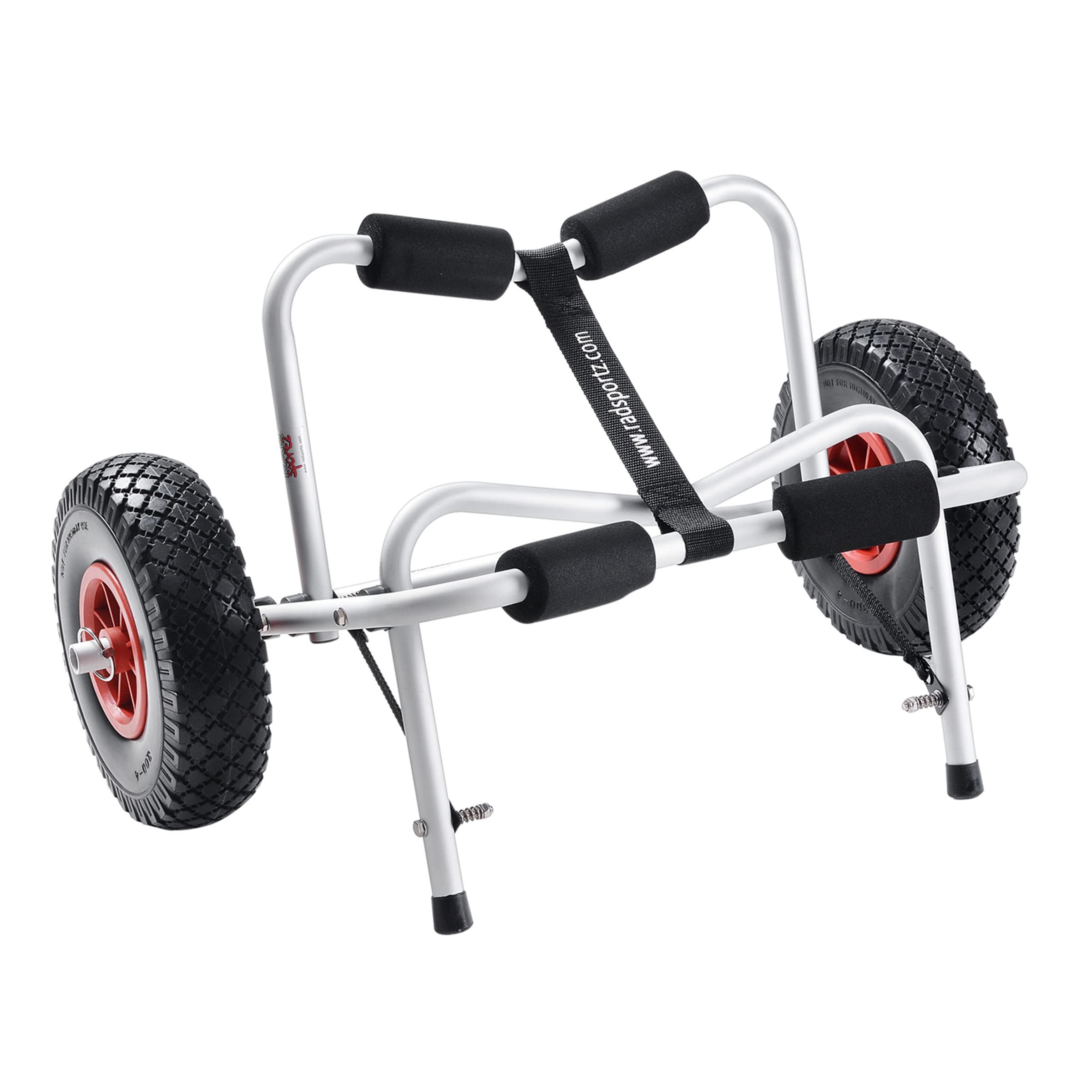
RAD Sportz Kayak Cart

89 /100
Angler Score Excellent

Key details

Frame
Powder-coated aluminum
Wheels
10-inch solid
Load Capacity
150 lb
Check Details on Amazon

One hundred and fifty pounds is the number in the specifications. That's a light recreational kayak with a paddle and a dry bag on it, not a rigged fishing boat, and it's why this cart sits where it does in the group: an inexpensive way to move a small hull down a path, and it doesn't pretend to be more.

The frame is powder-coated aluminum, it folds, and the ten-inch solid wheels are the same airless, puncture-proof kind the bigger carts use — fine on pavement and packed gravel. Assembly is quick and the whole thing stows in a truck bed or a closet.

Where it earns its place is the short carry: a driveway to a ramp, or a lot to a launch a few hundred yards off, with a boat light enough to lift onto the frame without help. The straps in the box run short for a wide hull, so plan on a longer cam strap of your own, and keep the boat well under the rating — this is a cart for a 50-pound kayak, not a 90-pound one with gear.

Pros

  • Low cost for a light recreational kayak
  • Folds flat for a trunk or closet
  • Ten-inch airless, puncture-proof wheels

Cons

  • 150-pound rating limits it to light boats
  • 30-day warranty is the shortest here
Our verdict

For a light recreational kayak and a short walk to the ramp, this is an inexpensive cart that does the job — provided you stay well under its 150-pound rating.

Check Latest Price
7

Narrow, Light Hulls

Pelican Sport Deluxe Cart

86 /100
Angler Score Excellent

Key details

Weight
8.8 lb
Wheels
10-inch airless
Width Range
8 to 13 inches
Load Capacity
175 lb
Check Details on Amazon

Most carts here are designed around wide fishing kayaks. This one goes the other way: the padded arms close to about eight inches apart, which is what a narrow sea kayak or a slim recreational hull actually needs, and they hold at two heights so a deep keel clears the tires.

The frame is aluminum with rubber bumpers, the tires are ten-inch airless, and nothing needs tools — the width sets with hand screws and the whole cart is the lightest full-frame model here at 8.8 pounds. That matters at the end of a carry, when you're the one walking the empty cart back to the car.

Ten-inch hard wheels are fine on pavement, gravel, and grass, and less happy on rubble: a small rock can stop a wheel that size dead. For a path-and-ramp launch that's not a problem, and for a boulder beach it is.

For a 45-pound touring kayak and a walk from the lot to the water, this is a simple, honest cart that adjusts where most don't and weighs almost nothing. It's the one we hand to a paddler with a narrow hull, because the arms close far enough to sit in the keel groove instead of rocking across it.

Pros

  • Arms close to 8 inches for narrow hulls
  • Two height positions clear a deep keel
  • 8.8 pounds and tool-free to adjust

Cons

  • Rated to 175 pounds, so not for rigged fishing kayaks
  • Arm brackets are plastic, not aluminum
Our verdict

For a light, narrow hull, this is the simple cart we suggest: the arms close down to eight inches, it weighs next to nothing, and it asks for no tools.

Check Latest Price
8

Sit-On-Top Drain Holes

VEVOR Scupper Hole Kayak Cart

82 /100
Angler Score Excellent

Key details

Weight
5 lb
Wheels
10-inch solid
Width Range
110 to 455 mm
Load Capacity
280 lb
Check Details on Amazon

Two padded posts drop into the scupper holes and the boat hangs on them — no cradle, no strap, no wrestling a hull onto a frame in the wind. Loading takes seconds once the width is set, and that's the whole appeal.

Width runs from 110 to 455 millimeters with a scale on the bottom for lining the posts up, and the column stands 390 millimeters tall. The frame is two-millimeter aluminum, the wheels are ten-inch solid, the cart weighs five pounds, and it comes apart small enough for a tank well.

The catch is compatibility. It works on a sit-on-top with open drain holes roughly an inch across or bigger, and the posts put load straight into those holes rather than spreading it across the hull, so a heavy boat asks a lot of a thin section of plastic. Check the fit on your hull before you load.

As a dedicated cart for one sit-on-top, there's a lot to like: it's the least expensive cart here, the lightest, and the fastest to load. As an only cart for a household with a sit-inside kayak in the shed, it's the wrong shape entirely — a closed hull gives the posts nothing to grab.

Pros

  • Loads in seconds with no strap
  • Five pounds and breaks down small
  • Width scale lines the posts up

Cons

  • Fits only hulls with open drain holes about an inch or wider
Our verdict

For a sit-on-top with open drain holes, this is the fastest cart to load — the posts drop in and you walk, no strap needed — and the least expensive here.

Check Latest Price

How We Chose and Tested Kayak Carts

We started with roughly 40 carts sold for kayaks, canoes, and paddleboards and thinned the field by reading specs closely. Pinned or plastic-hub wheels, bunks that wouldn't widen past 12 inches, and weight ratings that didn't line up with a loaded 60-pound sit-on-top got cut early, and we weighed what came in the box against the price. Twelve carts made the final list, and we spent six months with them.

Every cart ran the same route: loaded solo with a 12-foot sit-on-top at a gravel launch, then a soft-sand put-in, then a steep, wet concrete ramp, all within the same week so conditions were comparable. We timed assembly out of the box and folding for a hatchback, and we loaded each one alone, noting whether it stayed upright while we lifted the bow. Then we walked them over washboard gravel and exposed roots, watching for wheel bounce, frame flex, and whether the boat shifted on the bunks when we turned or backed up.

Straps got their own attention, because that's where carts quietly fail. We noted which carts shipped with straps and which didn't — two of the 12 had none in the box, a hidden cost — then checked whether the buckles held after a quarter mile or crept loose, and whether metal hardware scuffed a hull. Carts that came home wet sat in a truck bed for a week; the ones that spotted with rust told us plenty. We'll keep hauling with these and update if anything changes.

How to Choose a Kayak Cart

Size the Rating to a Loaded Boat

Start with the bare hull weight and then add everything that rides with it: seat, crate, rods, battery, motor. A fishing kayak that leaves the house at 60 pounds can be 120 at the ramp, and most carts are rated for a flat, smooth surface anyway. One model here publishes three numbers instead — 450 pounds on flat ground, 300 on trails, 200 over five-inch ledges. Read every single figure that way, and leave headroom rather than sizing to the badge.

How the Cart Holds the Hull

Two designs dominate. Padded bunker bars cradle the hull and rely on a strap over the deck; scupper posts push up into the drain holes and hold the boat with no strap at all. Bunker-and-strap carts fit almost anything — sit-inside, sit-on-top, canoe, paddleboard — while posts load in seconds and are useless on a closed hull. Whichever you pick, the strap matters as much as the frame: a cam buckle with a long tail beats a short ratchet strap that won't reach across a wide boat.

Match the Wheels to the Ground

Ten-inch solid wheels are fine on pavement, packed gravel, and grass, and they never go flat. Twelve-inch wheels roll over roots and cobbles that stop the smaller ones. For deep, dry sand nothing works like a low-pressure balloon tire, which spreads the load instead of cutting a trench — and the trade is real, because pneumatic tires want a pressure check before every trip and are more tire than you need on a ramp. Buy for the worst surface on your regular route, not the best one.

Width Adjustment and Hull Clearance

Bunk spacing across this group runs from about six inches to nearly nineteen, and the number that matters is the width of your hull where the cart actually sits, not the beam at its widest point. Measure across the flat area under the seat. Bars wider than that flat section let the boat rock; bars too narrow let it roll sideways. Height settings earn their keep on deep-V and tunnel hulls, because a hull that touches the tires will rub through.

Getting It There and Loading It Alone

Carts here run from five pounds to seventeen, and folded size matters more than weight if the cart lives in a trunk. If it rides on the boat instead, look for a frame that breaks into pieces without tools. For solo loading, a kickstand or a frame that stands up by itself is the difference between a calm two minutes and a wrestling match; our top pick manages it with a wide bunker frame and no stand at all.

Frequently Asked Questions

Final Verdict

For most people hauling a real boat, we recommend the Wilderness Systems. The two height settings solve the problem that trips up cheaper carts — a hull rubbing on its own wheels — the frame loads without a kickstand in the way, and 450 pounds of capacity leaves room for a crate and a battery.

If the budget is tighter, the Bonnlo universal cart does the same job for a lot less, and it brings straps and a kickstand with it. If the walk to the water crosses deep sand, neither of those wheels is the right one: take the Bonnlo balloon-tire cart and accept the pressure checks.