Best Landing Nets of 2026

The worst part of losing a good fish isn't the fight — it's the last ten seconds, when it rolls a foot from your hand and the net coming toward it is the wrong size, the wrong shape, or still folded on your back. A landing net is the cheapest insurance in fishing and usually the last thing any of us actually shops for. Over five months, my team and I fished fourteen of them, from small rubber-mesh trout nets to long telescoping models built for boats, on creeks, farm ponds, a dock, and one very windy morning in a kayak.

A couple of things surprised me. Foldability and a magnetic release matter enormously on a kayak or a crowded boat and almost not at all when you're standing waist-deep in a creek, and a long handle is only worth having if the net doesn't flex like a wet noodle at full extension. Rubber-coated mesh is gentler on fish and far less likely to grab a treble hook than plain nylon, though it's also the first thing to scuff. None of my favorites was the most expensive net I tried, which says a lot about where the value actually sits in this category.

1

Best Overall

PLUSINNO Floating Fishing Net

90 /100
Angler Score Outstanding

Key details

Hoop Size
15.8 x 11.8 in
Net Depth
11.8 in
Item Weight
12.5 oz
Handle Length
16.7 in fixed
Check Details on Amazon

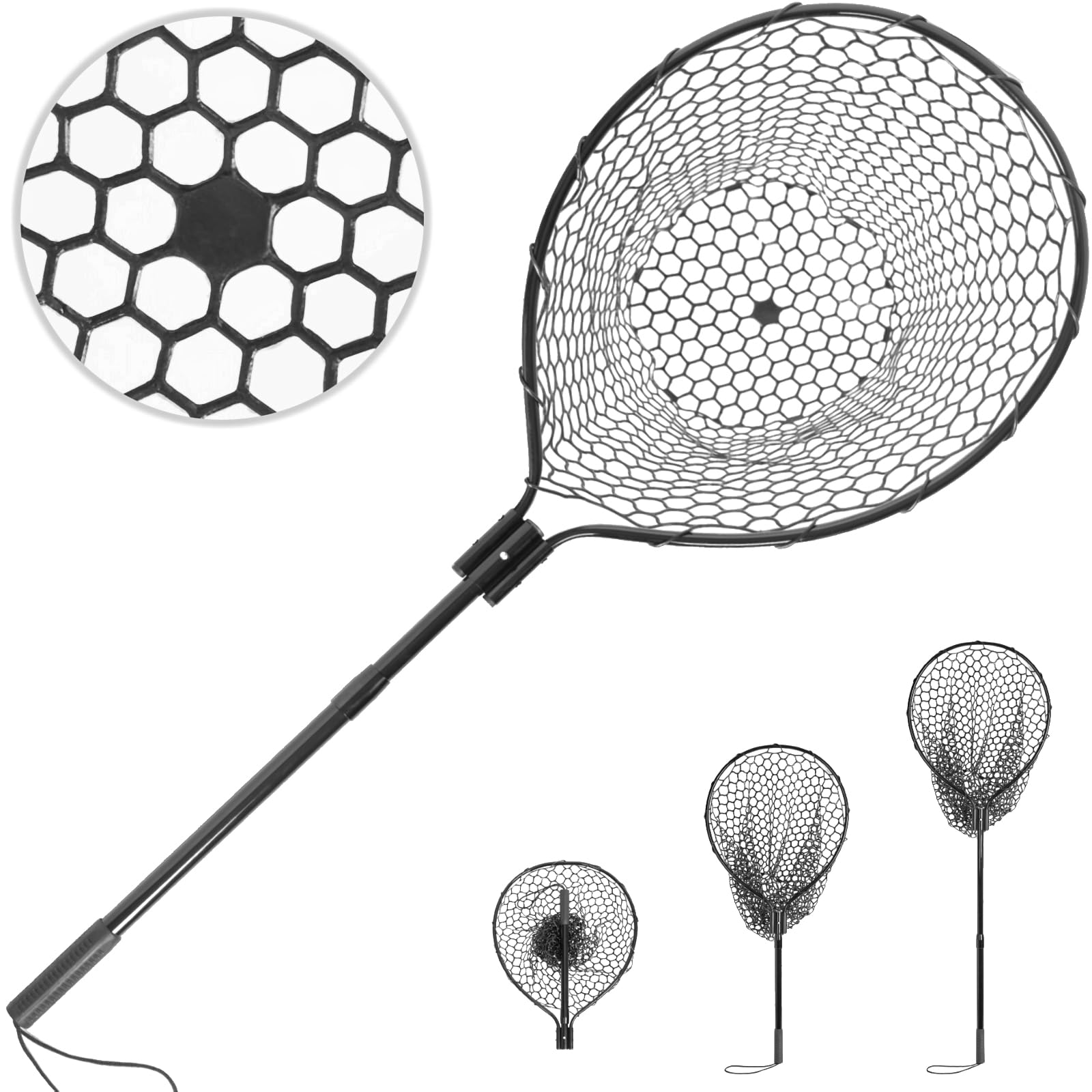
Foam runs around the hoop of this net, and that one detail decides more days than any number on the page. A fumbled net is a lost fish, and in moving water it's a lost net — the PLUSINNO sits on the surface instead of heading downstream. We kept reaching for it for that reason alone.

The rest of the package is sized for close work. The hoop is 15.8 by 11.8 inches with an 11.8-inch drop, enough basket for a bass, a walleye, or a decent stocked trout, and the whole net weighs 12.5 ounces. From a kayak seat that's the difference between scooping a fish and pawing at it one-handed while your rod loads up.

Rubber-coated knotless mesh does the quiet work. Treble hooks come out with a shake instead of a wrestling match, the coating doesn't waterlog the way nylon does, and a released fish keeps its slime coat. We noticed it most on a wet day, when a nylon net stays heavy and this one doesn't.

The folding hoop is why it lives in our kit rather than on a hook in the garage: it collapses to something you can drop in a crate or tuck behind a seat. The joint where the hoop meets the handle is the spot to watch on a net this light, and it's why a heavy fish gets supported under the body instead of swung aboard by the handle.

Pros

  • Floats if you drop it
  • Rubber-coated mesh shakes hooks free
  • Folds flat and weighs 12.5 ounces
  • Basket fits bass, walleye, and trout

Cons

  • Fixed 16.7-inch handle limits reach
Our verdict

If you fish from a kayak, canoe, or float tube, this is the net we point you to: it stays afloat if you drop it, the rubber mesh shakes hooks free, and it folds flat on deck.

Check Latest Price
2

Best for Trout and Catch-And-Release

Frabill Floating Trout Net

91 /100
Angler Score Outstanding

Key details

Hoop Size
13 x 18 in
Item Weight
11.3 oz
Mesh Opening
1 mm
Weight Limit
9.1 lb
Check Details on Amazon

A flat bottom sounds like a footnote until you see a trout lying in one. Rather than curling into a bag, the fish rests level in this Frabill's rubberized micromesh, which spreads its weight and keeps it from thrashing while you back the hook out. It also means the fish isn't folded in half when you hold it against a slot limit.

That's the reason we hand this net to anyone heading for a trout stream. The 1-millimeter micromesh is soft enough not to strip a slime coat, the floating hoop keeps the frame at the surface where you can grab it, and 0.32 kg hangs off a vest without pulling on your shoulder by mid-afternoon. It's also the quietest net here in the hand, with no rattle and no play in the frame.

Carry is handled by the lanyard and carabiner built into the handle: clip it to a vest or a pack strap and it rides there until you need it. There's nothing to collapse or lock, which we appreciate in November, when every folding joint on our other nets starts to stiffen. Rinse it in fresh water at the end of the day and it's ready for the next trip.

Pros

  • Micromesh is gentle on trout
  • Flat bottom keeps fish level
  • Floating hoop stays at the surface
  • 0.32 kg rides light on a vest

Cons

  • 13-by-18 hoop is tight for pike and salmon
Our verdict

For trout you plan to release, this is the net we reach for: the rubber micromesh and flat basket keep a fish calm and unharmed, and the hoop floats beside you.

Check Latest Price
3

Best for Fly Anglers

SF Fly Fishing Landing Net

91 /100
Angler Score Outstanding

Key details

Frame
Bamboo and hardwood
Hoop Size
15.1 x 10.8 in
Item Weight
12.7 oz
Handle Length
8.5 in
Check Details on Amazon

This is a wading net and it's honest about it: a 15.1-by-10.8-inch hoop on a laminated bamboo and hardwood frame, with a 360-degree copper swivel at the butt where the lanyard clips on. What you're buying is the system — net, coiled lanyard, and aluminum magnetic release — rather than a frame with mesh.

The wood is the best-looking thing in this group by a distance. The clear rubberized mesh looks sharp and, more to the point, won't tangle, rot, or mildew if you leave it damp in the truck overnight. At 0.36 kg the whole thing disappears on a vest.

Where it earns its place is the release. The magnet holds the net flat against a vest through brush and current, then lets go with a pull, so you're not working a clip with a fish on. The coiled cord stretches out to 100 inches, which is more than enough to get the net from your vest to the water without unclipping anything.

Pros

  • Magnet releases one-handed
  • Lanyard and release come with it
  • Wood frame looks the part and stays light

Cons

  • 8.5-inch handle is for wading, not boats
  • Wood needs rinsing and drying after trips
Our verdict

For fly anglers who want the net on their vest and a hand free, the whole kit — wooden net, lanyard, magnetic release — is what makes this one worth it.

Check Latest Price
4

Best Value

KastKing Pontus Floating Net

90 /100
Angler Score Outstanding

Key details

Hoop Size
16 in
Item Weight
1.12 lb
Mesh Opening
6.35 mm
Overall Length
28 in
Check Details on Amazon

The detail that sold us is printed right on the net: a built-in length scale. Lay a fish against it before you unhook it and you know whether it clears the slot without hunting for a tape in a wet bag, which is worth something at six in the morning in a cold kayak.

Everything else is aimed at the same angler. The 6063 aluminum handle and reinforced frame hold the whole net at 0.51 kg, the bright orange EVA grip is easy to find in a dark crate, and the triangular hoop folds on a push-down switch into its own storage bag. It floats, which matters more than anything when your other hand is full of paddle.

The hoop is the part to think through. Sixteen inches measured across a triangle gives you less usable basket than a round hoop of the same figure, so bass, walleye, and stocked trout fit comfortably while anything that needs a wide basket won't. For the money, we haven't used a better first kayak net in this group.

Pros

  • Built-in length scale for slot limits
  • Floats and folds into its own bag
  • Costs less than most nets here

Cons

  • 28 inches overall, with no extension
Our verdict

The cheapest net here that still floats and folds, with a built-in length scale that settles keep-or-release questions in seconds.

Check Latest Price
5

Best for Big Fish

NestSprout Large Landing Net

86 /100
Angler Score Excellent

Key details

Hoop Size
23 x 18 in
Net Depth
19.5 in
Max Length
60 in
Weight Limit
28 lb
Check Details on Amazon

Twenty-three by eighteen inches is a big basket, and 19.5 inches of depth beneath it is deeper than most boat nets bother with. That's what lets you slide a fish in head-first and let the mesh hold it while you deal with the hook, instead of lifting the whole weight clear of the water.

We recommend it when the fish you chase won't fit in a trout net: pike, musky, big stripers, flatheads, anything off a pier. The all-aluminum connectors are a genuine advantage over the plastic fittings on cheaper telescoping nets, and the two-section pole collapses to 26.2 inches yet reaches 60, so it stores in a locker and still clears the gunwale.

The 1.2-inch rubber mesh is soft enough for release, the ring frame is 0.52-inch aluminum, and the 28-pound rating is the figure to remember when something with shoulders comes alongside. Nothing about it is delicate; it's built to be leaned over the side of a boat and used hard.

Pros

  • 23-by-18 hoop holds genuinely big fish
  • 28-pound rated capacity
  • All-aluminum connectors, no plastic fittings

Cons

  • 1.9 pounds to carry in a pack
Our verdict

When the fish you chase won't fit in a trout net, this is the one: a 23-by-18 hoop rated to 28 pounds on a pole that reaches 60 inches.

Check Latest Price
6

Best for Long Reach

Fiblink Folding Telescoping Net

86 /100
Angler Score Excellent

Key details

Item Weight
2.4 lb
Handle Length
40-100 in
Extended Length
118 in
Retracted Length
59 in
Check Details on Amazon

A 118-inch pole is the whole reason to own this net, and also the reason to think before you do. At full stretch you have a long lever with a hoop on the end: it's at its best scooping a fish you couldn't otherwise reach, and at its worst when someone tries to lift a ten-pounder clear of the water with it.

Used the way it's meant to be used, it solves a problem nothing else here solves — a jetty, a pier, a high bank, a boat with tall freeboard. The three-section pole runs 40 to 100 inches of handle and tops out at 118 overall, the hoop folds flat, and the whole thing goes back in its bag and stows where you wouldn't expect a net to fit.

Our read is that this is a specialist's net rather than a first net. If the water is a long way down, the reach changes what you can land and that's worth the bulk; from a kayak seat it's length you don't need in a small cockpit. The nylon mesh carries a non-hydrophilic coating, so it sinks into the water fast instead of skidding across the surface when a fish is sulking deep.

The split reputation lands on the fittings — the joint where the pole meets the hoop is where these have failed, and the folding collar can stick going in or out. Keep the sections clean, dry, and free of grit, and the reach is worth the upkeep.

Pros

  • Reaches 118 inches
  • Folds and packs into its own bag
  • Coated mesh sinks fast

Cons

  • 2.4 pounds, the heaviest net here
Our verdict

Buy it for the reach: 118 inches of pole puts a hoop on a fish below a jetty rail or a high bank, and it folds into its bag.

Check Latest Price
7

Packable Travel

SARDVISA Foldable Floating Net

89 /100
Angler Score Excellent

Key details

Frame
Aluminum alloy
Included
Bag, lanyard, belt clip
Item Weight
15.5 oz
Handle Range
27-35 in
Check Details on Amazon

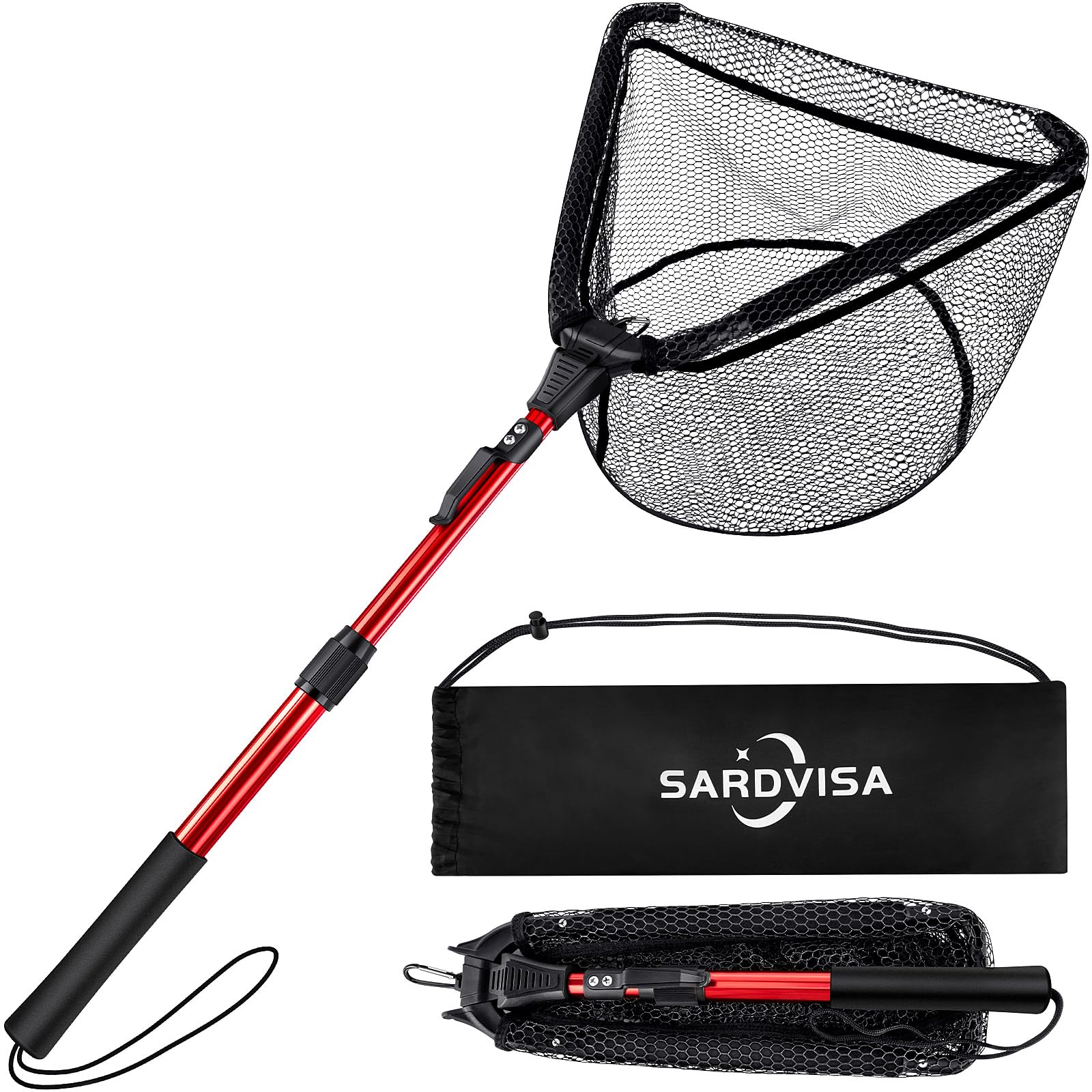
Set beside the bigger nets here, this one is a stowaway. The triangular hoop folds, the aluminum handle retracts, and the whole package — net, storage bag, lanyard, belt clip — goes into a daypack without a second thought.

Floating is what matters most at this size. Foam in the frame keeps it at the surface if it slips off the deck, and at 0.44 kg it's light enough to clip to a belt and forget about. The bright EVA grip is easy to spot in low light and stays grippy in wet, cold hands.

The hoop is small, and that's the other half of the trade: panfish, stocked trout, and modest bass fit, while a fish with shoulders doesn't. That's not a flaw in a net built for a backpack, but it does tell you where to take it.

Our recommendation is narrow but genuine: buy it as the net that goes in the pack on trips where a full-size frame stays home. As your only net, it will leave you short.

Pros

  • Folds and retracts into a daypack
  • Floats if it goes over the side
  • Ships with bag, lanyard, and belt clip

Cons

  • Reach tops out at 35 inches
Our verdict

The net that goes in the daypack when a full frame stays home, and one of the few here that folds small and still floats.

Check Latest Price
8

Spare Boat Net

Calamus Triangle Fishing Net

86 /100
Angler Score Excellent

Key details

Mesh
UV-resistant polyester
Frame
Nylon and fiberglass
Item Weight
11.3 oz
Overall Length
31 in
Check Details on Amazon

Clip this one to your belt and the hoop can swing open against your leg as you walk: the folding collar holds the net in half, but nothing latches it shut. Slide it into a boat crate or a pack instead and the annoyance disappears.

The mesh is the real compromise at this price. It's UV-resistant polyester rather than rubber-coated, so it drains and dries fast but grabs treble hooks in a way rubber doesn't, and it's less kind to a fish you mean to release. For bait, panfish, and a kid's first net, that's a fair swap.

The rest is sturdier than the price suggests: a 6061 aluminum handle, a nylon and fiberglass-reinforced frame, and a locking collar that folds the net in half for storage. The bright blue elastomer grip is easy to find in a cluttered boat, and the built-in elastic lanyard and belt clip mean it can ride on you instead of in a box.

Folded in half, it stows in places a full-length net won't, which is why it ends up in the truck bed, under a kayak deck, or in the bottom of a canvas bag. We like it best as the spare that turns a forgotten net into a non-issue.

Pros

  • Folds in half for storage
  • 6061 aluminum handle and reinforced frame
  • Light at 0.32 kg

Cons

  • Fixed 31-inch handle, no extension
Our verdict

The one to leave in the truck or under the kayak deck for the fish you didn't plan on, at a price that makes a second net easy.

Check Latest Price

How We Tested the Landing Nets

We started with roughly forty nets on paper — fixed handles and telescoping handles, rubber-coated and plain nylon mesh, hoop openings from tiny trout sizes up to 20-plus inches — then trimmed the list by reading specs, noting what anglers complained about most in reviews, and cutting anything that looked overpriced for what it was. Fourteen made the final cut, and each one spent five months in rotation rather than a single afternoon.

Testing happened where nets actually get used. Two of us waded spring creeks after wild trout, one fished farm ponds from a kayak, and the rest of the time we worked a dock and a friend's bass boat. We landed fish with every net on the list, then did the unglamorous part: measured each hoop and each folded length against a daypack, opened every net one-handed with wet hands to see how the hinge and the magnetic clasp behaved, and carried them through brush to check whether the release held or popped loose.

Handle length got evaluated at full stretch, never on the couch. We reached for fish from a rocking boat and noted which handles went soft or wobbled at the joint, and which stayed rigid enough to lift a decent bass. We dragged mesh over gravel and buried treble hooks in it to see how badly it snagged and how quickly the coating scuffed. After each trip the nets rode home wet in the truck bed, so by month five we had a clear picture of which frames had corroded, which hinges had loosened up, and which ones were still worth their price tag.

How to Choose a Landing Net

Match the basket to the fish, not the photo

The hoop decides what you can land. A 13-by-18-inch basket covers stocked and holdover trout and most bass; once you're chasing fish that run past the mid-twenties, look at 20 inches or wider, the territory the NestSprout is built for. Depth counts as much as width, because a deep bag lets a fish lie in the water while you work the hook out, while a shallow one lets it flip back over the rim.

Measure against the fish you actually catch. If you fish the same water every weekend, you already know the biggest thing you hooked last season, and that fish is the one to size the hoop for.

Reach is a handle measurement, not an overall one

Listings quote overall length, and it flatters the net. A model sold as 27 to 35 inches extendable is a compact net with a short reach, while the Fiblink's 40-to-100-inch handle is what real distance looks like. Decide where you fish before you decide how long: from a kayak seat a 16-to-30-inch net is plenty and easier to manage, while from a bank, a pier, or a boat with tall freeboard you want the handle that puts the hoop in the water without leaning.

Buy only the reach you need. Long poles flex and are slower to swing, and most close-quarters nettings get worse, not better, with another two feet of aluminum in the way.

Rubber mesh or nylon

Our default is rubber-coated, knotless mesh. Treble hooks come out with a shake, the coating doesn't soak up water, and it's easier on a fish you mean to release. Nylon and polyester baskets drain and dry fast and usually cost less, but they hold hooks and are rougher on a slime coat.

Let your fishing pick. Bait and panfish, where the fish goes in the bucket, make a cheap mesh perfectly reasonable; anything you plan to photograph and let go is worth the rubber.

How it rides matters as much as how it scoops

A net that lives in a locker can be big and heavy; a net that hangs off your vest cannot. Folding hoops, belt clips, elastic lanyards, and magnetic releases all exist to keep the net within one hand when a fish is ready. There are two traps here: a folding collar that doesn't latch can let the hoop swing open as you walk, and a magnetic release is only as good as the cord that holds it.

If you fish from water you can't wade, put floating on the list too. Foam in the hoop buys you the seconds it takes to turn around and pick the net back up.

Weight is the spec you feel at hour four

The nets here run from roughly 11 ounces to 2.4 pounds, and the gap shows up late in the day. Under a pound is the range to target for a vest or kayak net you hold out one-handed; a heavier net is fine when it lives in a rod holder or a boat locker and only comes out for the netting itself.

Picture the net where it will spend the day — hanging from a strap, folded in a crate, or extended in your hand — and weigh it against that, not against the shelf.

Frequently Asked Questions

Final Verdict

We recommend the PLUSINNO floating net first because floating, folding, and 12.5 ounces covers the way most people fish: from a kayak, a float tube, or a small boat where deck space is tight and a dropped net is gone for good.

Change the water and the answer changes. Trout in a stream call for the Frabill's flat basket and micromesh; a fish below a jetty rail is the Fiblink's 118 inches or nothing here at all.