Best Marine Battery Chargers of 2026

A dead battery bank is one of the more expensive ways to start a season, and the charger bolted into your locker is either preventing that or causing it. Cheap units keep pushing current long after a battery is full; good ones step down through bulk, absorption, and float and then hold there for months. What you're really buying is the confidence to leave something plugged in all winter without walking out to check on it.

I learned that the hard way watching a two-bank unit quietly cook a pair of AGM batteries over a single summer, so these days I read the charge profile list before anything else. We've spent the past nine months living with 12 onboard chargers, through a full season on the water and a cold off-season in storage, and the ones worth mounting keep proving the same handful of traits. One thing first-time buyers miss: a 3-bank, 30-amp charger splits that amperage three ways, so each battery sees 10 amps — plenty for maintenance, slow on a deeply drained bank. The picks below all earned a permanent spot.

1

Best Overall

NOCO GENPRO10X3

93 /100
Angler Score Outstanding

Key details

Warranty
3-year limited
Battery Types
12V lead-acid, AGM, LiFePO4
Banks / Output
3 banks, 30 A total (10 A/bank)
Waterproof Rating
IP68
Check Details on Amazon

Thirty amps split across three banks is the reason this NOCO sits at the top of our list, but the case depth is what surprised us. It measures 2.83 inches front to back, so it tucks against a battery-box wall without stealing footroom. Each bank gets its own 10-amp feed and its own chemistry setting, which means a cranking battery and a pair of deep-cycle trolling batteries can share one charger without sharing a profile. That flexibility is the whole argument for a three-bank unit, and this one executes it cleanly.

The rest of the spec sheet reads like a marine charger should: IP68 sealing, a thermal sensor that adjusts output with temperature, and a force mode for batteries that have dropped below the normal detection threshold. We also like the eyelet terminals, which make a permanent install more sensible than alligator clips. The three-year limited warranty is the part that matters most on a boat that sits outside; it gives you a real remedy if a bank quits.

The caveat is longevity. Some units have stopped charging, and that is the one reason we do not call this a set-and-forget purchase. We prefer to mount the charger where we can reach it without dismantling the battery compartment, and we treat the warranty as part of the purchase rather than a footnote. For a two- or three-battery boat, the combination of 10 amps per bank, broad chemistry support, and a real warranty is still the strongest package in this group.

Pros

  • 10 amps per bank across three batteries
  • Handles lead-acid, AGM, and LiFePO4
  • IP68 sealed and only 2.83 inches deep
  • Three-year limited warranty

Cons

  • Heavy 13.4-pound case
  • Wide 10.51-inch footprint
Our verdict

For a boat with a cranking battery and a two-battery trolling bank, this is the charger we recommend: 10 amps per bank, broad chemistry support, and a three-year warranty.

Check Latest Price
2

Best Value 3-Bank

FirstPower Pro 30A 3-Bank

89 /100
Angler Score Excellent

Key details

Warranty
3-year
Battery Types
12V SLA/AGM, lithium, calcium
Banks / Output
3 banks, 30 A total (10 A/bank)
Waterproof Rating
IP68
Check Details on Amazon

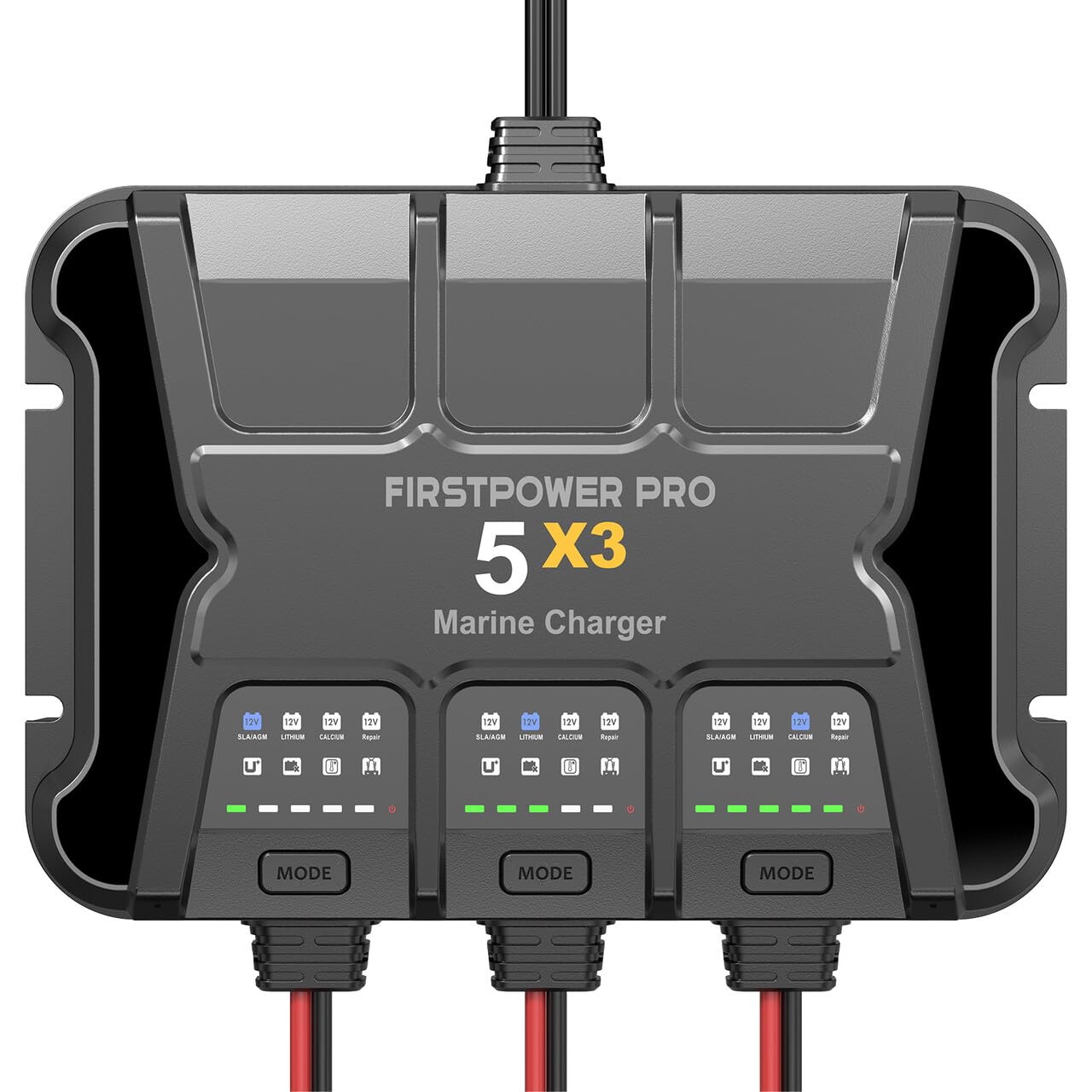
The case for this FirstPower is straightforward: it delivers a three-bank, 30-amp layout without moving into the premium tier. Each bank is rated at 10 amps and can be set independently for SLA/AGM, lithium, or calcium, so it covers the same mixed-battery job as the top pick. It also carries a three-year warranty, which is not a given at this end of the market.

We think that combination makes it the value pick for a three-battery boat. The five-grid power display is simple to read at a glance, and the box includes both battery clips and connectors, which gives you a temporary setup while you decide on permanent wiring. The three-year warranty also means you are not accepting a throwaway unit to save money.

The open question is how it holds up over several seasons. The three-year warranty is the answer we can point to, and an accessible mounting location makes any service claim easier to use. We also like that the charger does not force one chemistry across all three batteries; a lithium house bank and a lead-acid cranking battery can coexist. For a boater who wants three 10-amp banks without paying for the established name, the value is the point.

Pros

  • Three 10-amp banks for three batteries
  • Per-bank SLA/AGM, lithium, calcium modes
  • IP68 sealed housing
  • Three-year warranty

Cons

  • Wide 10.9-inch case
  • 10.4-pound body
Our verdict

A three-bank, 30-amp charger with per-bank chemistry settings and a three-year warranty, this is the value pick for a boat running three 12V batteries.

Check Latest Price
3

Best Fast-Charging 2-Bank

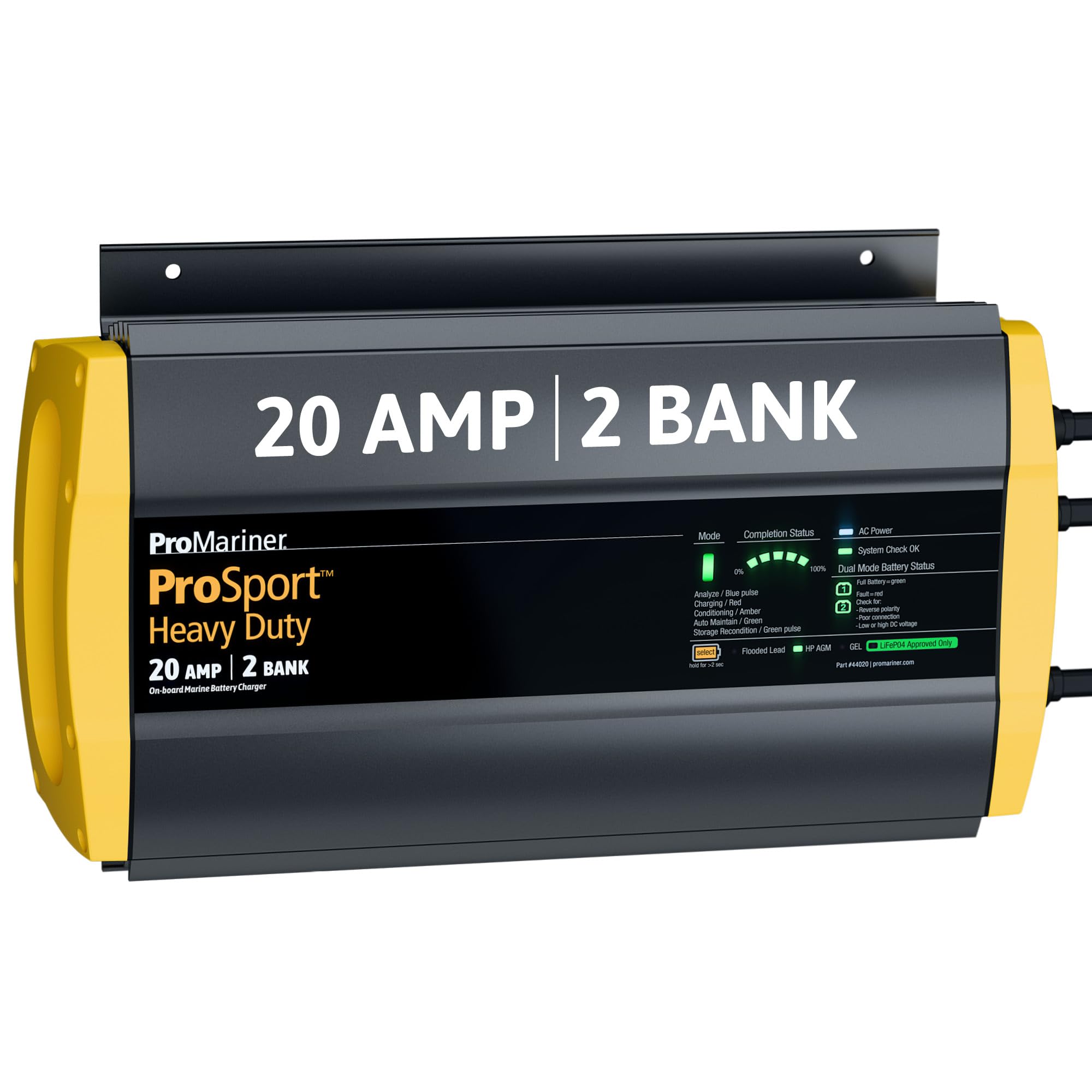
ProMariner ProSport HD 20A

89 /100
Angler Score Excellent

Key details

Battery Types
12V flooded, AGM, gel, lithium
Power Sharing
Distributed-On-Demand
Banks / Output
2 banks, 20 A total
Waterproof Rating
IP67
Check Details on Amazon

The feature that separates the ProSport HD is Distributed-On-Demand charging. Instead of capping each bank at its share, the charger sends unused amps to whichever battery needs them, up to the full 20-amp output. On a two-battery boat, that means the trolling battery can take more current once the cranking battery is topped off. It is a smarter use of 20 amps than a fixed split, and it is the reason this charger costs more than the simpler two-bank units here.

The hardware is built for a long run: a tri-surface extruded heat sink, IP67 sealing, and a four-color LED gauge that shows charge stage and completion. We like the gauge because it answers the question you actually ask at the dock—is this bank still working? The charger also supports flooded, AGM, gel, and lithium profiles, so it is not locked to one battery type.

We think the ProSport earns its premium for a two-battery boat that gets drawn down hard. The power-sharing design makes better use of 20 amps than a fixed split, and the display takes the guesswork out of shore-power checks. The trade-off is the two-bank limit: if you have three batteries, this is the wrong shape, no matter how good the electronics are.

Pros

  • 20 amps shared across two banks
  • Distributed-On-Demand sends unused amps
  • IP67 sealed housing
  • Four-color LED completion gauge

Cons

  • Long 16.4-inch housing
Our verdict

If your boat has two batteries and you want faster charging than a 5-amp bank, the ProSport's 20 amps and power-sharing design earn the premium.

Check Latest Price
4

Best for Flooded/AGM Pairs

Guest ChargePro 8A

90 /100
Angler Score Outstanding

Key details

Battery Types
12V flooded, AGM
Banks / Output
2 banks, 8 A total (4 A/bank)
Mounting Depth
2.4 in
Waterproof Rating
IP67
Check Details on Amazon

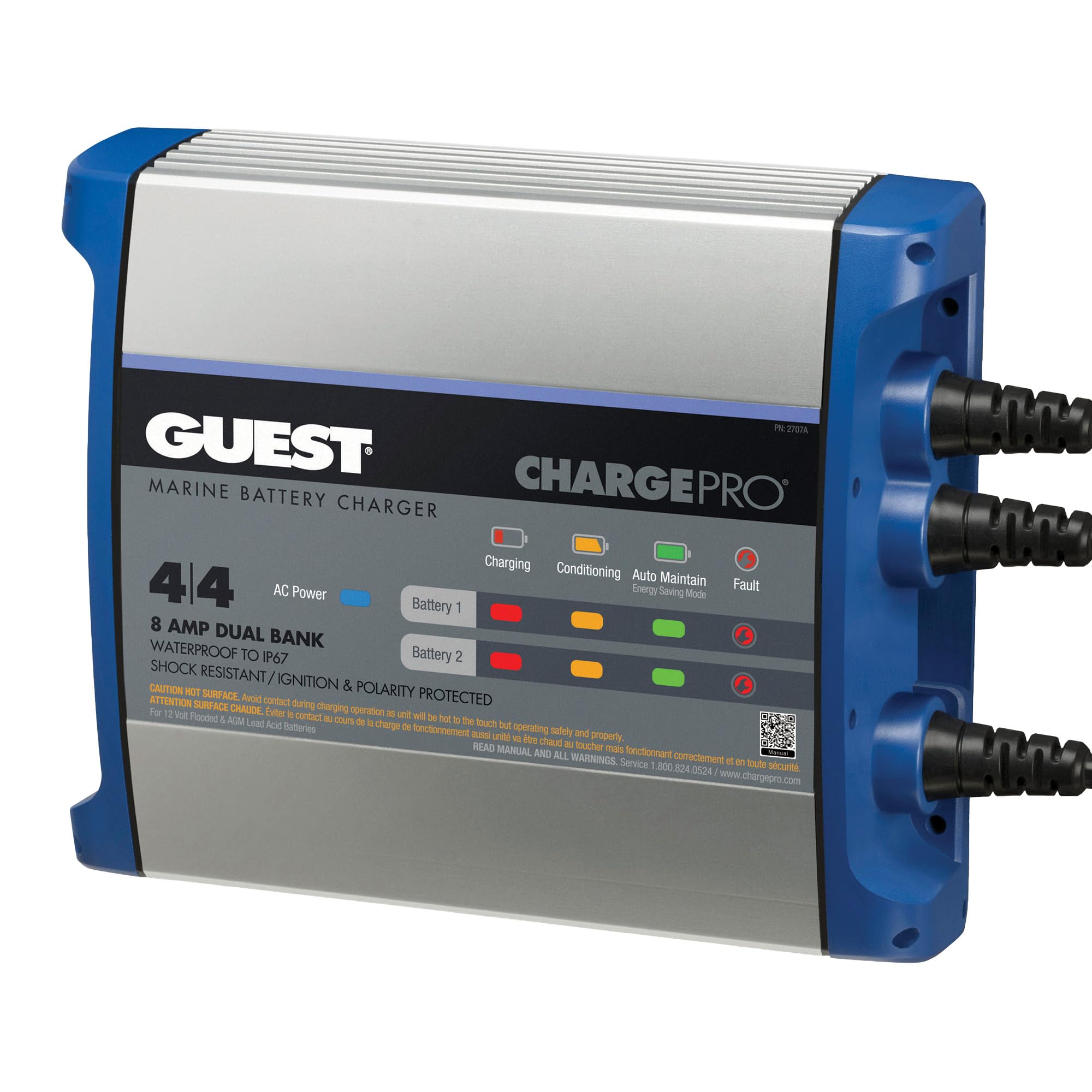
If your boat has two flooded or AGM batteries and no plans to switch to lithium, the Guest ChargePro is the least complicated way to keep them ready. It charges each bank independently at 4 amps, and the LED display shows the stage without asking you to interpret a menu. The controls are minimal because the charger is built for one job: plug in, confirm the lights, walk away.

We like that simplicity for a boat that lives on a trailer or a lift. The case is only 2.4 inches deep and 4.5 pounds, so it mounts on a bulkhead without much fuss, and the IP67 housing is sealed against spray. The charge indicators are easy to read from above, which matters when the battery box is low in the hull. The Guest does not try to be a universal charger, and for a traditional two-battery boat that restraint is the appeal.

The Guest is the charger we reach for when the boat has a simple two-battery routine and the owner wants to spend time fishing, not programming profiles. The sealed housing and in-line fuse protection are the right kind of boring, and the independent banks mean a weak starting battery does not drag down the trolling battery. It is a deliberate, limited tool, and it does that one job well.

Pros

  • Independent two-bank charging
  • IP67 sealed housing
  • Clear LED status display
  • Compact 2.4-inch depth

Cons

  • Only 4 amps per bank
  • No lithium charging mode
Our verdict

For a two-battery boat on flooded or AGM batteries, this Guest is the simple, sealed choice, with clear status lights and a compact case.

Check Latest Price
5

Best Budget 2-Bank

Zrfmib 2-Bank 10A

83 /100
Angler Score Excellent

Key details

Warranty
3-year
Battery Types
12V SLA/AGM, lithium, calcium
Waterproofing
Waterproof
Banks / Output
2 banks, 10 A total (5 A/bank)
Check Details on Amazon

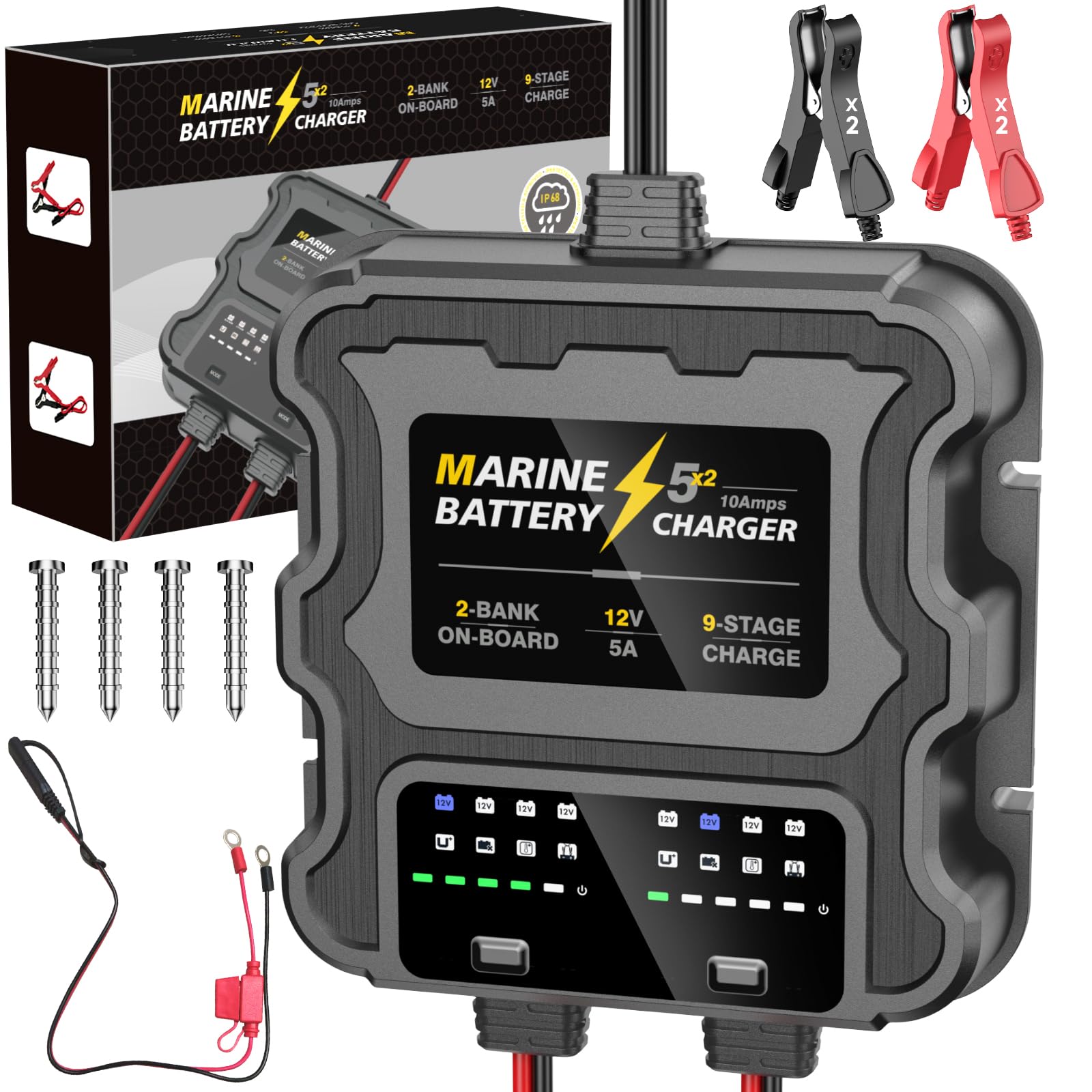
The Zrfmib is the smallest-footprint way into a two-bank charger in this group, and that is the reason it earns a place. The case is 6.5 inches square and just 2 inches deep, so it can mount on a battery-box lid or a narrow bulkhead where the bigger units will not go. It still gives each bank 5 amps and its own mode button for SLA/AGM, lithium, or calcium, which is more flexibility than we expect at the budget end.

The charging profile is more thoughtful than the price suggests: nine stages, automatic temperature compensation, and diagnostics for over-voltage, reverse polarity, a faulty battery, or overheating. We also like the three-year warranty, which is longer than the anegine's one-year coverage and matches the FirstPower units. The mode buttons are straightforward, and the diagnostics cover the faults that matter at the dock.

The Zrfmib makes the most sense for a small boat with a starting battery and a trolling battery and a tight mounting space. The 6.5-inch square case leaves room for wiring, and the three-year warranty gives it a longer support window than the anegine. For a compact two-battery install, it is an easy charger to live with.

Pros

  • Fits a 6.5-inch square footprint
  • Per-bank lead-acid, lithium, calcium modes
  • Three-year warranty
  • Automatic temperature compensation

Cons

  • 5 amps per bank is a slow recharge
Our verdict

A compact, budget-friendly two-bank charger with lithium support and a three-year warranty, this is the one for a small boat with modest charging needs.

Check Latest Price
6

Maintaining Three Batteries

FirstPower Pro 5A 3-Bank

91 /100
Angler Score Outstanding

Key details

Warranty
3-year
Battery Types
12V SLA/AGM, lithium, calcium
Banks / Output
3 banks, 15 A total (5 A/bank)
Waterproof Rating
IP68
Check Details on Amazon

At 1.97 inches deep, this FirstPower is the easiest three-bank charger here to fit against a bulkhead. Each bank gets 5 amps and its own mode for SLA/AGM, lithium, or calcium, so a mixed set of three batteries can stay on one charger without adapter boxes or profile swaps. That shallow profile is the detail we noticed first; it mounts without crowding the battery box.

The rest of the package is sensible for a boat that lives on a lift or trailer: IP68 sealing, a five-grid power display, automatic repair mode, and a three-year warranty. The 9.45-inch width and 7.68-inch height give it a footprint that is easy to plan around, and the per-bank mode buttons mean a lithium house battery and a lead-acid cranking battery can share the charger without compromise. We like that it does not force you into one chemistry for the whole boat.

We think this is the right charger for the boater who wants three batteries looked after without a big, high-output box on the wall. The three-year warranty makes it a safer bet than the anegine's one-year coverage, and the per-bank modes keep a mixed battery set simple. If your routine is plugging in at the dock and letting the charger maintain between trips, this is a quietly sensible three-bank choice.

Pros

  • Three independent 5-amp banks
  • Per-bank lithium, AGM, calcium modes
  • Slim 1.97-inch mounting depth
  • Three-year warranty

Cons

  • 5 amps per bank is slow for deep draws
Our verdict

For a three-battery boat that lives on a lift or trailer, this FirstPower delivers independent 5-amp maintenance and a three-year warranty in a slim case.

Check Latest Price
7

Compact Two-Bank

anegine 20A 2-Bank

85 /100
Angler Score Excellent

Key details

Warranty
1-year
Battery Types
12V lead-acid, AGM, gel, LiFePO4
Banks / Output
2 banks, 20 A total (10 A/bank)
Waterproof Rating
IP68
Check Details on Amazon

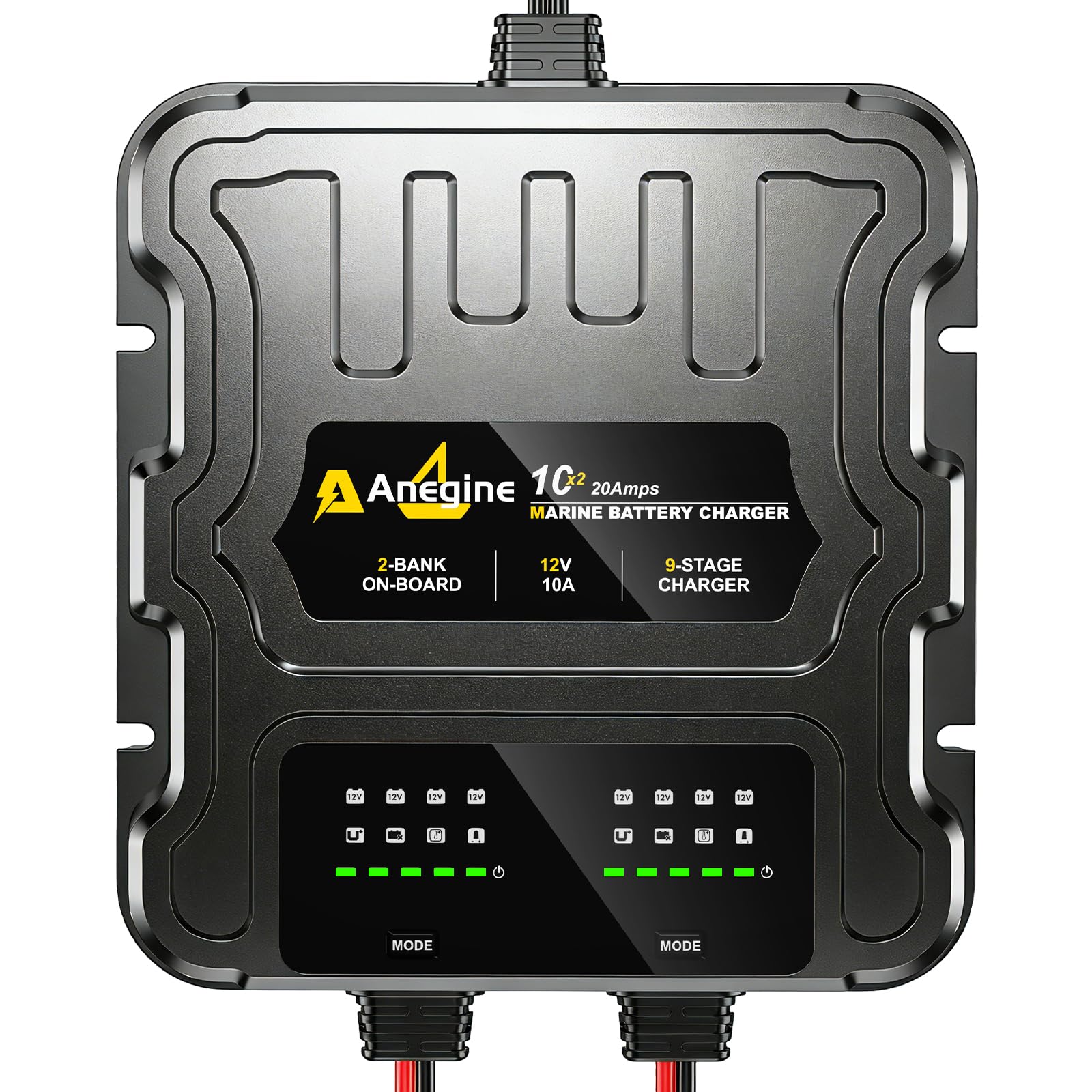
A 20-amp two-bank charger in a case 6.49 inches wide is a neat trick. The anegine delivers 10 amps per bank, enough to bring a trolling battery back faster than the 5-amp units here, without taking over the battery compartment. The LCD is a step up from a simple light bar, and the case is sealed to IP68. On a small boat with limited mounting space, that combination is immediately appealing.

The charging feature set is broad: selectable modes for lead-acid, AGM, gel, LiFePO4, and calcium, plus a repair mode for batteries that have dropped below 1 volt. Nine charging stages are the kind of spec we look for when a charger will live on a boat through temperature swings. The LCD shows the selected mode, which makes it easier to confirm that each bank is doing what you asked.

The terminals are the practical detail to check. The listing describes both alligator clips and ring terminals, so you can hardwire the charger or use it as a bench unit first. We prefer the ring-terminal route for a permanent install because it removes a connection that can loosen with vibration. The 9.17-inch depth is the other measurement to plan around; this case is narrow, not shallow.

We think the anegine is the compact two-bank pick for a boat that needs faster charging in a tight space. The 10-amp banks and LCD put it ahead of the budget 5-amp units on charging speed, and the IP68 case suits a wet battery compartment. If you want the smallest 20-amp two-bank case in this group, this is the one.

Pros

  • 10 amps per bank in a compact case
  • IP68 sealed housing
  • LCD status display
  • Lithium, gel, AGM, calcium modes

Cons

  • One-year warranty is short for marine duty
Our verdict

If space is tight and you want 10 amps per bank, this anegine is the compact two-bank choice, with a sealed case and a readable LCD.

Check Latest Price

How We Tested: A Season Onboard, an Off-Season in Storage

We started with roughly 40 onboard chargers sold for boat use and cut that to 12 based on bank count, rated amperage per bank, waterproofing claims, and whether the profile list covered flooded, AGM, gel, and lithium. Footprint eliminated more than I expected — a few otherwise solid units were too long for the locker on a 21-foot center console, so we taped out each case before ordering anything.

Every unit was mounted where it actually lives and left connected for all nine months: a battery locker on a center console, the compartment under a pontoon bench, and a garage shelf through the winter. Each was wired to a mix of group 27 and group 31 batteries, flooded, AGM, and one lithium bank.

Charging performance came down to amps, measured rather than claimed. We ran banks down to about 50 percent with a load bank, then logged current at each bank with a clamp meter every hour. Some held their rated output well into absorption; others tapered early or quietly starved one bank while a neighbor was still full. We shot case temperatures with an infrared gun too, since a charger that runs hot inside a closed locker is a durability problem in slow motion.

Build quality got the wet treatment — a hose splash, then weeks in a humid locker to see what fogged, corroded, or quit. On settings, we timed profile changes at the panel and checked whether the charger remembered them after a month unplugged; a few didn't. We also left every battery connected through the off-season and read resting voltage and specific gravity in spring, which is the only honest test of whether a charger maintains a bank or slowly damages it. Value, finally, meant what the extra money bought — a sealed case, a real lithium profile, another bank — not the sticker.

How to Choose a Marine Battery Charger

Match Banks to Your Battery Set

Count the batteries you need to charge separately, not the total voltage of the trolling motor. A 24V trolling system is usually two 12V batteries, and an onboard charger treats each one as its own bank. A second bank covers a cranking battery; a third covers a three-battery boat. Buying one extra bank is cheaper than adding a second charger later, but an unused bank is just more case to mount.

Amps per bank decide how quickly that bank recovers. Five amps is a maintenance pace, fine for a boat that gets topped up after every trip. Ten amps is the better default for a trolling battery that gets drawn down, and 20 amps total across two banks is our preference when you want a faster turnaround. The NOCO GENPRO10X3's 10 amps per bank is why it tops this group; the FirstPower 5A is for the opposite routine.

Check Chemistry and Mode Control

Flooded, AGM, gel, and lithium batteries do not want the same charge profile, and a marine charger needs to match the bank, not the boat. Look for a unit that lets you set each bank independently; a mixed set of a lithium house battery and a lead-acid cranking battery is common enough that a single global mode is a false economy. The Guest ChargePro is deliberately limited to flooded and AGM, while the NOCO and FirstPower units cover lithium and calcium. If you are buying for a boat you plan to keep, lithium support is worth having even if you have not switched yet.

Seal It and Measure the Mount

An onboard charger lives in a wet, vibrating place, so IP67 or IP68 sealing is the starting point, not a premium extra. The mounting footprint matters just as much: a long, wide case can be harder to place than a heavier compact one. The ProMariner ProSport HD needs 16.4 inches of width; the anegine two-bank fits in 6.49 inches. Measure the battery compartment, leave room for cables, and mount the charger where you can see the display and reach the terminals without standing on your head.

Treat Reliability and Warranty as Part of the Price

Chargers fail, and the failure usually shows up as one bank going quiet rather than a dramatic meltdown. That makes the warranty and the mounting location part of the purchase. A three-year warranty is common among the stronger picks here; the anegine carries one year. Mount the unit where you can remove it without dismantling the battery box, and check the charger after each trip during the first season. A quick look at the bank indicators is cheaper than discovering a dead trolling battery at the ramp.

Plan the Wiring and the Everyday Check

Permanent ring terminals beat alligator clips for an onboard charger; clips are useful for a quick test but can loosen with vibration. Some units ship with both, which is the flexible choice. Look for a display that tells you the charge stage and completion status, not just a power light. The Guest ChargePro's simple LED bar is enough for a two-battery boat; the ProMariner's four-color gauge and the anegine's LCD give you more information. Whatever you choose, label the banks so a mid-season swap does not turn into a guessing game.

Frequently Asked Questions

Final Verdict

The NOCO GENPRO10X3 is our pick for most two- or three-battery boats: 10 amps per bank, per-bank chemistry settings, IP68 sealing, and a three-year warranty. If the budget is tighter, the FirstPower Pro 30A gives you the same three-bank, 10-amp layout for less, with the same warranty. For a simple flooded or AGM pair, the Guest ChargePro is the easiest to live with. The common thread is matching the charger to the batteries you actually have, not buying the biggest box on the shelf.