Best Surf Fishing Lures of 2026

The trouble with surf lures is that the two things you want most — distance and action — pull against each other. Weight a plug heavily enough to punch through an onshore wind and it swims like a stick; lighten it so it darts and wobbles and it never reaches the second bar. Get it right, though, and one lure turns an empty stretch of water into a plan: fan your casts, cover the trough, and work back through where fish are actually holding.

I fish the beach most weekends and keep a plug bag by the door, so I have opinions. Over the past five months my team and I fished 18 lures — topwaters, jerkbaits, bucktails, and a few oddballs — from dawn tides to the last hour of light, judging how they cast into wind, how they swim on a slow retrieve, and whether the finish and hooks survive salt, sand, and teeth. A cheap lure that tracks straight all morning beats a pretty one you're afraid to throw near a jetty. The picks below earned their place in the bag.

1

Best Overall

Cotton Cordell Pencil Popper

91 /100
Angler Score Outstanding

Key details

Action
Walk-the-dog or chugging
Running Depth
Surface
Tail Weighting
Weighted tail for long casts
Length And Weight
7 in, 2 oz
Check Details on Amazon

Weight at the tail end is the whole trick with a pencil popper, and Cordell puts it exactly where it belongs. Two ounces of plug behind a 7-inch body loads a long rod on the back cast and keeps driving when the wind picks up, so you reach the bar instead of stopping short of it. In the surf that reach matters more than any color pattern.

What keeps this one at the top of our list is that it does two jobs. Rip it hard and it spits and chugs like a popper; work it with a steady walk-the-dog cadence and it snakes side to side with barely any wrist. One plug covering both a flat sea and a chop means fewer reties on a moving tide, and we noticed it most on the days the wind shifted halfway through a session.

The finish is plain and bluefish teeth will scuff it. Neither bothers us much, because a scuffed pencil still walks. Where it earns its keep is the morning a blitz pushes bait onto the outer bar and everything else in the bag falls short — that is the day it pays for its place.

Pros

  • Weighted tail adds real casting distance
  • Walks or chugs without a retie
  • 7-inch body built for big stripers and blues

Cons

  • Plain finish next to the pricier plugs here
Our verdict

The first surf plug we tie on when fish are showing beyond the bar: a 7-inch, 2-ounce body with a weighted tail that actually gets out there and still walks back.

Check Latest Price
2

Best Topwater Walker

Heddon Super Spook

94 /100
Angler Score Outstanding

Key details

Action
Walk-the-dog
Hardware
Super-stout line ties and hooks
Running Depth
Surface
Length And Weight
5 in, 7/8 oz
Check Details on Amazon

Five inches and seven-eighths of an ounce is the sweet spot for surf topwater: big enough that a schoolie striper or a bluefish commits to it, small enough that it does not spook fish sitting in flat water at first light. The Super Spook walks with almost no effort, which is why it is the surface plug we hand to anyone learning the retrieve.

The cadence is what you are learning: a short twitch, then slack, then another twitch. The walk comes from the slack line, not from how hard you yank, and this plug keeps tracking even when your rhythm wobbles. Line ties and hooks are stout enough for hard-charging fish, and the three trebles are sharp out of the package.

Seven-eighths of an ounce is light for a hard headwind, so on a big sea we fish it on a longer rod with braid, or switch to something with more weight behind it. Calm water over shallow bars is its home, and that is most mornings.

Pros

  • Walks the dog with almost no effort
  • Size suits schoolies, blues and slot stripers
  • Stout line ties and hooks

Cons

  • Paint chips along the back with teeth and trebles
Our verdict

The easiest topwater here to learn on, and still the one we hand a friend who wants to watch a striper smash a plug on the surface.

Check Latest Price
3

Best Slow-Suspending Plug

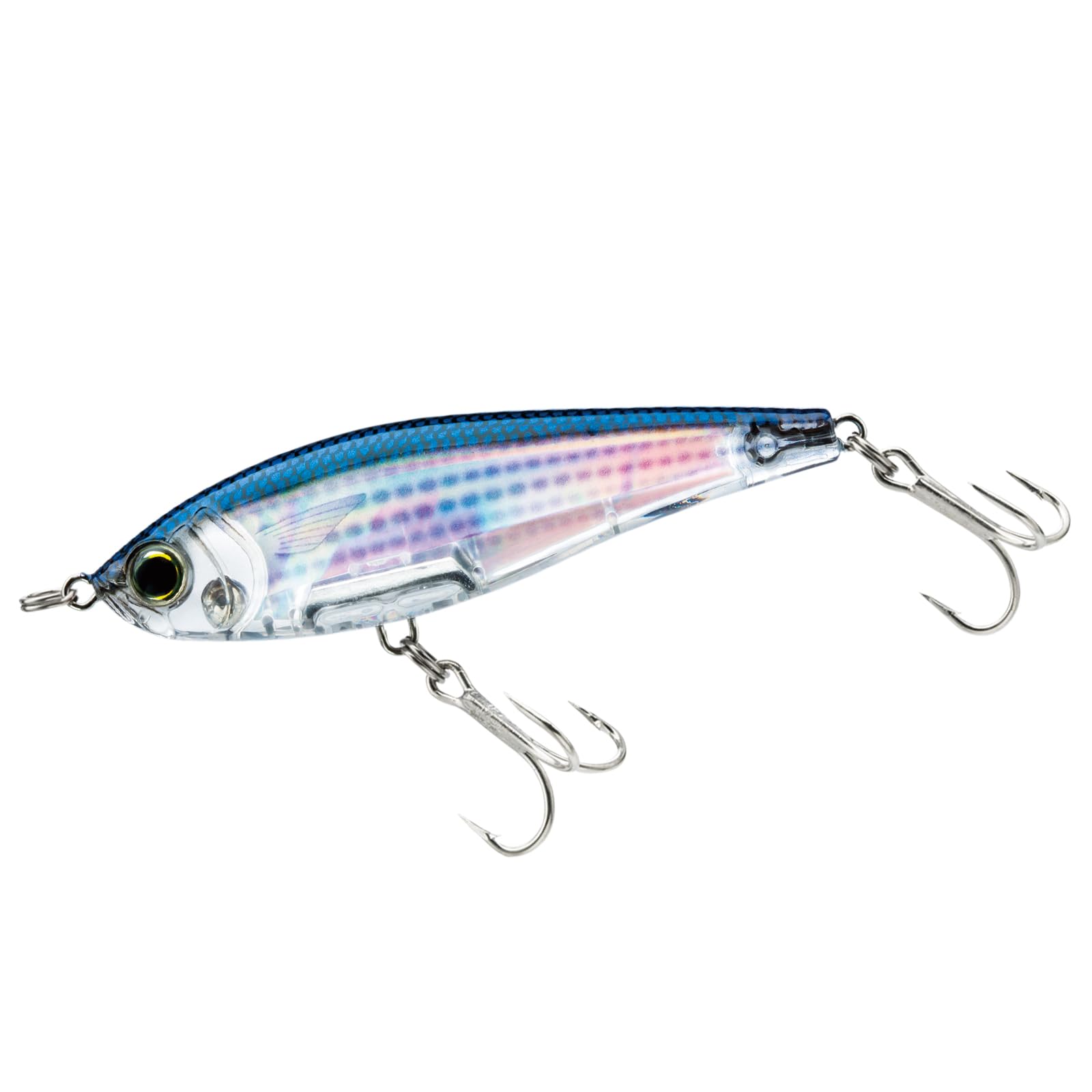
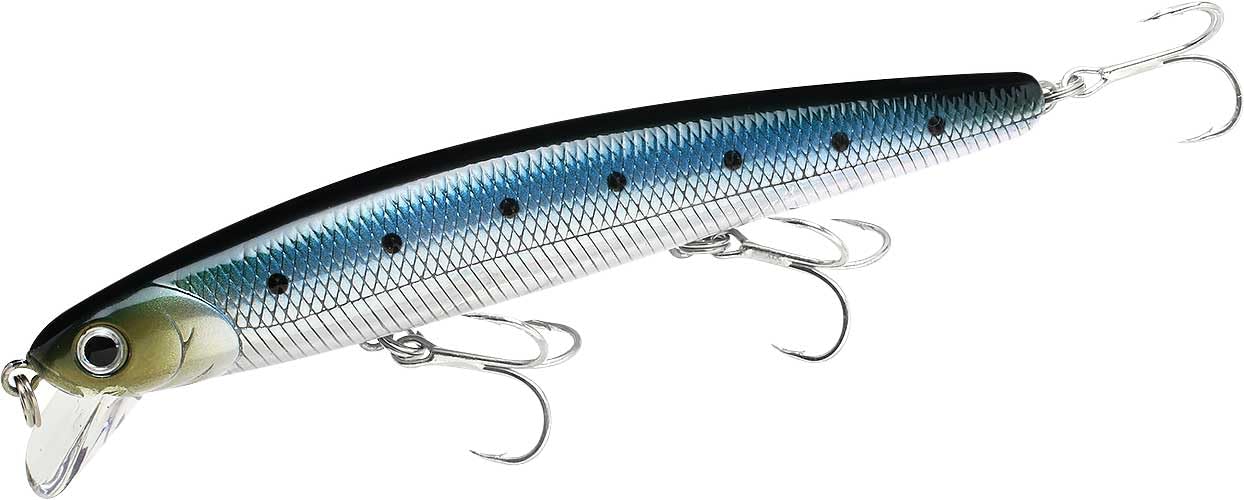
Lucky Craft FlashMinnow 110

93 /100
Angler Score Outstanding

Key details

Hooks
Three treble hooks
Action
Slow suspending, twitch-pause
Weight
0.64 oz
Running Depth
1–2 ft
Check Details on Amazon

This is the most expensive single lure here, and it is the one we baby. The FlashMinnow is a slow-suspending jerkbait built for the first two feet of water — the trough between the beach and the first bar, where stripers and halibut cruise when bait gets pushed in.

Twitch, twitch, pause. On the pause it hangs almost in place, and that is what separates it from a floating diver that bobs back up: a fish that follows and does not commit gets another look at a bait that has not gone anywhere. The metallic finishes throw a lot of flash in stained water, and the three trebles are sharp out of the box.

Hardware is the part that ages. Salt goes after split rings and hooks faster than it goes after the body, so rinse the plug in fresh water after every trip and plan on changing rings before the season ends. Do that and this is the most convincing baitfish imitation here — the one we tie on when the water is clear and the fish are looking hard at everything.

Pros

  • Hangs in the strike zone on the pause
  • Strong flash in stained water
  • Sharp trebles out of the box

Cons

  • Priciest single lure in this group
Our verdict

Worth the premium if you fish the trough: it hangs in the first two feet on the pause and keeps flashing when the water is dirty.

Check Latest Price
4

Best Shallow Diver

Yo-Zuri Crystal 3D Minnow

93 /100
Angler Score Outstanding

Key details

Type
Floating diver
Hooks
Saltwater-grade tin hooks
Sound
Internal rattle ball
Diving Depth
3 ft
Check Details on Amazon

The prism finish on the Crystal 3D sits inside the body rather than on top of it, so scuffs from teeth do not take the flash with them. That sounds like marketing until you have fished a plug whose paint went milky after a few bluefish — this one stays bright after the clear coat takes a beating.

It floats at rest and dives to about three feet on the retrieve, which makes it the best shallow-water search plug here: you can work it along a bar, pause, and let it rise instead of dragging bottom. The internal rattle is loud enough to matter in stained water, and the tin hooks and stainless rings are already saltwater grade.

Compact is the trade. This is a finesse plug, not the one to reach for when you need to punch a cast into a headwind, and we fish it on spinning gear while the heavier stuff waits in the bag. Over shallow structure, though, its slow rise keeps it in the strike zone longer than a sinking plug will.

Pros

  • Internal prism finish keeps its flash
  • Floats at rest, dives to three feet
  • Saltwater-grade tin hooks and split rings

Cons

  • Compact body gives up casting distance
Our verdict

A floating diver that rattles and flashes down to three feet, and our pick for working shallow bars in stained water.

Check Latest Price
5

Best Subsurface Twitchbait

Duel 3D Inshore Twitchbait

91 /100
Angler Score Outstanding

Key details

Type
Slow-sinking, lipless
Hooks
Power treble hooks
Length
3-1/2 in
Balance
Fixed weighted center
Check Details on Amazon

The sun is up, the surface bite is over, and there are still fish in front of you. That is the hour the Twitchbait earns its place: a flat-sided, lipless slow sinker you twitch and let fall, twitch and let fall, so it never quite leaves the upper column. It is the plug we swap to when the walkers go quiet.

The fixed weight in the center is why it darts on the first twitch instead of wallowing, and the internal prism gives it the flash of a baitfish rolling on its side. Three and a half inches is the right size for spearing, sand eels and peanut bunker — the forage surf fish are actually eating most of the year.

Sink rate is the thing to know. It drops quickly enough that we count it down and start retrieving early over shallow bars, and in cold water, when fish want a slower fall, it stays in the box. The rest of the time it is the most versatile subsurface plug here.

Pros

  • Darts on the first twitch
  • Keeps fishing after the topwater bite
  • 3-1/2-inch profile matches spearing and sand eels

Cons

  • Sinks too fast for cold-water finesse
Our verdict

The plug that keeps fishing after the surface bite dies — a slow sinker that twitches like a wounded baitfish and stays up in the column.

Check Latest Price
6

Best Budget Jig

Dr.Fish Bucktail Jig 3-Pack

91 /100
Angler Score Outstanding

Key details

Head
Lead head with 3D eyes
Hook
High-carbon steel
Pack
3 jigs
Size And Weight
1 oz
Check Details on Amazon

Three jigs in one pack is the cheapest way to add a bottom presentation to a surf bag, and a bucktail is the presentation that covers the most water in the wash. One ounce holds in a moderate sweep without turning your outfit into a broomstick, which is the balance most beach anglers want.

The head is lead, the hook is high-carbon steel, and the tail is real bucktail with crystal flash worked through it. That combination glides and pulses on the fall, and the fall is when most flounder and stripers eat it. Slow lifts off the bottom followed by a controlled drop is the whole retrieve.

Look after the hooks and this pack earns its keep. Salt and lead do not get along, so rinse and dry each jig after a session or the hook will rust long before the hair wears out. We keep a pack in the bag for flounder and for the days when the fish are glued to the bottom.

Pros

  • Three jigs at a budget price
  • Real bucktail and crystal flash
  • Sharp, strong high-carbon hooks

Cons

  • Three identical jigs, no size or color variety
Our verdict

Our budget pick: three one-ounce bucktails that fish the bottom of the wash for flounder, stripers and anything else holding in the suds.

Check Latest Price
7

Wind and Distance

Gotcha G300GH 3-Pack

90 /100
Angler Score Outstanding

Key details

Body
Metal
Pack
3 plugs
Finish
Gold
Check Details on Amazon

When the wind is up and there is a chop on the water, a slim metal plug outcasts a hollow topwater every time. That is the case for keeping a Gotcha in the bag: it is dense, it flies, and it knifes through a headwind instead of tumbling.

The gold finish in this pack is the one that has become standard for Spanish mackerel and bluefish along southern beaches. Fish it fast with a straight retrieve and it does the work; slow down and it drops into the wash, which is where weakfish and blues pick it up.

It sinks, and that is the trade for the distance. Over shallow bars and rock you have to start the retrieve the moment it lands or donate it to the bottom; over sand and deeper guts it is not a problem.

Where it earns a place is wind, distance and mackerel — it is the plug we tie on when the forecast ruins everything else. On a calm morning with fish up on top, it stays in the box. Three in a pack also means losing one to a jetty does not end the session.

Pros

  • Flies into a headwind
  • Gold finish for mackerel and blues
  • Three per pack, so losing one hurts less

Cons

  • Paint chips off the heads quickly
Our verdict

A slim metal plug for the days the wind ruins everything else — it flies, it sinks, and mackerel and blues eat it.

Check Latest Price
8

Slow Presentations for Flounder

Berkley Gulp! Alive! Swimming Mullet

0 /100
Angler Score Fair

Key details

Size
3in - Pint 4x7
Tail
High-action swimming tail
Scent
Gulp! scent dispersion
Check Details on Amazon

Open the jar and you will know about it. Gulp! Alive! sits in a pint of its own liquid, and the smell is the point rather than a side effect — this is a scented soft bait rather than a plug, and it earns a place in a surf bag because fish hold on longer.

Rig it on a jighead and fish it low and slow. The tail swims on almost no input, so a slow lift and drop over sand keeps it working while you cover ground. Three inches suits flounder, schoolie stripers and speckled trout, and the jar keeps the spares soaking between trips.

Drying out is what kills them. A Gulp! left on the hook overnight shrinks and stiffens for good, so the lid goes back on between casts and nothing stays rigged at the end of the day.

We use it as a change-up rather than a first choice. When fish follow a plug and refuse it, a scented bait on a jighead often gets the bite, and that is worth the mess and the restocking.

Pros

  • Scent keeps fish holding on
  • Tail swims on a slow lift and drop
  • Catches flounder, schoolies and specks

Cons

  • Tails tear and get bitten off fast
Our verdict

A scented soft bait that gets the bite when fish follow a plug and refuse it, as long as you can live with torn tails.

Check Latest Price

How We Tested Surf Lures From Dawn Tide to Last Light

We started with a list of about 60 lures and cut it down using the things that actually matter on a sand beach: whether the weight suited a rod rated for three-quarters to two ounces, whether the hooks and split rings were saltwater-grade straight out of the package, and whether the profile resembled what fish eat in the wash — sand eels, mullet, peanut bunker. Anything that only came in freshwater weights, or needed its hardware swapped before the first cast, didn't make the cut. That left 18 lures, which we fished for five months.

Most of the testing happened on foot at dawn lows and in the last two hours before dark, with a handful of nights around inlet mouths and one memorably windy week when casting into a headwind was the entire job. Using the same rod, reel, and 20-pound braid, we paced out casts into a steady crosswind and recorded the average, then counted how many retrieves we got before the line fouled or the lure rolled out and quit tracking. Each one got swum slowly alongside the beach so we could watch the action rather than guess at it, and dunked in the wash to see whether it floated high, sat suspended, or sank, and how it held position in current.

Durability and value got the less glamorous treatment. Hardware sat in a bucket of saltwater between trips, a few lures rode loose in the truck bed, and we checked finishes and hook points after every bluefish that came over the lip. We also kept track of what each lure cost per fish landed and per hour in the water, which is where the pack deals and the bargain-bin plugs separated.

How to Choose Surf Fishing Lures

Castability Comes First

Everything else in the surf is downstream of reaching the water you want to fish. A plug has to punch through wind and keep its line, which is why tail-weighted pencils and dense metal plugs outfish light floating divers when the sea is up. Match the lure's weight to your rod's rating rather than to the fish: an ounce and up needs a rod that actually loads, while a 7/8-ounce walker fishes better on a longer, softer tip. The Cordell Pencil Popper's weighted tail is the clearest example here of a design built around distance.

Pick the Running Depth Before the Color

Work out where the fish are holding, then choose the lure that fishes that band. Surface walkers and poppers cover the top; slow-suspending jerkbaits hold the first two feet where fish sit in the trough; floating divers searching to three feet work along shallow bars; bucktails and metals get down to the bottom of the wash. Depth is the one thing a different color cannot fix, and following fish down as the light comes up is exactly the shift the Duel Twitchbait is built for.

Size and Weight for the Fish You Expect

Match the profile to the bait that is actually around. Seven-inch, two-ounce plugs are big-fish tools for stripers and chopper blues; three-and-a-half-inch jerkbaits and twitchbaits match spearing and sand eels and catch more schoolies; a one-ounce bucktail covers flounder and anything hugging the bottom. Going too big is the more common mistake in calm, clear water, and going too small loses the fish that are keyed on bunker.

Saltwater Hardware Fails Before the Body Does

Salt eats hooks, split rings and paint long before it eats a lure's body. Tin and plated hooks last longer than plain steel, stainless rings outlast rings that were never meant for salt, and a freshwater rinse after every trip buys more seasons than any coating. If a plug comes with basic hardware, budget for a pack of rings and a pack of trebles and swap them before they cost you a fish.

Treat Soft Baits and Finishes as Consumables

Soft plastics tear, tails get bitten off, and paint chips off metal heads. None of that is a defect so much as the cost of doing business. Scented soft baits like the Gulp! Swimming Mullet catch well and restock often, so buy two jars rather than one. On hard baits, a scuffed plug still swims; if appearance matters to you, keep the painted ones out of the tray where they rattle against everything else.

Frequently Asked Questions

Final Verdict

Weight at the tail, seven inches of body and a walk that survives a chop: the Cotton Cordell Pencil Popper is the plug we tie on first when there is water to cover and fish somewhere past the bar.

If your surf is shallow and the fish are sitting in the trough, take the Lucky Craft FlashMinnow instead. It hangs where a pencil popper cannot reach, and it is the more convincing baitfish when the water is clear and the fish are fussy.